Bronzepocalypse (Part 2)
A continuation of the Bronze Age collapse story and its place in history and prophecy.
 Read Time: 9 minutes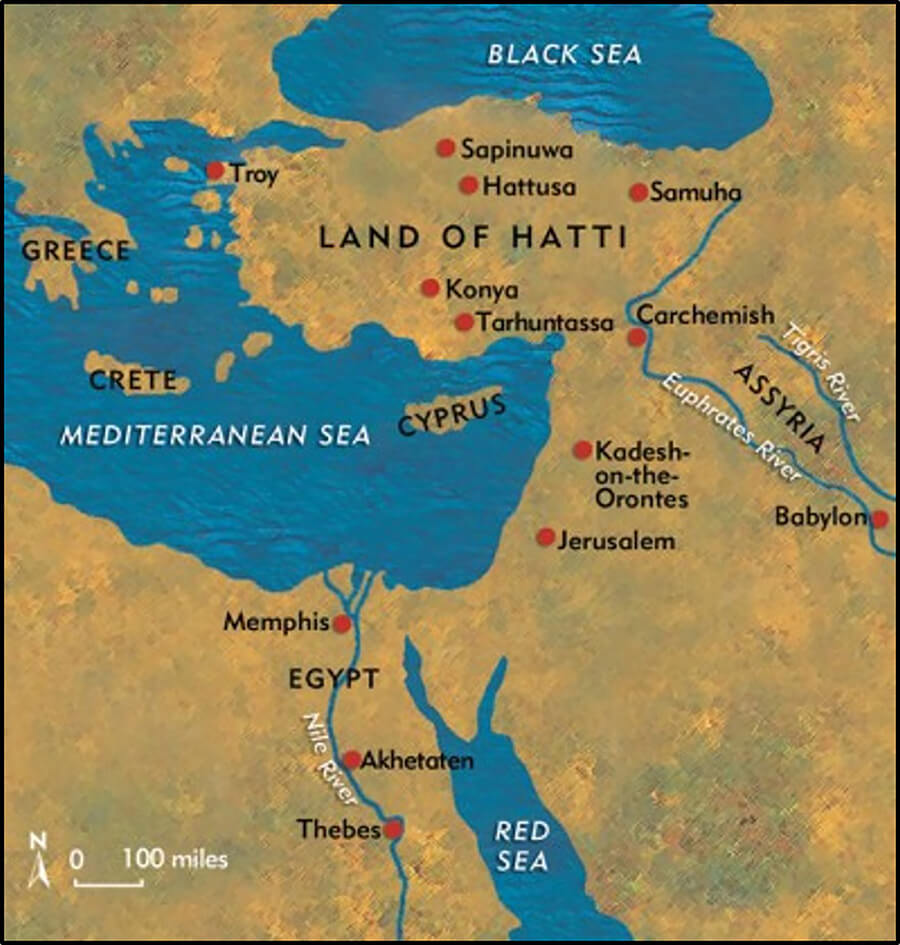
When we last stood in this story, we saw that the world once made of bronze didn’t slowly fade; it was driven into ruin by its own pride and crushed under the weight of its own hubris. Its fragile, interdependent systems stretched thin across distance and desire until it finally gave way. The tangled web that once carried wealth and power became the net that dragged it to ruin.¹
When looking back, we drifted in the stillness beneath the ancient sea, through the silt and silence, and passed the shattered hulls of ancient ships, finding their lost treasure. We discovered the remnants of a world that was so certain of itself, it never imagined it could sink. Right on cue, history, as ever, held up a mirror to our own age and time.
The plagues and distress that hammered the Late Bronze Age hadn’t been passing hardships; they were relentless episodes of drought, famine, and disease. They were but the beginning of sorrows and the measured unraveling of everything that had once held the world together.2
They were and are the evidence of God working His purpose into the world, preparing a place for His people.3 The “world that was” reached its high-water mark, and decade after decade in this time period, it slipped into its miserable death throes. Civility, cooperation, and diplomacy failed at every level, and then a great confederacy appeared on the horizon of the sea.4
The breaking of the world was in motion long before anyone realized it was already over. From the edges of the world, from coasts and fractured sea routes, the confederacy came, not as one people but as many, driven forward into a world already burning. They didn’t conquer strength; they hunted weakness, striking what could stand no longer until nothing was left but oblivion.5 Among that host sailed a brutal company known as the Peleset, hard and unyielding as iron. In the years to come, they would be remembered by another name: the Philistines.6
Far to the northeast, the Assyrians had managed to survive the collapse. They owed much of their survival to their inland geography, removed from the coastal systems that had been hit hardest.7 While the world burned, Assyria didn’t exactly rise; it just simply endured. It pulled inward, held together, and waited. When the time came, hundreds of years later, it emerged as something far more dangerous, savage, and hungry.8
By 883 BC, over 300 years after the collapse, Ashurnasirpal II began hunting. In time, under Tiglath-Pileser III, Assyria transformed from a regional power that had survived the collapse into a ruthless force of brutality.9 When Assyria rose to power, it prowled like a lion that developed a taste for human blood. With overwhelming and unbelievable violence, it expanded outward, leaving nothing untouched.10 Assyria wasn’t the only power left standing in the shadow of collapse, however. Egypt, or as Herodotus called it, the “gift of the Nile,” endured, though not untouched. It was sustained by waters that did not fail when the world around it did.11
It was here in Egypt that the collapsing world met God’s purpose. It was here that Israel had lived for centuries, set apart from a world that was steadily falling apart.12 Had they remained in Canaan, they would have been consumed with the rest of civilization, and their story would’ve ended before it began (Exodus 12:40).
Through Joseph, a way was prepared not only to preserve life during a famine in his era, but also to shelter all of Israel until their time had come.13 When that time came, it began with a clear command, “Let my people go.” (Exodus 5:1). What followed was a sequence of events that systematically dismantled Egypt. The plagues of the Exodus disrupted its water supply, devastated its agriculture, damaged its livestock, and undermined its social and religious structures. The land that was called the “gift of the Nile” saw that gift turned into something else entirely, a curse of blood.
Each plague peeled something away, not only from the land, but from the illusion of control Egypt had long held. The Ten Plagues were judgments of God, measured and intentional, cutting into the very structure of Egypt’s psyche and even into reality itself.14 By the end, Egypt didn’t disappear, but it had been forever changed. It was weakened in ways that couldn’t be undone. It was left exposed as the wider collapse drew nearer, and with that collapse, the Sea Peoples also came.
Through the plagues, Egypt had been undone piece by piece, until nothing remained untouched. The land had failed, the gods had failed. Ma’at, the cosmic order they believed held the world together, had failed, and in the end, even the future simply died. The plagues broke Egypt, but the Red Sea crossing finished the work. Pharaoh’s army, chariots, horsemen, the very symbol of Egyptian power, was swallowed in a single moment, when “not one of them remained.” (Exodus 14:28 ESV).
By the time Moses received the Ten Commandments, the children of Israel weren’t walking away from a world power at its height; they were walking away from something that had been turned inside out. What once held Egypt together had been totally undone, and what remained was a fragile shadow of itself. To be sure, Egypt would endure, but not as it had been, its strength reduced and its influence increasingly challenged in the generations that followed. Egypt’s very hold over Canaan, once firm, would weaken and eventually give way as the wider collapse unfolded. As Israel moved through the wilderness for 40 years, the world they would one day enter was already smoldering.15
It was around 1177 BC, in the eighth year of Ramesses III, that the Sea Peoples set their sights on a weakened Egypt. Ramesses met them with what power Egypt still had. In the north. In Djahy, he struck them on land, and in the eastern Nile Delta, near the region long associated with Goshen (now empty of Hebrews), Ramesses turned the river into a snare. The ships pressed in, the banks filled with archers, and the Nile itself closed around them. There, at the edge of the sea, the storm of the Sea Peoples broke. Egypt held. They were the only ancient empire to do so.
The invaders’ names and faces were carved into the walls at Medinet Habu, an Egyptian temple, and among them were the Peleset. The Peleset didn’t come like raiders who meant to leave. They came like a tide, with warriors, families, and the weight of everything they had already killed behind them. In the great temple carving, Ramesses III rises above it all, larger than life, unmoved, as if he alone held the line between order and the breaking world.

The Peleset were defeated, yes, but they didn’t simply disappear. They moved north and east, and settled along the southern coast of Canaan, where they became the Philistines, builders or rebuilders of places like Gaza, Ashkelon, Ashdod, Ekron, and Gath. Their pottery carried the memory of another world, and with them came the quiet beginning of something new. The Bronze Age was ending, and an iron one was coming. They would build some of the Iron Age’s earliest forges in the region and plague later generations of Jacob’s children.
Joshua led the Children of Israel into a land full of bandits, broken kingdoms, and chaos. It’s easy to see this post-apocalyptic wasteland of what was once Canaan, in the Books of Joshua, Judges, Ruth, and Samuel. In the time of the Judges, there was no king, only fragments of authority and the long shadow of a world that had already died. What order that somehow did exist was temporary. Any peace that was found didn’t last, and even the land itself could fail, as famine drove families from their homes as in the days of Ruth. It was a world where nothing seemed secure, and everything was extremely dangerous (just ask Gideon).
Even so, beneath it all, something endured. A quiet, nearly unseen family line pressed forward amid the uncertainty. Promises were made and kept, from Rahab to Jesse and finally to David. From the ruins of a world struggling to rebuild, a throne was raised, and another Promise made (2 Samuel 7:12-16). In the smoldering ruins of the Bronze Age Collapse, when the world was dangerous and broken, what looked like chaos became the beginning of a kingdom.
This period of time is when the pattern becomes impossible to ignore. The throne that was established in Israel did not develop from peace; it came through collapse. Solomon once famously said, “What has been is what will be, and what has been done is what will be done, and there is nothing new under the sun.” (Ecclesiastes 1:9 ESV). Our world is no different. It’s bound together by fragile systems that give the illusion of permanence. In the pride of our own age, its riches, and its turning away from its Creator, the lessons from the Bronze Age Collapse become unmistakable. Collapse isn’t the end of the story; it’s where the story changes direction.
So as we see and hear the words of the prophets fall into place, may the lessons of the Bronze Age Collapse strengthen our walk as together we await the Kingdom of our Lord and Savior, the greater David, the stone not cut by human hands that will strike the kingdoms of this world and stand when all others have fallen.
But that is a story for another day…
James Asbury,
Portage Ecclesia, IN
- Bro. James created another table that might be helpful in understanding this history. From collapse to kingdom: A pattern in history and prophecy Visit: mytidings.org/vai
- Exodus 14:21-31 (NLT) describes the crossing of the Red Sea and the destruction of Pharaoh’s army. “Then the waters returned and covered all the chariots and charioteers… not a single one survived.” Eric H. Cline, 1177 B.C.: The Year Civilization Collapsed (Princeton: Princeton University Press, 2014), 1-20, 147-175. Cline argues that the Late Bronze Age collapse was a “systems collapse” driven by the simultaneous failure of interconnected trade networks across the Eastern Mediterranean.
- Harvey Weiss et al., “The Genesis and Collapse of Third Millennium North Mesopotamian Civilization,” Science 261, no. 5124 (1993): 995-1004; David Kaniewski et al., “Environmental Roots of the Late Bronze Age Crisis,” Proceedings of the National Academy of Sciences 110, no. 10 (2013): 3862-3867. Demonstrates correlation between climate shifts, crop failure, and regional collapse.
- Genesis 50:20 (New Living Translation). Theological framing of divine providence: “You intended to harm me, but God intended it all for good.”
- Medinet Habu inscriptions, mortuary temple of Ramesses III (c. 1180-1150 BC), Western Thebes. These reliefs provide primary Egyptian accounts of invasions by the Sea Peoples; James Henry Breasted, Ancient Records of Egypt, Vol. IV (Chicago: University of Chicago Press, 1906), §§ 64-83. Translation and analysis of Egyptian inscriptions describing the Sea Peoples as a confederation of multiple displaced groups.
- Cline, 1177 B.C., 135-160. Describes opportunistic migrations and raids targeting weakened states during systemic collapse.
- Medinet Habu inscriptions explicitly name the “Peleset” among invading groups; Trude Dothan and Moshe Dothan, People of the Sea: The Search for the Philistines (New York: Macmillan, 1992). Archaeological evidence (pottery styles, settlement layers) identifies the Peleset with the later Philistines.
- Amélie Kuhrt, The Ancient Near East c. 3000-330 BC, Vol. II (London: Routledge, 1995), 473-480. Notes Assyria’s inland geography insulated it from coastal disruptions affecting trade-dependent states.
- Mario Liverani, The Ancient Near East: History, Society and Economy (London: Routledge, 2014), 399-420; Kuhrt, Ancient Near East, 492-510. These works describe Assyria’s contraction during the collapse (c. 1200-900 BC), followed by gradual recovery and eventual expansion during the Neo-Assyrian period.
- Royal annals of Ashurnasirpal II (r. 883-859 BC) and Tiglath-Pileser III (r. 745-727 BC), translated in A. K. Grayson, Assyrian Rulers of the Early First Millennium BC (Toronto: University of Toronto Press, 1996). These inscriptions detail military campaigns, territorial expansion, and administrative reforms.
- Assyrian royal inscriptions frequently describe extreme violence as political messaging; see Daniel D. Luckenbill, Ancient Records of Assyria and Babylonia (Chicago: University of Chicago Press, 1926); Karen Radner, Ancient Assyria: A Very Short Introduction (Oxford: Oxford University Press, 2015), 40-65. Discusses the ideological use of terror and spectacle in Assyrian imperial expansion.
- Herodotus, Histories, Book II. Herodotus famously described Egypt as “the gift of the Nile,” emphasizing its dependence on predictable flooding.
- Cline, 1177 B.C., 1-20, 147-175.
- Genesis 41-47. Narrative of Joseph’s administration during the famine, preserving Egypt and the surrounding regions.
- John D. Currid, Ancient Egypt and the Old Testament (Grand Rapids: Baker Academic, 1997), 83-110. Explains how the plagues function as theological judgments against Egyptian deities and natural systems, reinforcing the interpretation of intentional divine judgment.
- Eric H. Cline, 1177 B.C., 1-20, 147-175; Harvey Weiss et al., “The Genesis and Collapse of Third Millennium North Mesopotamian Civilization,” Science 261, no. 5124 (1993): 995-1004; David Kaniewski et al., “Environmental Roots of the Late Bronze Age Crisis,” Proceedings of the National Academy of Sciences 110, no. 10 (2013): 3862-3867.