Held in His Hands
This opening excerpt from Held in His Hands begins a story of danger, faith, and the light of the gospel in difficult circumstances.
 Read Time: 7 minutes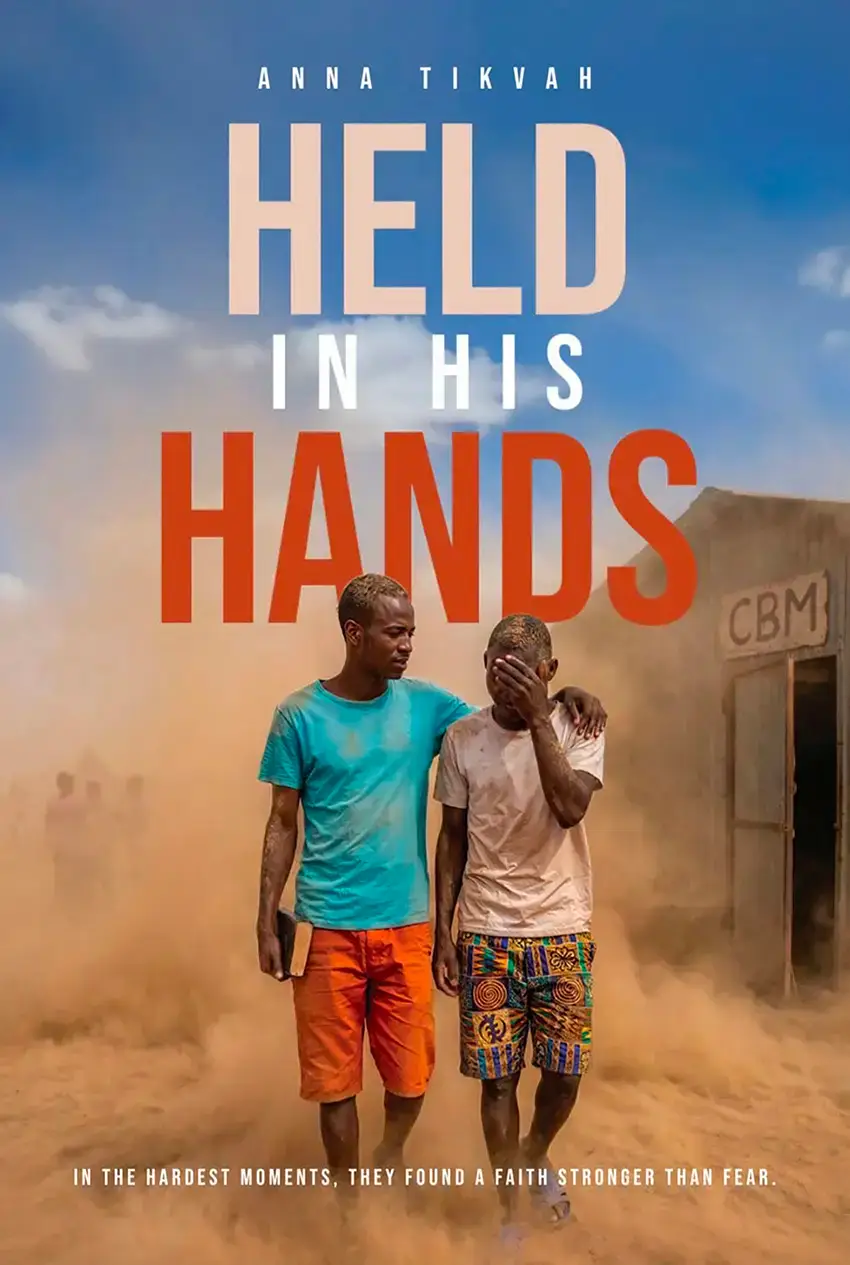
EDITOR’S NOTE: Held in His Hands is a new book by Anna Tikvah, based on the lives of two Christadelphians in Africa. The novel walks through both of their stories, allowing you to experience their fear in some of their dangerous circumstances, and also their peace and joy in finding Truth and embracing the gospel. We’re privileged at The Tidings to be able to offer you the first few chapters of the book, which we will print over the next few months, Lord willing. May these stories inspire us to continue to share our hope, recognizing that it brings light to those who feel trapped by darkness.
Jason Hensley
Chapter 1
David’s Story, The Day the Shots Rang Out
David’s eyes glanced over the question for the third time. One quarter times four-fifths. The fours would cancel each other out and then he would be left with one-fifth.
There were twenty more questions just like this on his page. It wasn’t hard math, but the young man’s mind was drifting off to other things. Would his mother be able to sell her peppers today? She was so happy they were growing well. Hopefully she would be able to buy maize. They were getting low.
A fly buzzed around his ear. In the quiet classroom, where everyone was busy with their respective duties, the noise was annoying. Raising one slim, dark hand, he brushed it away.
Looking out the window, he imagined his Mama out in the gardens as she was every morning. Little Furaha would be tied on her back. Her name meant “joy.” Often wearing a bright, colourful skirt, Bilemo, his mother, would be bent over, hoeing the beans and corn. She worked so hard to feed them all—all seven children. He imagined that his little sister Miriam would be picking the beans; she was still too young to go to school.
David was the oldest. He had just turned fourteen years old. Every day before school he got up early to try to help his family, selling the little polyethylene paper bags his mother bought in packages for 500 francs. Earnestly, he tried to double the price in order to make a profit and bring enough home to buy food, but he wasn’t the only seller. Many other youths were doing the same. Yesterday, he hadn’t sold any. He had complained, “Mama, why is it that my friends are selling all their bags when I can’t even get through one package? I go to church and they don’t. I tithe, and they don’t. Does God favour those who don’t know Him more than those who do?”
Patiently, his mother had explained, “God has a plan for everyone, mwanangu—my son. He gives graciously in His own good time.”
Slim and fairly tall, David would do anything to help his mama; she was his best friend. He loved her dearly. Gazing idly outside, past the rows of gravestones running parallel to the school, he could see the lake in the distance. Frowning slightly, he wondered if his father had caught any fish this morning. Maybe he would catch enough both to sell and to bring some home for dinner.
Last night his father had said, “I’m going to walk so majestically across the stage when you graduate. I will be so proud!” Both his parents wished they had had the opportunity to get an education.
His mother had added, “You must study hard, mwanangu. I hope you will change the future for our family. Being educated will give you a good job.”
But he still had four years of secondary school to finish before…
“David, do you know the answer?”
At the front of the classroom, Miss Abwe had asked him a question and David realized he had not heard. How would he get an education and improve his family’s life if he kept drifting off like this? With a start, he came back to reality.
“I’m sorry,” he apologized sincerely. “What was the question?”
“Nine-tenths minus one-half?” she repeated. Then with a glare she rebuked, “Pay attention when I’m talking.”
Suddenly, a gunshot rang out. Everyone reacted nervously. It wasn’t uncommon in the Democratic Republic of the Congo to hear shots, and even now David was aware that rebel armies were causing problems across the country, trying to force the government to submit to their demands. Greed and revenge were often at the heart of the conflicts. Many precious metals are mined in the DRC, and neighboring countries desire their share of the profit.
Three more shots, and then a scream of terror. Looking around at the other students, David knew they all felt the same fear. His friend Mani, who sat beside him at school and lived in the house next door to his, shared his look of dismay. He was one year older and not quite so dark as David.
Quickly, Mani wrote on his page, “Not good!!!” All too often rebel armies kidnapped young men into the army.
“I’m going home,” Ntinu called out. “I’m not staying here!”
“Stay in your seats,” Miss Abwe said sharply. “No one is to go outside. There may be stray bullets.”
Ntinu tried to leave and Miss Abwe stood in his way. “This is for your safety!” she insisted. “Stay with the class. Don’t go out on your own.”
Complaining bitterly, Ntinu sat back down.
If David had had trouble concentrating on his math problems when it was quiet, it was far worse now. Miss Abwe strode up to the chalkboard and began writing the questions down quickly, as though she was determined to keep an atmosphere of calm and normalcy for all her students. But David could see that she was anxious as well. His eyes scanned the date on the board: “January 28th, 2012.”
Uzima Institute Secondary School, in Baraka, was five kilometres away from the homes where David and Mani lived on the shores of beautiful Lake Tanganyika. Outside the school walls he could hear people calling for their loved ones. If his mother was calling for him, he would never hear her. What was going on out there? Was she safe? Were his brothers and sisters safe? Were they still at school? Swallowing hard, he wondered if his father was trying to defend the younger children… or his mother? Was Furaha crying? Often, he was the only one who could calm the lastborn’s fears and make her stop crying. She loved him. He adored her. Was she okay?
More shots rang out. More screams and yelling. Tense and anxious, David trembled. Mindlessly, he wrote down the answers that his teacher was writing out on the board. It helped to have something to do. With all his heart, David wanted to bolt for home and protect his family. He was afraid. He wanted to make sure they all were safe. In his mind, he could hear his mother say, “Amini katika Mungu, mwanangu,” which means, “Trust in God, my son.”
She had brought him up to believe strongly in a loving God who protects His creation.
As Free Methodists, David’s family had gone to church every Sunday. His parents respected other people and tried to be loving and kind. However, at that moment, it was really hard to trust in God.
From the corner of his eye, he saw movement outside. With a jolt, he turned quickly to the window and saw soldiers approaching the unfenced schoolyard. Rebel soldiers! There was no protection around the school. There were no locks on the doors. Trembling, he closed his math book and breathed deeply. What was going to happen? Was this to be the end of his short life? Would he ever see his family again?
Low murmuring broke out across the classroom. Terror was in David’s eyes, and some were beginning to panic. Miss Abwe ran to the door. In a moment, they heard the soldiers enter the school, shouting and stamping their feet, and cocking their guns at anyone who dared to question what they were doing. Herding everyone out of the classrooms they ordered every girl to go home. Watching the girls leave, David wished with all his heart that he could go with them. Fearfully, he wondered if they would be safe on their long walks home. He knew them all. Some were his good friends.
A rough soldier pushed the principal aside. The rebels spoke harshly, waving their guns in the air and telling the terrified students that they were fighting against the government. Sternly, they demanded that everyone now had to fight for them. Bracing himself, David was even more concerned this might be his last day on earth.
When rebels wanted to punish the government, they often killed innocent people just to create fear.
“Carry these magazines, boy!” a scowling soldier demanded, hitting him hard with the butt of his rifle. Wincing with pain, he obeyed meekly. What choice did he have? Most likely the rounds of ammunition had been stolen from the stores and would be fitted to rifles to allow for multiple shots without reloading. Often young men were forced to carry whatever the rebels stole, to their various locations… but then, sometimes the rebels would let the young men go back to their homes.
A brief flicker of hope flamed up inside the young man’s heart. Maybe if he did his job well with no complaints, they would let him go free. Heaving the biggest load of ammunition he could carry onto his thin shoulders, he did what he was told. Mani did the same.
It was a long hike to the hills, carrying the heavy magazines in the heat of the day. No one offered the young men a drink of water. Hours went by. Ntinu complained that his arms were tired and he needed a break. A soldier smashed his rifle across the young man’s face. His nose started to bleed. Now he had to march, holding his heavy load with blood dripping down his chin. Everyone took note and kept silent.
Six hours later, they reached the soldiers’ hideout. A burly man came out of the bushes with uniforms in his arms. “Put these on and sit down!” he yelled.
David’s heart sank. Carefully dropping the heavy load onto the ground, the little flicker of hope that he might go back to his family, was snuffed out. Reluctantly, taking a uniform, he noticed that it was the same camouflaged outfit that the government soldiers wore. Weary and heartbroken, he sank to the ground. Would he be forced into a battle he didn’t want to fight? Would he have to pretend to be a government soldier when he wasn’t? Would they make him kill and maim others? How could this happen? Where was God? Did the Father above not see what was happening?
Tears welled up in his eyes. He knew his mother would be worried that he hadn’t returned after school; his father would be pacing anxiously. No doubt they would all hear what had happened at school that day from the girls who had been sent home. None of his brothers and sisters would find it easy to sleep… that is, if they were still safe… and there was no way to know or to relay a message. With all his heart he yearned to be back with his family, and to cuddle Furaha. How would he now change the future of his family for good? There would be no education in the army. Were all their dreams going to be completely dashed?
“And don’t think for a moment that you’re going to escape!” the burly man shouted. “If you try, you’ll be shot dead. There will be no discussion! No apologies. Just a bullet to the head!”
It was dark. The rebels passed around some maize, but David couldn’t eat. All he could think about was his family. When the rebels told them to go sleep in the makeshift huts made of grass, he obeyed meekly, curling up on the dirt floor beside Mani.
“We need a miracle,” he whispered desperately to his friend.
“That’s our only hope,” Mani agreed, wiping tears from his face. He began to pray earnestly, “Oh, Papa Kimbangu, our spiritual leader, please rescue us from these soldiers who want us to kill and maim. Please set us free in the morning…”
Mani was a Kimbanguist, and they were against violence of any kind.
Bewildered and confused by all that had just happened, David rested his weary head on his arm and started the only prayer that he knew, “Our Father who art in Heaven…” but he was fast asleep before he reached the end.
Anna Tikvah