It’s All Greek To Us
A look at how the Greek of the New Testament reflects the language and patterns of the Old Testament.
 Read Time: 5 minutes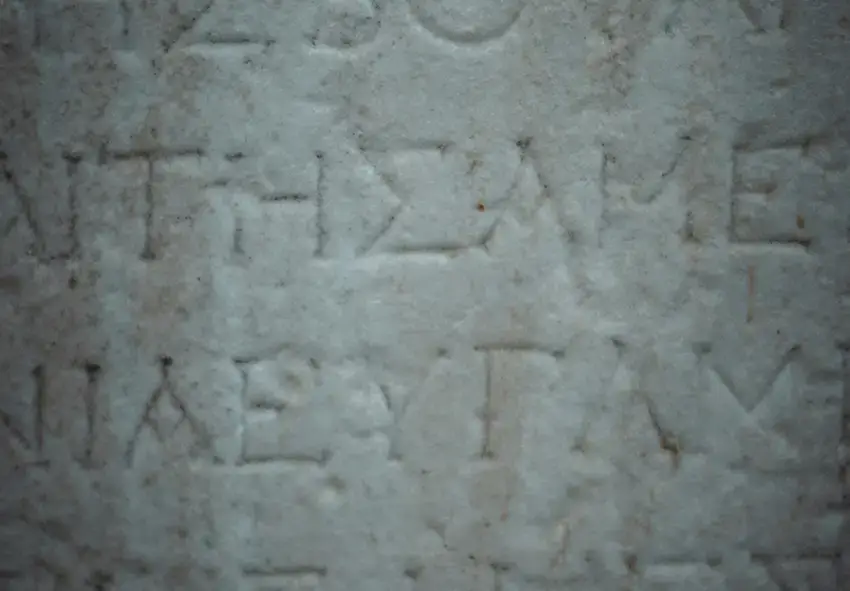
One of the most startling things about the Greek of the New Testament is how unGreek it actually is.
In the late 19th century and into the early 20th century, a collection of documents was discovered by archaeologists and scholars. These were mainly on papyrus, found in Egypt, and dated to the Hellenistic period—a time when the effect of Greek culture, which had spread through the conquests of Alexander the Great, was felt across a swathe of land from Greece to Egypt. The discovery of these documents led to an influx of scholarship that sought to investigate them and understand their context, particularly the language they used. One such scholar was Adolf Deissmann, who was struck by similarities he saw between the Greek of the documents and inscriptions, known as Koine or common Greek, and the language of the New Testament.
It had been a question for many years as to why the Greek of the New Testament did not sound or feel like the Greek that classical scholars were used to when they translated plays by Aristophanes or Sophocles, or speeches by Demosthenes, or the philosophy of Plato, all of which were written in what is called Attic Greek. The Greek of the New Testament was different. It was less flowery and less technical. It was Greek that had shifted from what classical scholars expected. It did not sound right to their ears.
It was this shift that Adolf Deissmann, bolstered by a bevy of new archeological finds, identified, particularly in a work entitled Licht vom Osten (Light from the East), published in 1908. This work established a consensus in New Testament scholarship that has lasted almost unquestioned for 120 years: the Greek of the New Testament was “street Greek,” spoken by the common people.
This argument, though, misses a significant factor that helps us identify exactly why it sounds different from Classical Greek: the Greek of the New Testament is not primarily the “Greek of the street,” but has been carefully crafted and designed by God. As we progress, we will see the clear hand of an intelligent designer behind the use of Greek in the New Testament.
God tells us in 1 Corinthians: “Which things also we speak, not in the words which man’s wisdom teacheth, but which the Holy Ghost teacheth; comparing spiritual things with spiritual.” (1 Corinthians 2:13). And what we find when we search the New Testament, and read it in the original Greek, is that He has written it in such a way to aid us in our endeavor to compare spiritual things with the spiritual, that we might glimpse in His Word the shining of His face. That, in fact, is what God has done: He has altered the ordinary Greek of the street, making it unrecognizable in places, so that it resembles the grammatical structure of the Hebrew Old Testament.
Let us begin with one very clear example of this. At the beginning of His creation, God flooded the earth with the light of His glory. He tells us this in this way:
Note how each verse, and each clause within a verse, begins with the word “and.” This choice is reflected in the Hebrew text and is a feature of Semitic languages, particularly Hebrew. Examples occur throughout Scripture; one particularly striking example is in Exodus 14:21-27, which contains a long string of clauses all connected by the word “and.” While this is a feature of Hebrew grammar, the same cannot be said of Greek. Neither the literary forms of Attic Greek nor the commonplace, vulgar tongue of Koine Greek employs this grammatical structure; it is characteristically Semitic. And yet, when we look into the pages of the New Testament, what do we find?
The word in bold is the Greek word kai, a Greek conjunction translated as “and.” God has here forced the Greek of the New Testament to mirror the grammatical structures commonly found in the Hebrew Old Testament. But why? Perhaps to draw our attention to the principle that here, at the commencement of the ministry of the Lord, we are witnesses to the start of the work of the new creation.
The New Testament is replete with examples of the same phenomenon, where God has broken the grammar of the Greek language so that it resembles the Hebrew of the Old Testament. Consider the language of Ezekiel 14:22: “Yet, behold, therein shall be left a remnant that shall be brought forth, both sons and daughters: behold, they shall come forth unto you.” Note the way that the subject (yellow) of the verse, “the remnant that shall be brought forth,” is isolated from its verb (blue) by a phrase (green) that defines the remnant further, “both sons and daughters.”
This is a Hebrew construction called a “hanging case,” and is common in the pages of the Old Testament. Another example comes in Genesis 50:5, in which Joseph reports the instructions of Jacob concerning his body. The subject is introduced, “The grave which I have digged for myself in the land of Canaan,” but is separated from its verb phrase, “you shall bury me,” by an explaining phrase, “it is there.”
This form of language is extremely rare in Koine Greek but found throughout the New Testament. A key example for us can be found in Romans 11:5, “Even so then at this present time also there is a remnant according to the election of grace.” Here is the Greek (compare the colors to Ezekiel 14): οὕτως οὖν καὶ ἐν τῷ νῦν καιρῷ λεῖμμα κατ᾽ ἐκλογὴν χάριτος γέγονεν
In the Greek, the remnant is defined as being “according to the election of grace,” before the verb where they come into existence! And the subject (yellow) and verb (blue) are separated by a phrase (green) that further defines that subject. This is the same pattern as we saw in Ezekiel 14. God has designed the Greek of the New Testament to harken back to the passage in Ezekiel, showing how God is working, by His grace, not by our works, to bring forth a remnant.
God is guiding us, by the way the Greek language has been changed in the New Testament, to compare what we are reading in the New Testament with what He has revealed in the Old. As we read these things, especially in the original languages, we are brought to wonder at the intricate way in which God has woven His Word that we may behold glories in it. What an honor we have to dig for these treasures.
Matt Baines,
Coventry West Ecclesia, UK