The Still Small Voice
A reflection on anger, self-control, and learning to answer with the still small voice of God.
 Read Time: 8 minutes
Have you ever stood in the aftermath of your own volcanic eruption, watched the ashes of your destruction fall to the ground, and wondered, “Was that necessary? Did it really help me achieve what I hoped to accomplish?” Like many others, I felt I had a good handle on the topic of “anger,” and not much could “ruffle my feathers.” Then I had kids.
There is little that can limit the spirit of longsuffering quite as effectively as early parenthood. Or perhaps it is parenthood in general, and I have yet to experience the later stages? And if we are honest, all human relationships test the bounds of longsuffering from time to time—spouses, long-term friends, families, and even ecclesias. Conflicts ensue in all human relations, and feelings of anger are inevitable (I speak for myself).
But back to the initial question: is it okay to erupt like a volcano, spewing words and commands, when you feel your buttons have been pushed long enough? Is it ok to just raise your voice? To start shouting? What does Scripture say on this topic?
In the moment, when despite several valiant attempts, the children still have not cleaned up, or your partner has again forgotten the trash, or the Sunday School children are still running around the hall like the proverbial “chickens with their heads cut off,” it is easy to think of Jesus cleansing the temple and feel justified to attempt a similar feat. But is that what we are supposed to learn from that story? Does our anger at “personal wrongdoings” justify white-hot vengeance?
In this article, I want to look at three Bible characters and their response in the “heat of the moment.”
Moses
Have you ever dealt with complaining children? For how long? And how long does it take until you snap? For me, it really depends on the day. If I have slept well and the day is running smoothly, I can deal with complaining relatively well. The other days? Not so much.
Have you ever put up with complaining for 40 years? Day in and day out? Probably not. Moses led the children of Israel for 40 years, and while he certainly had many moments of conflict and moments where his “anger burned hot” (Exodus 32:19),1 it never led him to sin, except once.
Do you remember the incident in Numbers 20:10-13? It is hard to understand how Moses could have endured so much and yet slip up. He was so close to the end of the wilderness journey. Tragically, it was over something so inconsequential—complaining! This problem he had faced repeatedly. To begin with, he handled the issue correctly. When the people complained, he quickly turned to God in prayer. The miraculous thing is, God immediately gave him a solution. He asked Moses to speak to a rock, and water would flow out. What an exciting and incredible task to be assigned. He had even done this before, albeit in a slightly different manner (Exodus 17:1-7).
But how did Moses respond to God’s solution? Instead of speaking to the rock, he struck it with his rod. There is no record that Moses was angry, but it is hard to imagine Moses speaking the following words, in a pleasant, cheerful voice: “Hear now, you rebels! Must we bring water for you out of this rock?” (Numbers 20:10 NKJV). It is equally hard to imagine Moses, the meekest man on earth (Numbers 12:3), taking credit for bringing water out of a rock, except that he had for a moment lost control of himself.
So, what went wrong between receiving God´s answer and enacting God´s will? Did Moses forget God´s instructions? Was it all too much for Moses? After all, he was still mourning his beloved sister, who had filled such an instrumental role in his life. He was also at the end of his ministry. We will never know exactly why, but his response to God’s instruction was an incredibly tragic end to his inspiring life of faith!
And the consequences of this action were dire. It was a death sentence for him and his brother. Moses even pleaded with God for mercy for himself, but God did not lessen the sentence (Deuteronomy 3:23-26). Instead, God barred his faithful servant Moses from entering the promised land because he did not uphold God “as holy in the eyes of the people of Israel.” (Numbers 20:12).
What are we supposed to learn from this story? It teaches us to emulate God´s character. This lesson is particularly vital when we deal with small children, whether spiritually or physically (see Matthew 18:6). Does that mean we are not allowed to become angry? In this situation, the answer seems to lie in Ephesians, where Paul commands us to “be angry, and do not sin… nor give place to the devil.” (Ephesians 4:26-27 NKJV). When we allow our anger to overcome us, so that we lose control of our actions or our thinking, then we allow room for “the devil,” or our own sin-prone nature to take center stage. This behavior always ends poorly.
Elijah
For our next character study, we are staying in the desert. But first, let´s set the stage. Imagine working zealously in your ecclesia and pouring your life´s work into it. After all your efforts, which have included some spectacular displays of God´s hand at work, your ecclesia has rejected you to the point where you feel hated and alone.
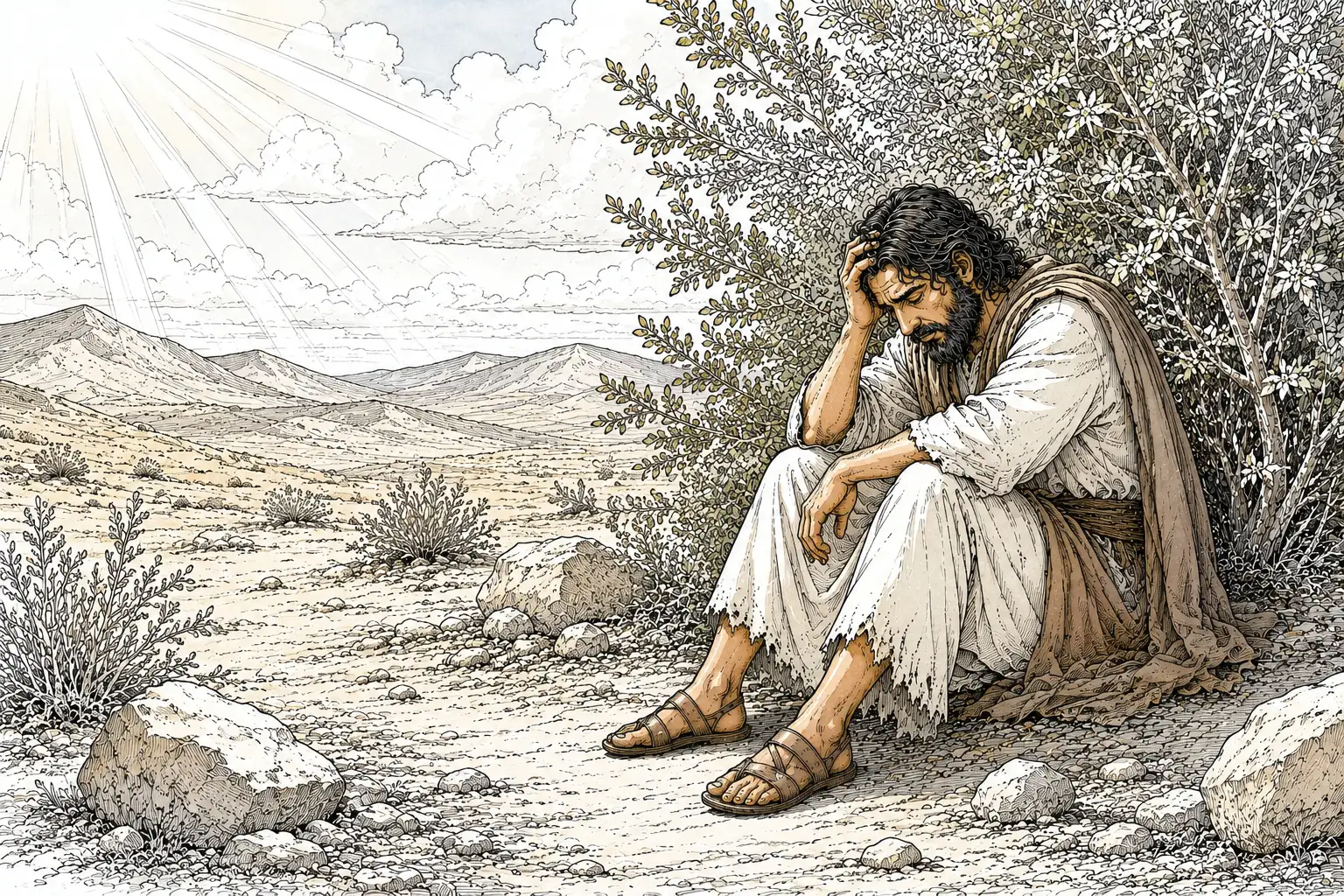
Elijah found himself in this situation. Alone under a desert bush with a death sentence over his head, he asked God to end his life, thinking all his work was in vain (1 Kings 19:4). We can surely understand Elijah’s feelings. In the presence of all Israel, he had just proved the vanity and inconsequence of the gods they were worshipping. He had proven beyond any doubt that God was the only true God. Could there have been any evidence more terrifying or electrifying than seeing a huge pillar of fire come down from heaven to consume a stone altar (1 Kings 18)?
The story does not end there, though. Following this majestic display of power, God sent a devastating storm to end Israel’s years of drought. Can you imagine Elijah´s exhilarating run as he raced Ahab´s chariot to the gates of Jezreel (1 Kings 18:46)? Have you ever experienced such an incredible spiritual high, thinking finally your life´s work will yield fruit, only to have it all come crashing down the next day?
After these imposing demonstrations of God´s power, it seems that life returned to normal for Israel. Not so for Elijah! His efforts were immediately rewarded with a death threat from Jezebel, and so he fled into the desert, thinking his work was in vain (1 Kings 19:2-3). Maybe he felt crushed, dejected, and angry? Either way, while camped in the desert, he requests that God “take away my life, for I am no better than my fathers.” (1 Kings 19:4).
Instead of answering him immediately, God sends Elijah on an arduous journey across the country. After 40 days and 40 nights, he finally reaches “Horeb, the mount of God.” (1 Kings 19:8).
It is worth pondering the purpose of this long journey. Can you imagine what Elijah was reflecting on during those 40 days? Did it give him the time to consolidate his troubled feelings into something more articulate? Did it allow him to “cool down” and think more rationally? Before he left the desert, the angel gave Elijah only a few fleeting commands (1 Kings 19:5, 7). Perhaps Elijah was not yet in the mindset to be reasoned with? As he plodded along, was he able to get a better grasp on the issues bothering him? Did he first need to journey to the “mount of God” before it would be worthwhile discussing the things that were eating him up inside?
Elijah’s journey compels us to reflect on our own emotions when we are upset, frustrated, or even angry. It is often helpful to slow ourselves down, take a walk, think more rationally, probe our emotions, and consider constructive responses to them. Do we encourage ourselves to do this? Instead of responding in the heat of the moment, when we may feel “It would be better if I just gave up,” do we first take the time to journey through God´s Word and let it guide our response? Elijah needed 40 days and 40 nights to work through these challenges—we often need considerable time, too!
When Elijah reaches Mt. Horeb, God gives him another chance to confront his feelings. What did Elijah learn while on “the mount of God”? He learned that God is found in the “still small voice.” (1 Kings 19:12-13 NKJV). Often, I instinctively expect people to be most heavily swayed by an extremely strong wind, a fierce earthquake, or a raging fire. This reasoning is true whether in my dealings at home, family, or ecclesial life. However, God teaches me that he is found in the “still small voice,” not the loud, harsh, angry words. This lesson also reminds me of the verse, “A soft answer turns away wrath, but a harsh word stirs up anger.” (Proverbs 15:1). Do we have the faith to believe that this fundamental principle can positively impact our interactions with others?
Did you notice that God also allowed Elijah to fully explain the problem before giving His answer? Almighty God knows our thoughts and has a solution long before we ask for it, but He also provides us with an opportunity to verbalize it to Him (e.g., in prayer) while he listens intently—just as He did for Elijah. Likewise, we are called to “Be quick to hear, slow to speak, slow to anger” with each other (James 1:19). We can likely recite this helpful verse, but are we familiar with the verse that follows? James continues with an additional reminder about our emotions: “For the anger of man does not produce the righteousness of God.” (v. 20).
The “angry” wind, fire, and earthquake did not contain the spirit of God. It is no surprise, therefore, that Paul does not include anger in his famous list of the fruit of the Spirit in Galatians. Instead, he lists “fits of anger” as one of the “works of the flesh.” (Galatians 5:19-20). On the other hand, our “fruit of the spirit” is manifested in attributes such as peace, gentleness, and self-control (vv. 19-25). Since we “belong to Christ Jesus” and have “crucified the flesh with its passions and desires,” “let us also keep in step with [this] spirit.” (vv. 24-25).
Jesus
Let us now turn to the final example I would like to consider. I alluded to him at the beginning of this article, our Lord Jesus Christ. In John 2, we find him in the temple, brandishing a whip of cords and driving people and livestock out of the temple while knocking over the money tables. Surely, he was shouting the words “Take these things away; do not make my Father´s house a house of trade.” (v. 16). His disciples stood by nervously, and remembered the prophecy, “Zeal for your house will consume me.” (Psalm 69:9).
What can we learn from this story? Can we rub our hands together in glee and think, just wait until the next ecclesial debate, or until my children have again not tidied up their room? Do we have a whip of cords on our bedside table, just waiting for a cause to necessitate its use?
I believe the answer lies in both Matthew 16:24 and John 13:1-10. Here, Jesus is actively calling us to follow his example and do as he has done. Does he tell us to pick up our whips of cords and start driving the offenders out while loudly shouting a litany of allegations against them? On the contrary, he tells us to pick up our cross and follow him, and he calls us to follow his example and wash the feet of our fellow brothers and sisters.
In conclusion, then, I want to answer the questions I asked at the beginning. Is it wrong to erupt in anger when we have been slighted? Can we start shouting and spewing words as they enter our minds?
From Moses, we learned the dangers and the undesirable results of losing our self-control, and the consequences of forgetting to show the holiness of God to the people around us. From Elijah, we learned that it is not the wind, earthquake, or fire that win people over to God, but rather that God is found in a still, small voice. And while Jesus could wield a whip and drive people from his Father’s house, he has called us to endure trial, deny our own selves, follow him, sacrifice our lives to him and others, and be a servant to his brothers and sisters.
Finally, let us contrast several wise Proverbs where we learn that: “A man without self-control is like a city broken into and left without walls.” (25:28), but “Whoever is slow to anger is better than the mighty, and he who rules his spirit than he who takes a city.” (16:32).
Faith Imhof,
Esslingen Ecclesia, Germany
- All quotations, unless otherwise noted, are from the ESV.