With God, Nothing is Impossible
A powerful reminder through Sarah, Elizabeth, and Mary that true faith means believing in what seems humanly impossible.
 Read Time: 8 minutes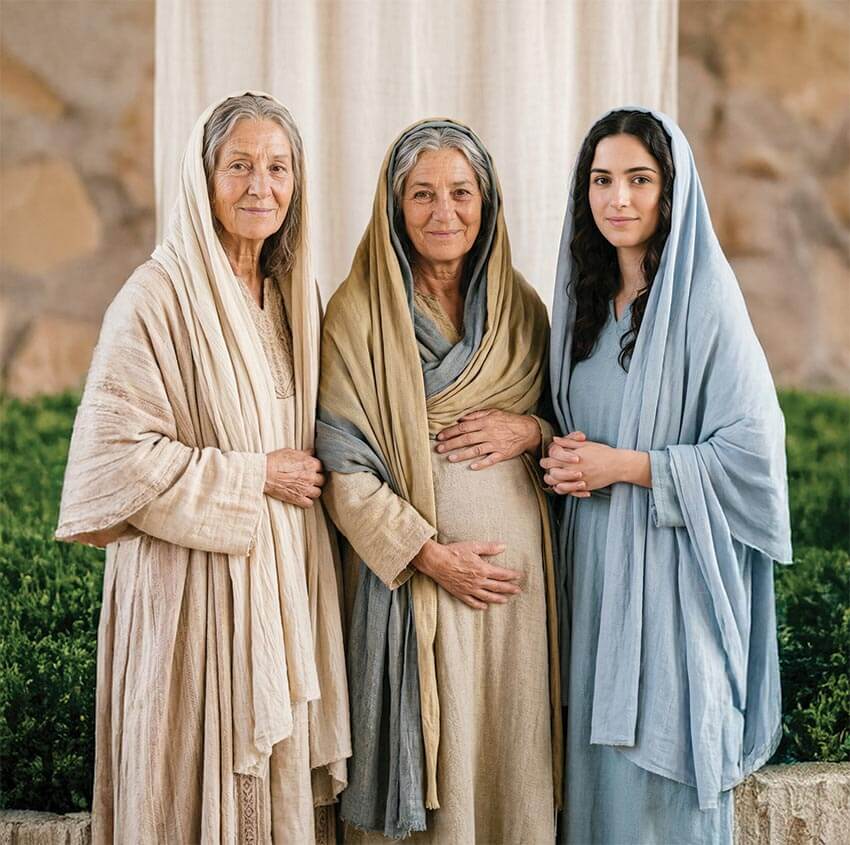
Dearly beloved Brothers and Sisters,
We want to look at three women of faith who all believed that with God, nothing is impossible: Sarah, Elizabeth, and Mary.
Sarah, the wife of Abraham, is the first woman of faith portrayed in any detail in the Old Testament. Elizabeth, the wife of Zechariah, is the first woman of faith we find portrayed in the New Testament. Mary, the Lord’s mother, was the second. Their example of faith is inspirational to young and old alike.
In the Bible, Sarah and Elizabeth are linked together in God’s plan by common experiences. They both:
- Had been barren for many years.
- Had struggled with adversity and frustration.
- Had long prayed for a child.
- Were visited by an angel of God’s presence.
- Were to become the subjects of miraculous intervention.
- Would be physically rejuvenated at a humanly impossible age.
- Would bear a precious child in God’s plan—one, the Seed of Abraham, who would prefigure the sacrifice of Jesus on Mt. Moriah—the other to have a son called John, to go before the Messiah and to prepare the way of the Lord.
The verse that binds them all together is found in Luke 1:37, where Gabriel remarks to Mary about the miracle of Elizabeth giving birth in her old age, concluding with “For with God nothing shall be impossible.”
This statement is almost a direct quotation from what the angel Michael said to Sarah in Genesis 18:14. The Yahweh angel said to a disbelieving Sarah, “Is anything too hard [too wonderful] for Yahweh?” (ESV). In fact, the Septuagint reads, “Is anything impossible for Yahweh?” Gabriel is making a direct link.
Mary, with her quick mind, would have latched on to the reference immediately. Mary instantly believed all the incredible things she had just been told about herself.
We know this instant belief occurred because Elizabeth, under the power of the Spirit (Luke 1:41), says about Mary “Blessed is she that believed: for there shall be a performance of those things.” (v. 45).
Mary had not disbelieved the angel as Zechariah had, nor been slow to believe as Sarah had been. She instantly accepted the humanly impossible promise that a virgin shall conceive. “Be it unto me according to thy word.” (Luke 1:38).
The Bible links together these three women of faith—Sarah, who by faith finally bears the seed of promise, Elizabeth, who by faith bears the forerunner, the messenger, the voice crying in the wilderness, and Mary, who by faith bears the Messiah.
The common link is their ability to believe implicitly in the humanly impossible.
Sarah’s Story
Let us take Sarah first. These are the things God promises her in Genesis 17:15-16:
- For the first time, God confirms Sarah will be the mother of the seed.
- A change of name to “princess.” She was to be a mother of kings.
- “Her” occurs 4 times in these promises. She is not just Abraham’s wife, but a co-heir in the faith, the mother of us all who are the children of Abraham by faith.
- She is also a mother of nations, and kings over people will come from her (especially the king-priests of the age will come from her).
You would imagine Abraham shared his joy with her about this promise. But like us all, she battled with the stubborn realities of mortality—years of disappointment and dashed hopes had taken their toll on her faith. So, in Genesis 18, Sarah receives a personal visit from the Yahweh angel. This is the one angel who speaks directly for God (Genesis 18:10).
The words of v. 12 reflect the mind of Sarah, which resisted both the report of Abraham and the words of the angel: “Therefore Sarah laughed within herself, saying, After I am waxed old shall I have pleasure, my lord being old also?” This struggle is common for us all: to really believe in things God has said He will do, because we just can’t see past our human limitations.
So, Sarah now receives a whole raft of miracles, all aimed at solidifying her failing faith. Firstly, she sees that the angel can read her mind. “Thou didst laugh.” (Genesis 18:15). The next morning, Sodom was destroyed. Imagine standing there watching the huge pall of smoke and reflecting: “Is anything too hard for Yahweh?” Moving westward to Gerar, her body rejuvenates miraculously. Again, Sarah becomes the beautiful woman who attracts a king’s attention. Most kings do not pick up 90-year-olds for the harem. Imagine waking up each morning and being younger. There is also the rejuvenation of Abraham’s body. His humanly “dead” body was so changed that he was to have another whole family after Sarah died 37 years later. Finally, in Abimelech’s house, Sarah witnesses a miraculous cessation of childbearing, followed by its sudden resumption.
All of these miracles occurred right in front of her eyes over the course of just three months. Hebrews 11:11 comments, “Through faith also Sara herself received strength.”
In the end, she looked at the miracles she could see happening around her and so believed in those not yet fulfilled; the once-humanly-impossible became an absolute conviction to Sarah.
Elizabeth’s Story
Let’s now move on to Zechariah and Elizabeth in Luke 1.
No doubt these two are part of the select group (along with Simeon and Anna) that looked for redemption in Jerusalem and were in expectation of the Messiah. Despite their godliness, they had the same problem experienced by Abraham and Sarah, Isaac and Rebekah, Jacob and Rachel, and especially Hannah. Childlessness carried far greater social stigma than it does now. Never underestimate the shame she felt, the sense of failure at not providing a seed for her husband, as Hannah did. Elizabeth called it reproach (Luke 1:25).
We note in Luke 1:36 that Gabriel knew what her neighbors called her—“the barren one” (this reflects the Greek). Imagine the nasty sneers, the false sympathy at the well: “Poor old, barren Elizabeth.”
After 400 years of silence, with no open revelation or appearances of angels, the appearance of Gabriel would have been very surprising and troubling. Fear fell on Zechariah. After many years of praying for a son, an angel appears to him (1:13). As Isaac had done (Genesis 25:21), Zechariah probably prayed as much for his wife as for himself. He had seen her sadness and unfulfilled life. Yet God had a great reward in store for them: their son was to be the forerunner of the Messiah, a picture of Elijah (Luke 1:17), who would open hearts and prepare the way.
Think of the moment Zechariah came home. He arrives shocked and dumb. He must have written his experience for her to read. We wonder when she knew she had conceived. She certainly did not broadcast it to all who had pitied her (1:24). Elizabeth did not gloat publicly in the miracle, which would have been tempting. Perhaps the first absolute proof of her impending motherhood came with Mary’s arrival (“the babe leaped,” 1:41).
Having visited Zechariah and Elizabeth, the angel waits for six months, then tells Mary about her, and Mary rushes to share her joy with Elizabeth. These two women were to share the blessing of a miraculous childbirth—but with opposite personal results. One would have her reproach taken away, but the other would find that reproach would be laid on her for the rest of her mortal days. Thirty years later, the enemies of Jesus would taunt him about his mother, throwing insults like, “Where is thy father?” (John 8:19) and “We be not born of fornication” (John 8:41).
In v. 25, Elizabeth quotes the words of Rachel, who finally prayed to God in faith. “God hath taken away my reproach,” is from Genesis 30:23. Elizabeth makes a wonderful speech (vv. 42-45) about the impending birth of Jesus and describes Mary as “the mother of my Lord.” This acknowledgment shows that she totally believed Mary’s incredible report.

Mary’s Story
Consider Mary’s faith. She was young, of low estate, very likely a poor orphan. Yet she instantly believes incredible things—impossible things:
- A virgin shall bear a son.
- You will have shared parenthood with God.
- Your son will rule the world forever.
Mary’s response in v. 34 is merely curiosity as to how—it was not unbelief. She had absolutely no doubt, which is a contrast to Zechariah. The angel can discern the difference, just as he perceived the difference between the laughter of Abraham and Sarah. Mary believed in the humanly impossible; the virgin birth can never be explained in human terms.
Today
The lessons for us today are simple. God asks all of us to really believe in the humanly impossible. Absolutely nothing is too hard for Yahweh. There are many unique and miraculous things that we do believe in:
- The virgin birth of Jesus
- The numerous miracles of the Bible (from small ones like water into wine up to the Flood)
- The fact that God inspired all the varied writers over 2000 years of writing.
- That God knows and informs us of future history.
- That Jesus rose from the grave
- That Jesus ascended to heaven, and that we poor mortals can approach the “throne of grace” with confidence.
- That God can raise the dead.
- That God can recreate the saints with healthy bodies, fully restored minds and characters at the resurrection.
- That we soon will be made immortal and live for eternity.
- That God will soon set up His worldwide kingdom.
- That God will restore our earth, bringing in total peace.
- That God can and will finally wipe away all tears.
Why do we have faith in such humanly impossible things? Perhaps because we have seen the miracles performed in the past. Miracles like:
- The absolute glory of created things
- The numerous fulfilled prophecies of the Bible.
- The miraculous history of modern Israel
- The transforming impact of the resurrection of Christ on the disciples.
We must continue to have solid faith in the humanly impossible, especially as our modern world erodes faith in the Bible and its miracles. We live in a world that puts human reason as the determinant of belief. A world where God is being fast relegated to myth and legend.
The Bible is full of people who listened to God. Having heard the most incredible things He promised, they really believed them and chose to act on their faith. Many even gave their lives.
The greatest compliment we can pay to God is to believe Him, to accept His faithfulness and His ability to perform what He promises. Even humans hate being disbelieved. How much more would God be offended? He cannot lie. Believing the humanly impossible glorifies Him. Our faith is not deterred by any current situation or by natural laws.
Think of some of the miraculous things that God has promised to all of us—things that are incomprehensible to the world at large.
- God can forgive sins totally.
- God wipes out our past and provides ongoing forgiveness.
- God will finish the work He has begun in us. It is His good pleasure to give us the kingdom (Luke 12:32). “Faithful is He that hath called you, who also will do it.” (1 Thessalonians 5:24).
- God will make his saints His immortal children—equal unto His angels, perfect in mind and body.
- God promises He will wipe away all tears, something that many of us with hurting hearts and mental scars really struggle to understand.
So how do we get the faith to believe the impossible?
Romans 10:17 says, “Faith comes by hearing, and hearing by the Word of God.” (NKJV). We will never have meaningful faith without constant reference to and application of the Bible. Faith comes by hearing the Bible. That is a choice we all have to make: read it, study it, and become increasingly familiar with it. Faith must be fed, or it will wither and die. True hearing is the choosing to believe all that God has said.
God wants to give us the Kingdom. Be assured—with God, nothing is impossible.
Ron Cowie,
Enfield Ecclesia, SA