A Shepherd’s Story
An imaginative retelling: Announcing the birth of the Messiah.
 Read Time: 7 minutes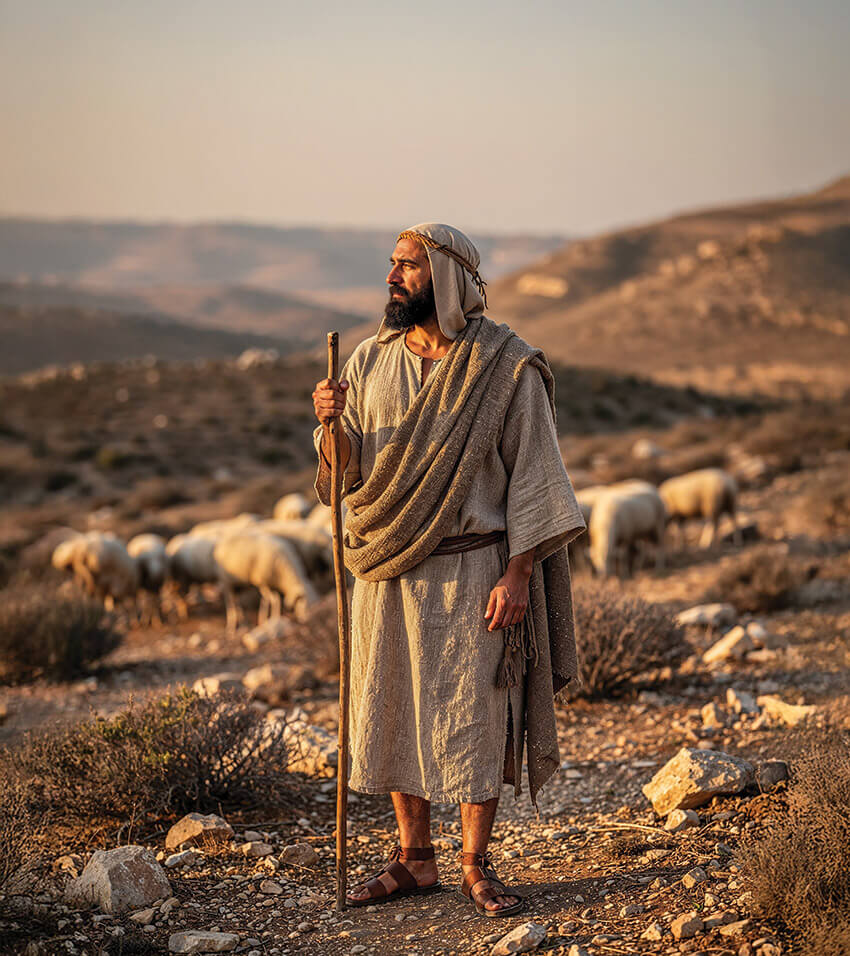
EDITOR’S NOTE: This article begins a new series by Brother George that examines various fictional and non-fictional characters who met the Lord Jesus and how this meeting, and for some, that friendship, changed their lives. May it cause us to remember how the Lord has changed us. By nature of the genre, George has elaborated on the record by attempting to envision the Biblical scenarios and draw out possible details. Each article ends with notes that help substantiate his creative license or indicate where license has been taken. These stories are based upon the true Biblical record and, in large part, on real people. May you find that they help you remember that the Biblical record is real and true, and that one day we will hear the complete details of these people’s lives.
I am Moshe ben David, one of many shepherds who lead their flocks around the countryside near Bethlehem. My father, who was also a shepherd, was proud to call me Moshe (or Moses), naming me after the great shepherd who led the whole flock of Israel out of Egypt and guided them through the vast wilderness of Sinai. My father’s family name, David, refers to the other great shepherd of Israel, the son of Jesse who nurtured and protected his family’s flock, and then grew up to become king of Israel, shepherding all God’s people in the same way as he had cared for his sheep. In short, I am named after the two greatest shepherds our nation has ever known.
I must add, however, that if I have learned anything at all during the past months, I have certainly learned this: my name means nothing at all, not really. The Name of the Almighty—hallowed be His Name—that divine Name means everything to those who believe.
And I do believe, in the God of Abraham, Isaac and Jacob (also shepherds!), and the God of Moses and David. My father, along with his parents and grandparents, had been wealthier and more educated than most shepherds. But, instead of seeking all the advantages such a family might afford, my father had abandoned what others might consider valuable in favor of a workplace and a lifestyle far simpler than is usually enjoyed by well-to-do people. Personally, I think he wanted to be sure his family lived far away from the temptations of the big city, as our patriarchs did in the beginning.
Thus, I became a shepherd too, learning much from my father, so that I could take over his trade one day, but also learning from him much of the Word of our Lord: the Law, the Prophets, and the other inspired Writings of our people. Such an education was one of the few real benefits of the more prosperous families in Israel, and I also have the advantage of it, secondhand though it is. So, by a strange twist of fate, or providence, I came to be the unofficial “rabbi,” or teacher, of my friends—the uneducated shepherds of Bethlehem.
A Shepherd’s Life
The life of a shepherd is not an easy one. For the most part, we live outdoors, in the fields, at the mercy of whatever weather the Lord provides. However, and very much like farmers in Israel, we shepherds are disposed to see the Almighty as the giver of all good things, because we live in the midst of the great wonders of His vast creation. All of us, the working classes, learn to trust in the same All-powerful One even when our circumstances seem less than favorable, for has He not said: “I will never leave you nor forsake you?” (Joshua 1:5 ESV).
In a sense, we shepherds also live our lives as sojourners, reflecting in our own small way what a shepherd like Moses did. In earlier years, Moses first guided and protected his sheep in the Sinai wilderness, and then, when he was much older, he was called by the Lord to care for the great mixed band of Jews and other oppressed peoples of Egypt—delivering them from Pharaoh and the Red Sea, shepherding them through a desolate wasteland on their way to the Land of Promise, and finding food and water when such blessings were scarce or nonexistent.
As a shepherd, I spend most of my time away from my family. They might be encamped only a few miles away, but my duties prevent me from seeing them nearly as often as I would like. Occasionally, I might cross paths with another shepherd or two in this area. At such times, we will enjoy meeting around the campfire to talk about families, other news, or perhaps the Scriptures themselves. Sometimes, such encounters give us the opportunity to leave our sheep in another’s care and make a quick visit to our own family. At other times, some of the shepherd’s family might come looking for him. And so we keep in touch as best we can.
A shepherd’s life can be dangerous, from time to time, and we must always be vigilant. Our duty is to protect our flock at all costs, putting ourselves between our sheep and the lion or bear, or the wild dogs or wolves, or most dangerously, human predators.
At other times, most times in fact, a shepherd’s life is simply lonely, but even that has its advantages. We have time to think, to meditate on what we know and care about, to pray for those whom we love, and to seek the Lord’s blessing on what we do. The young shepherd David composed many of his psalms while alone with his flock in the fields.
Taken as a whole, we live very much like soldiers—knowing long periods with little to do, but punctuated with brief periods of danger. The older David, still a shepherd to his followers, wrote other psalms while on the run, hiding here and there and trying to keep away from Saul and his soldiers.
The Tower of the Flock
Most times, each shepherd must go his own way, leading his own flock to green pastures and safe drinking water. But there are other times when we shepherds all come together with our flocks. This could be due to cold weather or because predators are known to be in the area around Bethlehem.
We also gather together at the times when ewes give birth. Then we find protection in our numbers and help in sharing duties. While some shepherds keep watch over the combined flocks of all the others, other shepherds assist with the lambing and the care of the little newborns. It is at such times that we all drive our flocks to one of the landmarks in this area, which is called “Migdal Eder,” the Tower of the Flock.
Bethlehem is a small village just an hour’s walk south of Jerusalem. Just outside the village, there is a tower. It is not imposing, like the towers of large cities, but it has an entrance leading to a shelter, and steps leading up to outlooks where shepherds can keep watch over their flocks in nearby fields. In the lower area, there is straw and fodder where ewes might eat and rest with their newborn lambs. Since the earliest days of the patriarchs in the Promised Land, there seems to have been a tower here.
Centuries ago, one of our Hebrew prophets, Micah, spoke of a king and his kingdom coming to “Migdal Eder” at Bethlehem. How could we have ever imagined that this rather obscure prophecy might be fulfilled in our time, and in such a marvelous way? Yet I can tell you now how wondrous this was, for I have seen it with my own eyes, and heard the voices of angels proclaiming good news from heaven.
“Good news of great joy”
It was the time of lambing, and some of the shepherds were tending to the lambs inside the tower shelter, while others were overseeing the flocks gathered nearby. I was with the shepherds out in the fields. Suddenly, there was a great light descending over all of us, as though the sun had risen late at night, yet was shining only on our little cluster of hills and nowhere else. As shepherds, we were prepared for various threats, but what does one do when a light appears out of nowhere, and heavenly figures appear in its midst? I must say, I was terrified, and I am sure everyone else felt the same.
One of the angels moved forward to speak for the rest. He spoke directly to us:
Do not be afraid. I bring you good news that will cause great joy for all the people. Today in the town of David a Savior has been born to you; he is the Messiah, the Lord. This will be a sign to you: You will find a baby wrapped in cloths and lying in a manger. (Luke 2:10-12 NIV).
Immediately after this, the other angels, like a great choir, broke into chants and singing. I have never heard such beautiful voices, not even in the great temple at Jerusalem: “Glory to God in highest heaven, and on earth peace to those on whom his favor rests.”(Luke 2:14 NIV). It occurred to me that, of all God’s people, He had chosen a handful of ordinary shepherds like us to receive such words of love and blessing.
What did it mean? I had heard the words clearly. A savior, a great leader, a shepherd, and a king—most especially, the Messiah or Anointed One of the Lord God—was to be born somewhere near us. And we would find him “lying in a manger,” a feeding trough in a stall where animals are housed. What an extraordinary message. A king born in a barn!
George Booker,
Austin Leander Ecclesia, TX
Notes and References:
- Introduction: I have created one shepherd to speak for all those who witnessed the great miracles on that wonderful night at Bethlehem, and I have given him a back story to account for his narrative.
- A shepherd’s life: It was a common practice for two or more shepherds to combine their flocks temporarily, depending on circumstances. In his parable of the Good Shepherd, Jesus himself said that each shepherd could call his own sheep out of a larger flock, because “his sheep follow him because they know his voice.” (John 10:3-5 ESV). This frequently happened in the Holy Land a century or more ago, as attested by various travelers and writers at the time. See also Joshua 1:5.
- The Tower of the Flock: Alfred Edersheim (1825-1889) was an eminent Hebrew scholar who converted to Christianity. He wrote a number of books which essentially explained much of the Hebrew Torah (the “Law,” that is, Genesis through Deuteronomy) and Mishna (rabbinical expositions) for the benefit of other Christians. In his Sketches of Jewish Social Life in the Days of Christ (pp. 39-40, etc.), he wrote of the background and setting of Migdal Eder, the Tower of the Flock, very near Bethlehem. See also Genesis 35:19-21; Micah 4:8-10; 5:2-4; Matthew 2:1; Luke 2:1-20; John 1:29, 36.
- “Good news of great joy:” Luke 2:1-20.
- “That will be to all people:” Also Luke 2:1-20, and especially verses 1, 2 (the census).