Are We Children of Light?
Nicodemus and Joseph of Arimathea lingered between darkness and light. Their story challenges us to ask whether we are truly living as children of light.
 Read Time: 5 minutes
Some thought it was thunder, others that an angel had answered Jesus’ prayer, but the Voice that signaled the end of the Master’s public ministry1 was the same Voice that had marked its beginning (Matthew 3:17). The Lord prayed, “Father, save me from this hour: but for this cause came I unto this hour. Father, glorify Thy name.” (John 12:27-28). And the Father answered—“I have both glorified it, and will glorify it again.” (v. 28). Did any in the crowd understand what was going on? There must have been some because Jesus said, “This voice came not because of me, but for your sakes.” (v. 30).
There is good reason to think Nicodemus was there, listening to that last discourse (John 12:30-50), because the words of the Lord take us back to the first conversation he had with Nicodemus, recorded in John 3 (see table).
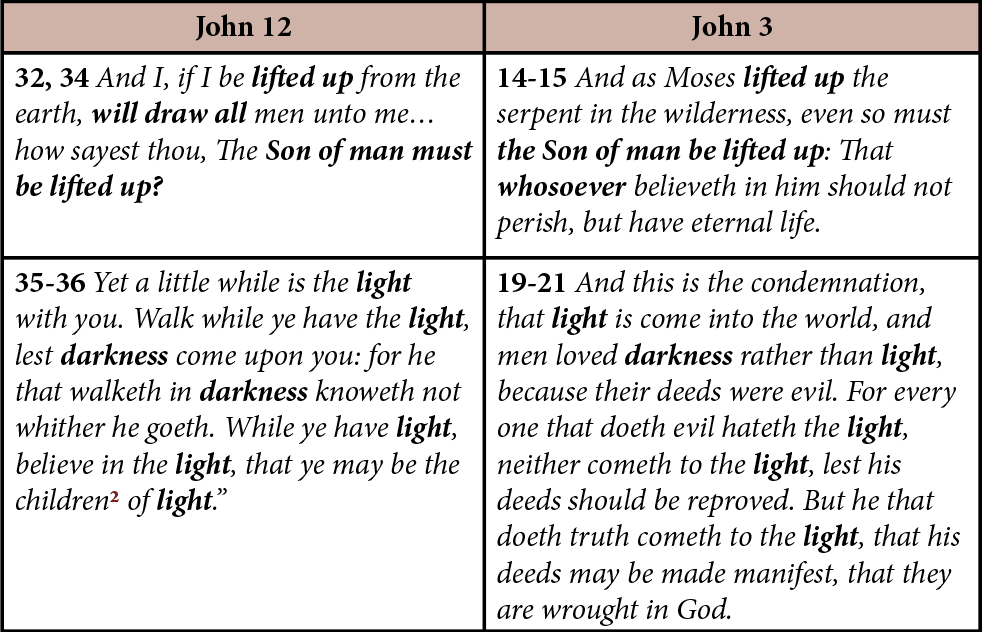
Since their first conversation, Jesus had proven that he was the “light of the world,” the one who could open the eyes of the blind (John 9:5-7) and reveal the righteous path to eternal life (ch. 8:12). And he had the authority to call the deceased Lazarus out of the darkness of the sepulchre into the light of life. The many senior Jewish witnesses had seen the “glory of God” (ch. 11:40). Now the Voice from heaven declared that He who had “glorified His name” in the resurrection of Lazarus would “glorify it again” in the resurrection of Christ.
But before we get very far into the Master’s last discourse, the inspired Gospel writer interrupts with a narrative section (12:37-43) that tells us that despite the miracles, the nation as a whole did not believe on Jesus (as Isaiah 53 and Isaiah 6 predicted), but there were exceptions—“many believed on him; but because of the Pharisees they did not confess him, lest they should be put out of the synagogue: For they loved the praise of men more than the praise of God.”
After this interjection, the discourse continues3 on the same theme of “light” and “darkness”—“Whoever believes in me, believes not in me but in him who sent me. And whoever sees me sees him who sent me. I have come into the world as light, so that whoever believes in me may not remain in darkness.” (ch. 12:44-46 ESV). This discourse is a final appeal to would-be disciples to “come to the light,” to be born again, to become “children of light.”
The Gospel of John associates Nicodemus with darkness. He first came to interview Jesus by night (John 3:2), and thereafter he is known as “He that came to Jesus by night” (John 7:50). This senior Sanhedrin theologian4 did not want to be seen with Jesus. Was this an agreed policy of the Council, or was it a reflection of Nicodemus’s own personal concerns? We do not know how Nicodemus reacted to the Master’s words, but by the time of John 7, Nicodemus had distanced himself from his erstwhile colleagues. He spoke up for fair treatment of Jesus, only to be rebuked disrespectfully—“Art thou also of Galilee? Search, and look: for out of Galilee ariseth no prophet.” (v. 52). Has Nicodemus’s growing sympathy for Jesus already undermined his authority? The challenge to “Go and look” might have been made cynically, but it would have been easy for Nicodemus to check and find that Jesus was indeed born in Bethlehem of the house of David. I suggest this is precisely what happened.
Nicodemus disappears from the record only to reappear with Joseph of Arimathaea to bury the body of Jesus. Ah, Joseph, an honorable and righteous man, but still a secret disciple “for fear of the Jews.” (John 19:38). Was he also in the audience standing with his friend Nicodemus, neither one having the courage of their convictions? How many scriptures did they pore over together? In how many private conversations did they agonize about whether they should confess their faith? But at what cost? Disrespected and disowned by society, by the Temple leaders, no income, no status? Would it be too difficult?
For Joseph, the opportunity to step out of the twilight came soon. His conscience could not let him stay silent. He must have spoken out against the injustice of the illegal Sanhedrin show trial. He had not consented to their decision (Luke 23:51). Not only that, but he was determined to rescue the body of Jesus and to lay it in his own private sepulchre. Did he know he was fulfilling Isaiah 53:9? It was evening when he asked Pilate for the body. Perhaps it wasn’t full daylight, but Joseph must have known they were being watched. No one could go in to speak to Pilate without being noticed. And they all knew whose sepulchre was used. But where was Nicodemus? Was he still a member of the Sanhedrin, and was he present at the trial? The Bible does not tell us. None of the Gospels states he was with Joseph when he went to Pilate. He appears later, bringing the spices, but that doesn’t necessarily mean he was hiding. Under the suspicious eyes of the authorities, procuring such a considerable weight of spices would also have been noticed.
But why did he and Joseph decide to finally step forward when it might have been thought to be too late? Had the Voice from heaven convinced them that Christ would rise from the dead? I like to think so. What became of Joseph and Nicodemus, we do not know. We want to believe they did become full disciples and saw the risen Lord. Yet they stand in the record as men who stayed too long in the twilight zone, hovering on the edge of darkness, reluctant to come into the daylight.
We are not here to judge them. It is for us to examine ourselves, to allow the light of the Word to search our own hearts and minds, to see if the praise of men, of human ambition, of social respectability, is more important to us than the praise of God, to ask if we are truly “children of light,” if we are walking in that light, if we are trying to live the Christ-like life. The apostle Paul uses the same rare phrase when writing to the Thessalonians and with the same sense of urgency and the same hope of resurrection to eternal life:
But ye, brethren, are not in darkness, that that day should overtake you as a thief. Ye are all the children of light, and the children of the day: we are not of the night, nor of darkness. Therefore let us not sleep, as do others; but let us watch and be sober. For they that sleep sleep in the night; and they that be drunken are drunken in the night. But let us, who are of the day, be sober, putting on the breastplate of faith and love; and for an helmet, the hope of salvation. For God hath not appointed us to wrath, but to obtain salvation by our Lord Jesus Christ, Who died for us, that, whether we wake or sleep, we should live together with him. (1 Thessalonians 5:4-10).
Stephen Palmer,
Mumbles Ecclesia, UK
- In the synoptic gospels, the public ministry ends with the rebuke of the religious authorities. John 12, however, likely comes after this rebuke because as soon as the Lord had finished speaking, he “departed and hid himself from them.” (John 12:36). Thus, the curtain closed on his ministry.
- The Greek word here for “children” is υἱοὶ (huioi; G5207), which is typically understood to mean “sons,” or “sons and daughters.” It is not the word generally used for “children.” Perhaps Christ specifically chose this word to urge Nicodemus and Joseph of Arimathea, those to whom “sons” could refer, to make a choice.
- To my mind, it makes most sense to understand vv. 44-50 as a continuation of the discourse of vv. 35-36.
- Perhaps something like Chief Rabbi.