Let Us Learn
“The LORD is my shepherd” may be more present and powerful than we realize. This article explores how the Hebrew reveals God as actively and continually shepherding His people.
 Read Time: 6 minutes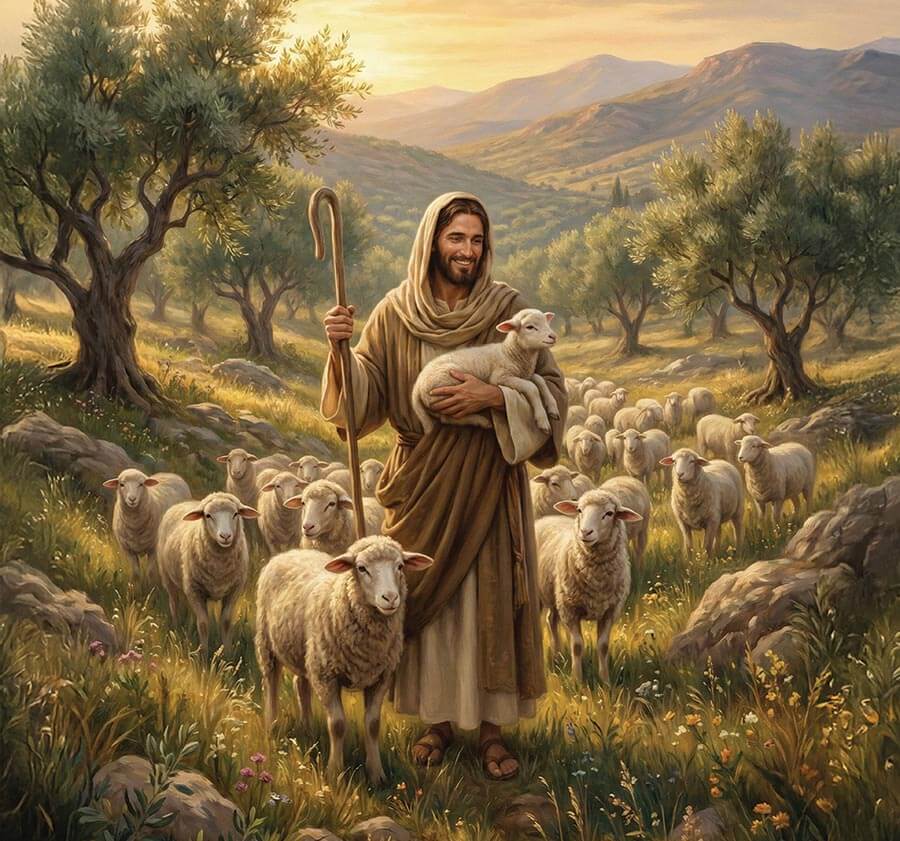
-Jason Hensley
The LORD is my shepherd. We all know these words, and we’ve probably appreciated them most of our lives. At some point, they have probably been the source of meditation on who God is and what He is doing in our lives. We could say this phrase another way: the LORD has shepherded me. Looking back honestly and reflectively, we can often see His shepherding. Another idea might be that the LORD will shepherd me. This thought requires faith, but we can trust it is true now because of our past experiences. Finally, Yahweh is shepherding me.
All of these phrases can be true, but is there a distinction in the Hebrew that may have become lost in the translation to English? According to the Masoretic pointings, the vowel dots were added to maintain the meaning of the words, the word for shepherding is transliterated: roh-ee, and is considered a participle. In Hebrew, participles can occur when the timing of a verb is not embedded in its form. The Hebrew doesn’t say “Yahweh shepherded me,” with an inherent past tense, nor does it say “Yahweh will shepherd me,” with a promised future tense, though we are thankful that both are true. Instead, the Hebrew is more ambiguous.
Adding to that ambiguity, we could translate the Hebrew to indicate that Yahweh is the one who is shepherding me. As in many Biblical versions, the italics in the phrase signify that the words “the one” are not actually in the original text but are an appropriate way to understand the meaning of the Hebrew when translated to English. Yahweh is shepherding me. Yahweh is the one shepherding me. Say it to yourself again, as often as needed, until it sinks in. Yahweh, the LORD of Heaven and Earth, of sea and dry land, revealer of secrets, helper of the helpless, is in an ongoing perpetual sense, shepherding me. When the idea of the inspired words of the Psalmist grows a root in our minds, we respond with clarity, recognizing: We will lack (chesar) nothing How could I be in want when Yahweh Himself is shepherding me?!
This concept does not mean that life is easy. We need only continue in the familiar words of the Psalm to remember that the valley of the shadow of death is part of this journey.
When reflecting on their time in the wilderness without food and water, God reminds the Children of Israel that they lacked (chesar; H2637) nothing (Deuteronomy 2:7). The period of deprivation was not a lack; it was an intentional time of humbling, of being put to the test, of knowing whether they knew that life comes only from the mouth of God. It was a time to be very careful to ensure they remembered who God is and what He is doing during intentional periods of hungering and thirsting. In truth, how could we know how to hunger and thirst for righteousness if we never experienced hunger or thirst? It is a part of the shepherding, a state of following the shepherd, needing experiential knowledge. When Yahweh is shepherding me, these periods of food and waterlessness are not a scarcity. They are a teachable moment on the way to eternity.
As we continue in the Psalm, many of the verbs do carry the future tense. Remembering, however, that we are in Hebrew poetry, we should acknowledge that “the future tense” means more than just something that will happen at a future time. He will cause me to lie down, He will return my soul, and He will also lead me in paths (lama’an) of righteousness for His Name. These paths are not the flowery garden paths I sometimes pictured wandering in. It is David, entrenched in war, heading to the battle with Goliath (1 Samuel 17:20). It is Saul, encircled by his men when trying to capture David (1 Samuel 26:5, 7). It is the wayside where those gathered for war lay a net for the psalmist (Psalm 140:2, 5). So, as we delve deeper than the familiar words of the psalm, we acknowledge in our deepest hearts that Yahweh, the One shepherding me, will guide me in trenches of righteousness, for His name’s purpose. Our Lord Jesus’ words come back with so much fervor, “lead us not into temptation and deliver us from evil.”
Though it may seem as if I might now provide insights on the hopeful sections of verses 5 and 6 of Psalm 23, my intention is not to give you a moment to ponder the complete Psalm 23, but to encourage you in a lifetime of reading the Scriptures in the richness of the original languages. So, I will instead go to one more passage. In Psalm 1, the blessed man is the one planted (shatul) by rivers of water. Now that you know we are in this for the Hebrew, I am excited to tell you this is a passive participle from the root, which means “transplanted.” He will be like a tree, being transplanted by the rivers of water (c.p. Psalm 92:13; Jeremiah 17:8; Ezekiel 19:10,13). Such a big hope! Yet, for me, the most powerful part is next: being transplanted by rivers (palgay) of water. In Brown Driver Briggs, a Hebrew lexicon, we find that the root word for “rivers” has the idea of a channel or an artificial canal. Think of how water erodes a channel in a dry place (Isaiah 32:2), or of how tears seem to run tracks down our cheeks (Psalm 119:136; Lamentations 3:48). The happy, or blessed man, is the one who is digging channels to the water of life by meditating on God’s law day and night. This person is the one who will give fruit in his time, whose foliage will not wither.
Taking time to learn and read the Scriptures in their original languages is one way we can, right now, learn of our God and His ways.
So let’s learn, let us press on to know the LORD; His appearance is as sure as the dawn; and He will come to us like the rain, as the spring rain waters the earth. (Hosea 6:3 NASB 2020; c.p. Isaiah 2:3; Micah 4:2).
To begin this new section, I’d like to list some of the main benefits that I’ve personally experienced in learning Hebrew. Hebrew has:
- Transformed the Bible reading ritual into a discovery process of drawing near to God, allowing for more specificity.
- Helped in the appreciation of the challenges of translation. There is ambiguity and incredible depth unavailable in the English.
- Developed an appreciation for the distinctions of words available in Hebrew that may not come across in each person’s mother language.
- Seen the connections in the Hebrew language between different parts of Scripture.
- Unearthed the similarities of the root words in verses, seeing the patterns of repetition and emphasis.
- Understood the Rabbinical culture behind the Jewish oral traditions.
- Found a point of discussion with people of all different faiths who are interested in the Bible, Jewish people who are reconnecting to their heritage, and others who are learning the language.
- Added focus and profitable occupation of my time, increasing the depth of my ability to meditate on the Scriptures.
On a more mundane note, it has dramatically aided my ability to travel throughout the land of Israel, because now I can read the street signs much better than I could before!
However, learning feels scary for many of us. We may find ourselves thinking “It’s too difficult,” or “I’m too old,” or “I finished school years ago, and I don’t want to go back.” We might feel like we don’t have enough time, or even that Hebrew or Greek is irrelevant to our walk with Christ. Nevertheless, I’ve found that even small amounts of time learning one of the languages helps—even if we don’t have time to do the homework. Spending time with the language allows us to grasp the differences between Hebrew, Greek and English (or whatever other language may be native to us). In learning those differences, we can better appreciate and understand translation differences, and even begin to see familiar passages in a new light. Anything is better than nothing.
With all of that said, sometimes we really don’t have the time. Thus, may this special section provide encouragement and an opportunity for all of us to learn together, and to dive deeper into the original languages—recognizing the depth of the Word of God, and ultimately, its beauty.
Martha Monahan,
Largo Ecclesia, FL