Let Us Learn: Part 2
The Hebrew expressions translated as “forever” reveal David’s joy in dwelling with God, inviting a closer look at how Scripture describes the length of our days.
 Read Time: 6 minutes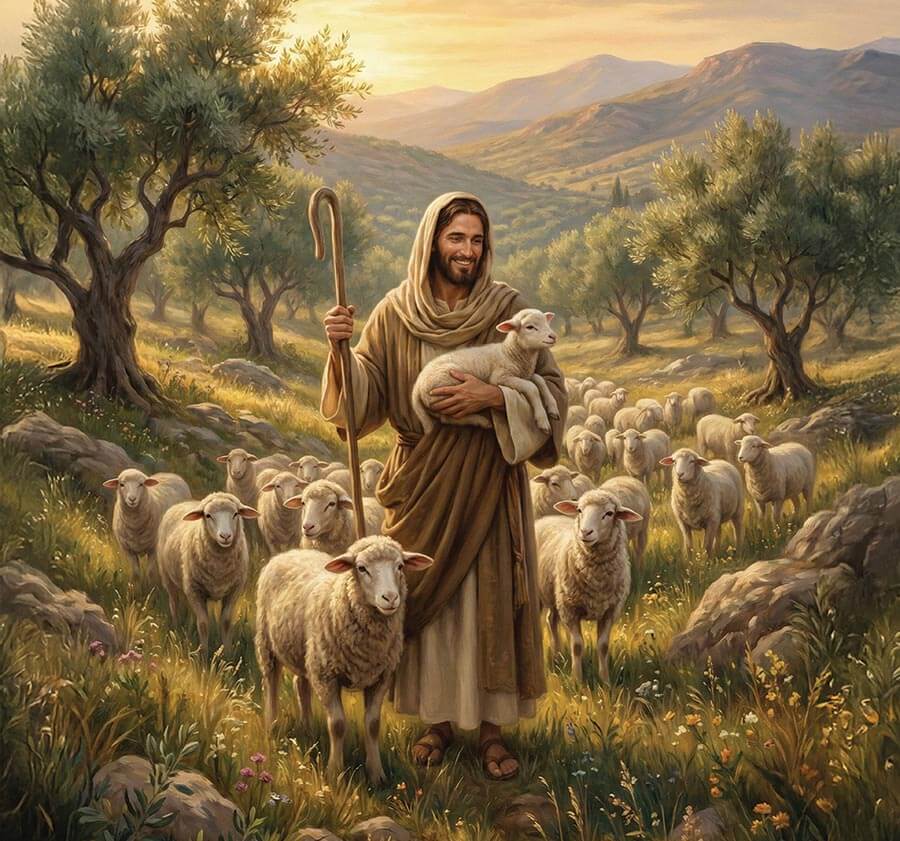
“And I will dwell in the house of the LORD forever,” or
“and my dwelling will be in the house of the LORD for a length of days”
(Psalm 23:6)1
We are starting again with words we know well. The English wording is so familiar that translators face a problem. If they change the translation too much from what people know and have accepted, then readers will just choose to purchase a version they already recognize. Yet we desire to truly know the Scriptures, and we recognize they weren’t originally recorded for us in English. We are not just looking for familiarity; we are seeking to know God so that He might reveal Himself to us more completely through His Word. By tracing the original words behind “forever,” we will discover a beautiful reality: David was not just looking toward a distant eternity, but rejoicing that he could dwell in God’s presence right now—amazed that the eternal God invites us into His permanent household even for the temporary length of our days.
The words we will look closely at right now are the Hebrew ones typically translated in our English Bibles as “forever.” In Hebrew, there are several words or sets of words that are translated into English as “forever.” In Genesis 3:22, God is speaking of the possibility that the man may eat of the tree of life and live forever (‘olam). When talking with Abram in Genesis 13:15, God says that he would give Abram all that land that he could see to him and to his seed forever (‘ad-olam). There is a word that can be translated as “until” added before olam in this passage, so the Hebrew is transliterated ‘ad -olam. Interestingly, in the Song of Moses, another form appears, sometimes translated as “forever and ever” (le‘olam va‘ed). Here, the preposition ‘ad/ed (until/to) follows le‘olam, joined by the conjunction v’ (and). Literally rendered, it might look like “to forever and until.”
In Psalm 23, we do not have any of these options. Instead, we have Hebrew words that could be translated literally as “for a length of days” (le’orech yamim). The same or similar phrase appears in Deuteronomy 30:20, Job 12:12, and Psalm 91:16, and isn’t typically translated as “forever” in any of these. In Psalm 21:4, another Psalm of David concerning the King, we have a combination of both expressions: “length of days for ever and ever” (ESV; orech yamim ‘olam va’ed). This would imply that they can add meaning to each other and are not just interchangeable idioms of the same thing. While I cannot definitively explain why translators chose to render the “length of days” expression as “forever” in Psalm 23:6, it does seem to misrepresent the text. We look at this not to disparage the translators—I have spent most of my life reading the Bible in English and am truly thankful for the work that was done so I could read it. We look at it to understand that the hope of the inspired Psalmist in this verse is to dwell in the house of the LORD for the length of his days, not “forever.” We can see this idea in another Psalm of David, “That I may dwell in the House of the LORD all the days of my life.” (Psalm 27:4). I remember the specific moment in an exhortation when I realized that I could dwell in the house of the LORD now, that this was not just a hope for the Kingdom age, but for me, personally, now. I am still in awe of this gift God offers.
Recognizing that David’s horizon in Psalm 23 was a lifetime (length of days) rather than endless eternity allows us to look with fresh eyes at another familiar poem of David’s: Psalm 15. Like Psalm 23, this poem explores what it means to live in God’s presence, but it introduces a fascinating linguistic puzzle. David asks, “Yahweh, who will sojourn (yagur) in Your tent? Who will settle (yishkon) in the mountain of your Holiness? The one walking uprightly and working righteousness and speaking truth; in his heart… the one doing these will not be shaken forever.” (vv. 1-2, 5). This is deeply puzzling, because sojourning, settling, and tents all have a temporary nomadic nature, though the temporary can become long-term. For example, Abraham went to sojourn (lagur; same root as yagur) in Egypt in Genesis 12:10, and Elimelech went to sojourn (lagur) in the fields of Moab (Ruth 1:1-2). Both of these men were fleeing a famine, not becoming new residents there. The margins of some versions even note that the root in Psalm 15:1 means “to sojourn.”
As for settling, the words we find in other passages share the exact same Hebrew root (sh-k-n) as David’s word for “settle” (yishkon) in Psalm 15. For example, in Genesis 3:24, two cherubim were settled (vayashken) East of the Garden of Eden, and again in Genesis 14:13, Abraham is settling (shochen) in someone else’s area, Mamre, the Amorite’s land. We may also recognize this shared root from Exodus 24:16, when God settled on Mount Sinai, and the Eden-like promise in Exodus 25:8 that “the sanctuary” is where God might settle with men. Holding these temporary ideas in our minds, the ending that “the one doing these will not be shaken forever” seems a little incongruous. We are left with a beautiful paradox: how could someone in a temporary residence never be shaken? This is a sharp contrast to Psalm 23, which describes dwelling (veshavti) in a “house” (beveit), not a tent, and uses a word for “dwell” that doesn’t suggest sojourning or anything temporary. To put it all together: in Psalm 23, David speaks of one who dwells in a house(hold) for the length of days (a lifetime), whereas in Psalm 15 he speaks of one who sojourns and settles in a tent forever.
Why is the Hebrew written this way? Why use temporary words for a permanent hope? To begin to understand the depths of this, we must let Scripture interpret Scripture by following the exact Hebrew words. David asks, “Who will settle (yishkon) in the mountain of Your holiness?” Centuries later, a crucial clue appears in Joel 3:17 using this exact same vocabulary. God declares: “And you shall know that I, Yahweh your Elohim, am settling (shochen) in Zion, the mountain of My holiness.”
So when David asks God who will settle in the mountain of His Holiness, God Himself provides the answer: “I, Yahweh your Elohim am settling in the Mountain of My Holiness.” This incredible idea—that God chooses to settle (sh-k-n) in Zion, whether described in the past, present, or future—is echoed throughout Scripture (Psalm 68:16; 74:2; Isa 8:18; Zech 8:3). Then all the incongruous pieces of the Psalm fall into place. Why a temporary settling forever? Because God does not need a place to live (yeshev), the heavens and the heavens of heavens cannot contain Him, yet He desires to settle among His people (1 Kings 8:27; cp. 1 Kings 6:11-13).
Because it is God Himself who settles on this mountain, the environment must reflect His character. Returning to the text of Psalm 15, David draws a sharp contrast: those who do evil to their friend, give their silver with usury, or exploit the innocent do not belong on this mountain of God’s holiness. They will ultimately be moved. When we realize this, a profound New Testament fulfillment snaps into focus. This is exactly what we see Jesus enforcing when He cleanses the temple (cp. Matthew 21:12-17; Mark 11:15-19; Luke 19:45-48; John 2:13-21; Psalm 69). By driving out the money-changers and those exploiting the innocent, Jesus is actively fulfilling the boundaries of Psalm 15, proving that the wicked cannot abide in His Father’s house. Our understanding of the answer to David’s question deepens when we hear an echo in Psalm 2:6. God does not only settle on the mountain; He establishes His Son there to rule it, declaring, “As for me, I have set my King on Zion, my holy hill.”
When we realize the import of these passages—that Yahweh our God will settle in Zion, the mountain of His Holiness, because He desires to tent with His people—we humble our hearts. With David, we ask, “Who shall ascend the hill of the LORD? And who shall stand in his holy place?” (Psalm 24:3), because we long to be there, with Him who will not be moved. We recount to ourselves the promises that “foreigners who join themselves to the LORD… even those I will bring to My Holy Mountain.” (Isaiah 56:6-7; cp. Isa 27:13; 66:20). And we quiet ourselves with Hezekiah, even as Assyria may sit outside our gates. We choose to sing “the Songs of the Ascending Ones” (Songs of Ascent) because we know it is through much tribulation that we enter into the Kingdom of God (Psalm 120-134).
When we stand on Zion with the psalmists and the prophets, the journey loops back to where we began. We realize that the green pastures, the quiet waters, and the table set in the presence of our enemies are not just future promises for a distant age. They are the reality of dwelling in the House of the LORD for the length of our days—right now. The prophet Isaiah captured this perfectly when he promised that God’s holy mountain would become “a pasture for flocks… for my people who have sought me.” (Isaiah 65:10). Let us rest in this grace, living today in the presence of our Shepherd who desires to pitch His tent among us forever.
Martha Monahan,
Largo Ecclesia, FL
-
All quotations, unless otherwise noted, are my own translation.
Thanks Martha, I have noticed that there were times that the word forever in the sense of never ending did not always fit the context and I appreciate knowing it can mean a life span.
Thank you Martha for your article using the words ‘forever’ and “for the length of his days’. The more we read our Bibles, the more we realize and appreciate the entire history of God’s word. We see how it is interwoven on a daily basis and look forward to the day when we see ‘forever’ being fulfilled.