Out of UR: Part 2
God called Abram out of Ur, but his journey stalled in Haran until he fully separated from idolatry and moved west toward God’s promise.
 Read Time: 11 minutes
In the last article, we considered Abram’s family and life in Ur. It was there, in Ur, that God appeared to Abram, and it was from Ur that Terah, Abram’s father, chose to move the family.
And Terah took Abram his son, and Lot the son of Haran his son’s son, and Sarai his daughter in law, his son Abram’s wife; and they went forth with them from Ur of the Chaldees, to go into the land of Canaan; and they came unto Haran, and dwelt there. And the days of Terah were two hundred and five years: and Terah died in Haran. (Genesis 11:31-32).
We know from Genesis 27:42-43 that Laban, the grandson of Nahor and Milcah, lived at Haran, so it would seem that Nahor had migrated to Haran from Ur. Yet Genesis 11:31 does not refer to Nahor. It only says that Terah took Abram, Sarah and Lot with him when he left Ur. Why is Nahor not mentioned?
Perhaps because the details in this genealogy were designed to focus the reader only on the transition of Abram and his seed as the vehicle through whom, from now on, God would work out His plan and purpose. Nahor reappears in the record later, when Abraham considered a wife for his son, Isaac. While Nahor went with his father to Haran, he never went to Canaan; verse 31 focuses on the move from Ur to Canaan.
If we were to restrict ourselves to these verses, we might assume that it was Terah who was called to leave Ur, but that is not the case. The very next verse in Genesis implies this: “Now the LORD said unto Abram, Get thee out of thy country, and from thy kindred, and from thy father’s house, unto the land that I will shew thee.” (Genesis 12:1 RV). Because it follows immediately on the record of Terah’s family sojourning in Haran, one could read this passage as implying that God called Abram when he was in Haran. But Acts makes it clear that God called Abram, rather than his father Terah, and that the first calling took place before the family reached Haran:
Brethren and fathers, hearken. The God of glory appeared unto our father Abraham, when he was in Mesopotamia, before he dwelt in Haran, and said unto him, Get thee out of thy land, and from thy kindred, and come into the land which I shall shew thee. Then came he out of the land of the Chaldaeans, and dwelt in Haran: and from thence, when his father was dead, God removed him into this land, wherein ye now dwell. (Acts 7:2-4 RV).
This fact is reinforced by references to the calling of Abram in Genesis 15 and Nehemiah 9.
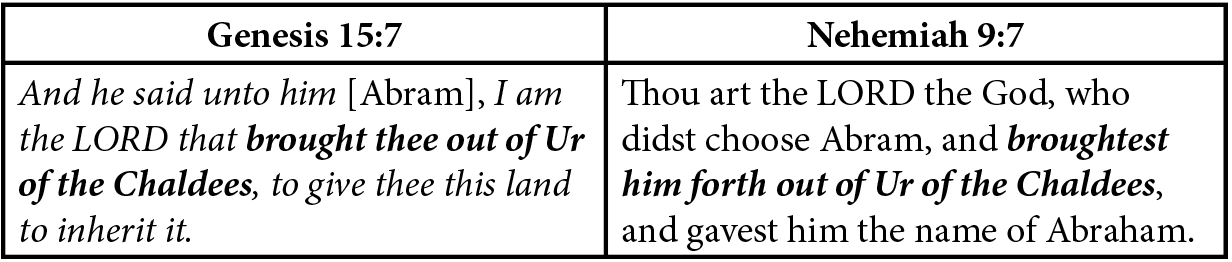
God called Abram while he was in Ur of the Chaldees. So why does Genesis 11:31 imply that Terah initiated the departure from Ur? Sir Leonard Woolley suggests an answer:
For the move from Ur to Haran was made not by Abraham but by Terah; the son was not a free instrument during his father’s life, for by Sumerian law the head of the family held absolute authority, and therefore it was the father who, in this case, decided to depart and took his son with him.1
Presumably, Abram influenced his father, as the text states that Terah intended to go as far as Canaan, but it was only Terah who ultimately could decide to leave.
Having left Ur with the intention of going as far as Canaan, the family of Terah came to Haran and “dwelt there” (v. 31). The Hebrew word rendered “dwelt,” yashab, means “to remain, stay, linger.” This word is not always used in a negative sense, but its use here suggests they were no longer prepared to be pilgrims and were happy to put down permanent roots.
The same word appears at the beginning of Genesis 11:2 when the tower builders decided to dwell in the land of Shinar. It is also used of Lot when he “dwelt” in Sodom (ch. 14:12), and when Hamor encouraged Jacob to abandon his nomadic life and to settle at Shechem (ch. 34:10-16).
The pilgrimage to Canaan, initiated by God’s prior instruction, was interrupted by a decision to stay at Haran and not resumed until after Terah’s death. In Genesis 12:1, therefore, God speaks to Abram again; in response, Abram leaves Haran and continues the journey to Canaan (v. 4).
He travelled north to Haran and then south to Canaan to reach his final destination, which is due west of Ur. When God called Abram to leave Ur, He was instructing him to travel from east to west. This point is significant.
Traveling Westward
God placed the cherubim to the east of the Garden of Eden (Genesis 3:24). Their placement there suggests that when Adam and Eve were expelled, they traveled eastward from the Garden, beyond the cherubim. This position meant that to worship before the cherubim, they and their family would need to approach the cherubim, thus traveling from east to west.
There is a pattern in Genesis which suggests that moving from east to west is associated with moving toward God spiritually, while moving from west to east is associated with moving away from God:
- “Cain went out from the presence of the LORD, and dwelt in the land of Nod, on the east of Eden.” (4:16).
- The men who built the tower of Babel “journeyed east” (11:2 RV) to the plain of Shinar.
- Lot came with Abram to Canaan but later separated from him; he “journeyed east” (13:11) from Bethel and “pitched his tent toward Sodom.” (v. 12).
- When Abraham wished to separate the sons of his concubines from Isaac, he sent them “eastward, unto the east country.” (25:6).
- Jacob traveled northeastward and “came into the land of the people of the east.” (29:1) when seeking a wife. He found two wives in Laban’s household, but he also encountered trouble until he returned and traveled southwest, back to the Promised Land.
This pattern in Genesis continues throughout the Bible. It is evident in the positioning of the Tabernacle, Solomon’s Temple, and the temple described in Ezekiel’s prophecy. Elements of it are sprinkled through the prophets, right up to Revelation 16 and the “kings of the east.” (v. 12). These directions symbolize a movement either toward or away from God.
Why Haran?
But why did Terah not complete the journey to Canaan? Why did he choose instead to settle in Haran? We have a clue as to the answer to these questions in Joshua 24:2: “And Joshua said unto all the people, Thus saith the LORD God of Israel, Your fathers dwelt on the other side of the flood in old time, even Terah, the father of Abraham, and the father of Nachor: and they served other gods.”
When Jacob came to Laban in Padanaram, where Haran is situated, Laban addressed him: “The God of Abraham, and the God of Nahor, the God of their father [Terah], judge betwixt us. And Jacob sware by the fear of his father Isaac.” (Genesis 31:51-53).
By comparing Laban’s words and the language of Joshua 24, it seems Terah and his family followed a religion that blended the worship of Yahweh with the idolatry of Ur. The fact that when Rachel left Laban’s house, she stole some of his teraphim, or household gods, supports this assumption. Presumably, Laban retained an interest in the idolatry of his forebearers in Ur. This blend of truth and error was never going to be acceptable to God, and God’s people would have to make a clean break at some point. In Genesis 31, despite referring earlier to “Yahweh” (Genesis 24:50), Laban does not use the name “Yahweh” in his words to Jacob. This evasion allows for an element of ambiguity regarding the deity to which he is referring. Laban’s words might even allow for more than one deity. Jacob’s reply neatly side-steps Laban’s ambiguity.
Terah served other gods. He was an idolator, likely a worshipper of the moon god, the dominant deity in Ur. The French archaeologist André Parrot suggests that the names “Terah,” “Sarai,” “Milcah,” and “Laban” are all related to the worship of this moon god.2 According to Sir Leonard Woolley, the name Abram in the Akkadian language of Ur means “the [divine] father is light,” which is curiously ambiguous. We can see how it could be relevant to the moon god, but could also have a higher application to the true God of Abraham.3 Either way, Ur was full of idolatry and that idolatry fully encapsulated Terah and his family. “We have to think of Ur in Abraham’s time as dominated by a cult the essence of which was its material magnificence, a cult absolutely inseparable from the city.”4
The religion in which Abram grew up contained at least elements of the worship of the moon god. And it is this devotion to the moon god that explains why Terah stopped his pilgrimage at Haran. Woolley writes: “Haran was the only other important town of Mesopotamia to have the moon-god for its special patron; from the one city of Nannar Terah goes to the other, and the change of place involves no transfer of allegiance.”5 He also suggests a further reason the idol-worshipping Terah would feel at home in Haran: “In North Syria [i.e., the location of Haran], the name of the moon-god, the local equivalent of Nannar of Ur, was Terah.”6
No wonder Terah was happy to dwell in Haran! It is very clear, therefore, why Genesis 12:1 tells us that Abram is required to leave his kindred and his father’s house.
The cult of the moon god remained strong in the area of Ur long after Abram left. In Genesis 14:1, the coalition of kings who invaded Canaan included Arioch, king of Ellasar. Ellasar was near Ur, and Arioch’s name means “servant of the moon god” in his local dialect.
Babylon and Canaan
God called upon Abram to uproot himself from a settled and prosperous life in Ur to become a pilgrim living in tents in Canaan. This request must have been daunting for both Abram and Sarai. However, in God’s providence, circumstances were arranged that would make the transition less challenging than it might otherwise have been. In the centuries preceding Abram’s call to leave Ur, a thriving trade developed between Babylonia and Canaan. As A. H. Sayce observed: “Writing and literature, religion and mythology, history and science, all these were brought to the peoples of Canaan in the train of Babylonian conquest and trade.”7
Abram and Sarai would have been able to communicate easily with the locals when they arrived, and they would have been familiar with many things when they arrived—in fact, all too familiar! Still, their new location was not totally alien to them.
Babylonian involvement in Canaan is evident in the record of the invasion of the land when Abram was encamped near Hebron:
It came to pass in the days of Amraphel king of Shinar, Arioch king of Ellasar, Chedorlaomer king of Elam, and Tidal king of nations; That these made war with Bera king of Sodom, and with Birsha king of Gomorrah, Shinab king of Admah, and Shemeber king of Zeboiim, and the king of Bela, which is Zoar. (Genesis 14:1-2).
One disturbing sign of the early influence of Babylonian culture on the Holy Land is in the name of Mount Sinai. Both Hastings’s Bible Dictionary and A. H. Sayce argue that the name “Sinai” is derived from the name of the moon god of Babylonia.8
When Abram left Ur and later Haran, he came to a land with a culture and religion remarkably similar to that which he had left behind. For that reason, he needed to separate himself from his relatives, who blended the worship of God with the idolatry of the society in which they lived.
God called Abram out of Babylonia. In language used of a later manifestation of the Babylonian apostasy, Abram and Sarai were told to “Come out of her, my people, that ye be not partakers of her sins, and that ye receive not of her plagues.” (Revelation 18:4). They went to great lengths in Canaan to remain separate from the culture and religion of the land, preferring to dwell in tents rather than becoming residents of any Canaanitish city.
Echoes Later in Genesis
There are two incidents later in Genesis that echo chapter 11. We know from Genesis 27:43 that Laban was living in Haran. When Abraham sent Eliezer back to his family in Haran to find a wife for Isaac, he used a curious title for God. He spoke of Yahweh as “the God of heaven” (Genesis 24:3, 7).
This is the first instance of “the God of heaven” being used as a divine title for Israel’s God. Its use is rare until after the exile, after the Israelites had been exposed for a long time to the gods of Shinar and the ziggurats of Babylonia, with a shrine called heaven at the top. But its use here is appropriate. Abram reminded Eliezer that, regardless of what idolaters in Haran might say and the impressive religious structures he might see, Abraham’s God is the only God of heaven.
Later, there is another incident associated with a journey back to Haran. While Jacob was on his way there to find a wife, he had a dream in which he saw a ladder, the top of which reached heaven (Genesis 28:10-12). The Hebrew word translated “ladder” occurs only here. It likely means “steps” and could refer either to a ladder or a staircase. It is impossible to be dogmatic about the translation, although most translators render the word as “ladder.” But Jacob was on his way to where his ancestors worshiped, surrounded by reminders of their false worship—worship that in Ur centered around a temple with a prominent staircase leading to a shrine at the top that the locals called heaven, after the pattern of the Tower of Babel.
Whatever he may have seen while he slept, when he thought about the religion of his ancestors and remembered the ziggurats in the land of Shinar, he would probably have remembered his dream. With that remembrance, he would be reassured that the God of heaven was in control and guiding him. The way Jacob summarized his impression of his dream is significant:
Jacob awaked out of his sleep, and he said, Surely the LORD is in this place; and I knew it not. And he was afraid, and said, How dreadful is this place! this is none other but the house of God, and this is the gate of heaven. (Genesis 28:16-17).
“This is the gate of heaven!” He was on his way back to Mesopotamia, where, further south, men in defiance of God had tried to build the Tower of Babel. In the language of Shinar, Babel is “Bab-ilu.”, which means the “gate of God.”9 God was fortifying Jacob to resist this kind of misbelief when he reached his destination. Whatever shrines he might see or hear about in Haran, and no matter how high they were, he would know they were not the “gate of heaven.” And in verse 15, he was assured God would bring him back to the Land of Promise. When his quest for a wife was over, he, too, just like his grandfather, would turn his back on Haran and travel westward back toward Canaan and his God.
The record of Abraham’s call to leave the idolatry and sophistication of Ur has been preserved for our benefit. It emphasizes that a complete and wholehearted response to God’s call is vital. And having made such a response, it encourages us to turn our backs on the idolatry and trappings of a world that rejects God and His ways as we continue in our pilgrimage to the land of promise. We must cling to God, setting our minds fully on Him, and make those promises our full hope and desire.
Geoff Henstock,
Happy Valley Ecclesia, SA
- Leonard Woolley, Abraham: Recent Discoveries and Hebrew Origins (London: Faber and Faber, 1935), 239.
- André Parrot, Abraham and His Times, trans. James Farley (Philadelphia: Fortress Press, 1968), 36-38.
- Leonard Woolley, Abraham: Recent Discoveries and Hebrew Origins (London: Faber and Faber, 1935), 278.
- Ibid., 95.
- Ibid., 196.
- Ibid.
- AH Sayce, Patriarchal Palestine (London: Society for Promoting Christian Knowledge, 1895), 83.
- Hastings’s Bible Dictionary (Art. Sinai, Mount), Volume 4, page 536; AH Sayce, Patriarchal Palestine, page 59.
- W.H. Boulton, Babylon, Assyria and Israel (London: Sampson Low, Marston & Co., 1924), 3. See also C.C. Walker, The Word of God (Birmingham, UK: The Christadelphian, 1926), 73.; Andrew E. Walker, The Genesis of Blessings (Birmingham, UK: The Christadelphian, 2016), 113.