Raising Neurodivergent Children
Three diagnoses in one family prompted very different reactions. Over time, each helped these parents understand and support the children they already loved.
 Read Time: 8 minutes

When I was first asked to write an article about the challenges of raising neurodivergent1 children, I was pretty hesitant. The biggest reason is that everyone’s journey is so different. There is no one-size-fits-all, and as much as we can learn from and support each other, it’s still a personal journey of growth.
We have three neurodivergent children. When our first child received a diagnosis, we felt grief and anger. By the time our second child received a diagnosis, we celebrated and embraced it. It was simply another piece of information that helped us understand the child we already knew and loved. When our third child received a diagnosis, it kind of wasn’t even a thing.
I think that says more about how much we have changed than anything else.
For a very long time, I struggled to reconcile how deeply I loved my child with how hard we found life. Things that seemed to come naturally to other families took enormous planning and energy for ours. And then there was the guilt. I loved my child more than I could put into words, so why was I finding this so hard?
I also struggled with trying to fit into what I thought a Christadelphian family was supposed to look like. Attending meeting, Bible schools, and ecclesial events was something we genuinely wanted to do, but sometimes just getting there took everything we had.
When we did make it, we could arrive already completely depleted. Other parents seemed able to keep an eye on their children from across the room while having conversations, while I needed to be right there with mine. I might physically be sitting in a talk, but mentally I wasn’t hearing a word. I was watching my child. Were they okay? Was the noise becoming too much? Did we need to leave?
One of the hardest things in those early years was feeling judged.
People would send us parenting articles or recommend parenting books. They would try to relate by telling us about something their child was doing or a parenting struggle they were having. I know most of it came from wanting to help, but sometimes I would sit there thinking, I wish those were our problems. And then I would feel awful for thinking that too.
We couldn’t punish or consequence our way out of neurodivergence. It wasn’t that we hadn’t tried hard enough or weren’t consistent enough.
There were times when we were absolutely drowning, and it felt like people standing safely on the shore were criticizing the way we were trying to stay afloat.
Looking back, I can see how much that fear of judgment affected my parenting. For a very long time, I parented out of fear. I didn’t want to look weak or like I couldn’t control my child. Sometimes I parented for the people watching instead of the child in front of me.
At this point in our journey, I have learned to parent out of love and not fear.
That doesn’t mean I expect less. Sometimes I limited my children because I was frightened of what might happen. Now I have higher expectations of what they can achieve, while understanding they may need more support to get there.
I’ve also learned about capacity. Just because my child can do something one day doesn’t mean they can do it the next. Being capable of something and having the capacity to do it in that moment aren’t always the same thing.
Even between our three children, neurodivergence looks completely different. They have different strengths, struggles, and capacities. Our middle child, who is autistic, has struggled significantly more, and we went through a crisis that lasted years.
There is grief that comes with that.
Sometimes we are frightened to admit to grief because it sounds as though we are grieving our children. I’m not. I adore my children. But I have grieved how hard life has been for them— watching my child struggle in a world that doesn’t always understand them.
Love and grief can exist together.
I’ve learned that faith and grief can too.
For much of my life, I have struggled to reconcile my emotions and my faith, as if the two are mutually exclusive. If I was finding life this hard, something must be wrong with me. My faith must not be strong enough. I must not be thankful enough. I haven’t prayed hard enough.
I’ve heard well-meaning comments: “God doesn’t give people more than they can handle,” “someone else has it worse,” “just pray, read your Bible, and leave it to God.”
There have been times when I have been completely brought to my knees, and I’ve come to believe that sometimes we are given, or allowed to go through, more than we can handle.
That is why we need God.
There is no shame in unveiling our brokenness to Him. So many psalms give us a picture of exactly that: someone crying out to God, pleading with Him, and at the same time acknowledging His mighty hand and giving thanks.
God is big enough for it all.
He is big enough for our anger. He is big enough for our questions. He is big enough to hold our tears.
If I could sit beside the mother I was when we received that first diagnosis, I wouldn’t give her another parenting book or tell her to look on the bright side.
I would put my arm around her and say, “This is still your child. This is the same child you loved yesterday. You don’t have to understand everything today. You are going to learn together. You are going to grow together. And God loves your child.”
That same God understands the physical exhaustion, patience, and emotional weight it takes to raise your child. I love the tenderness of Isaiah 40:11: “He will tend his flock like a shepherd; he will gather the lambs in his arms; he will carry them in his bosom and gently lead those that are with young.”
Something about those words, “gently lead those that are with young,” speak differently to me now. The God who gathers our children in His arms also knows what it takes to care for them. He sees us, and He gently leads us too.
My husband and I have talked many times about how we are all made in the image of God. God created our children in my womb. He knew them before I did. He saw fit to create them the way He did.
He loves them.
And if I truly believe that, if we truly believe that, then it has to affect how we think about belonging in our ecclesias too.
My children are some of the most loving, thoughtful, insightful, funny, and determined people I’ve ever known. They continually show up in a world that isn’t always built for them. They show up when the noise is overwhelming and when simply being there takes more effort than anyone realizes.
Sometimes they suppress who they are to fit in. Sometimes they hold everything together while they’re there and fall apart when they get home.
And still, they show up.
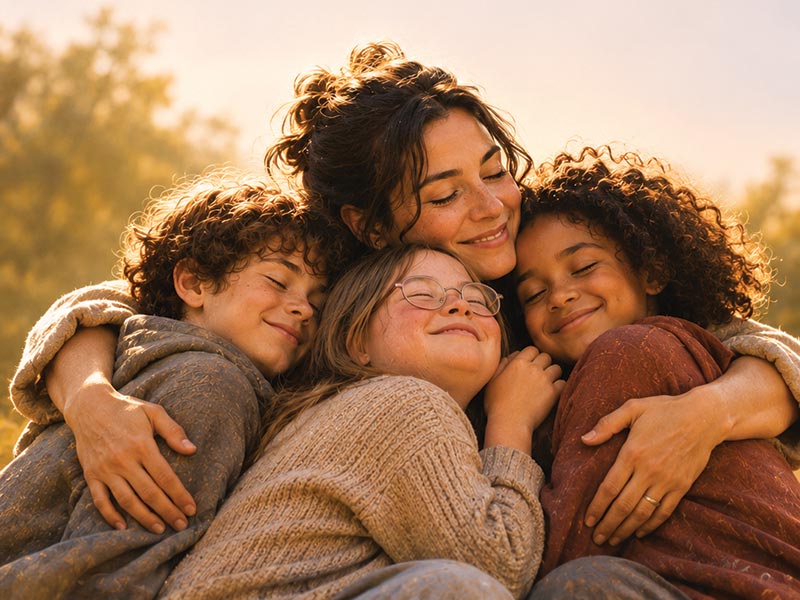
I wish our ecclesial spaces understood that better. I wish people didn’t make comments about a child being “too old” to sit on the floor. Sometimes sitting on the floor is what allows that child to be in the room. I wish we thought more about noise, quiet spaces, schedules, and sensory needs. What looks like rigidity around a routine might be what keeps a child safe and regulated enough to participate.
But I don’t only remember the times I felt judged. Some of the moments of love shown to us are etched into me just as deeply.
I remember leaving an event after one of our children had really struggled. I was overwhelmed and broken. It was pouring rain, and a friend stood beside my car, their arm around me, getting soaked while I cried.
That’s it.
They stood in the rain while I cried.
They didn’t give me advice or tell me everything would be okay. I just remember that they didn’t leave me there alone.
When we were in crisis, for weeks, a family would drop a meal at our house on a Sunday. They didn’t know what they could do to help, but they knew everyone needed to eat. Another friend dropped off coffee and flowers, with no expectation that I’d invite them in or explain anything. They just wanted me to know they cared.
Those are the things I remember.
Not someone with the perfect words or a perfect understanding of neurodivergence. Just people who loved us enough to come close.
In my darkest days, I couldn’t reach out. Half the time I didn’t even know what we needed.
We often say, “Reach out if you need anything.” I know it comes from love, and I’ve said it too. But perhaps we need to stop relying on people who are drowning to reach out, and get better at reaching in.
Drop off the meal. Send the text. Leave a coffee at the door. Send the card. Sit beside them. Notice when they disappear outside with their child.
Stand in the pouring rain.
A phrase I have tried to live by in my adult years is, “Be the person you needed.” Raising our children has given those words an entirely different meaning for me.
What I needed wasn’t someone to take away my sadness or remind me somebody else had it worse. I needed tenderness, warmth, compassion, connection, and presence. Sometimes love is simply being willing to sit with someone in their darkest moments without trying to fix them.
Some of our greatest resources have been neurodivergent people themselves. Listening to people with lived experience has helped us understand our children in ways generic parenting advice never could. Specialists and professionals who understand neurodivergence have also been invaluable. I especially love Rach Vermeulen’s writing from A Little Extra Love. Her writing about disability, parenting, and church life touches my heart because so much of it feels relatable.
But my greatest teachers have been my children.
They have taught me about capacity, behavior, and assumptions. About resilience, grace, and love. They have shown gifts of problem-solving, creativity, empathy, hyperfocus, and attention to detail. They have taught me that what something looks like from the outside doesn’t necessarily tell you what is happening underneath.
Most of all, they have taught me that belonging shouldn’t depend on our ability to fit in.
We are still learning. There are still hard days. There is still grief. I don’t want to tie everything into a neat bow and pretend we have arrived, because we haven’t.
But I am different.
The mother who received that first diagnosis with grief and anger couldn’t see the mother she would become, how much her children would teach her, or the ways God would carry us when we couldn’t carry ourselves.
She couldn’t see beyond the pit she was standing in.
And the thing about being in the pit is that the pit lies. It tells you this is all there is.
I love the thought that hope is the voice that meets you in the storm and says there is more than what you can see right now. Sometimes we need someone else to hold that hope for us until we can see it again.
Maybe that is one of the greatest gifts we can give each other as an ecclesial family.
Notice. Reach in. Make room. Love our children as the people God created them to be.
And sometimes, when there are no words and nothing we can do to fix it, just be willing to stand with them in the rain.
Jen Wallace,
Upper Gully Ecclesia, VIC
- Neurodivergent is a non-medical descriptive term that means that an individual’s development and/or functioning is different from what is culturally or societally considered the norm.