The Chapters that Changed My Life: Part 7
The next chapter in the series continues to examine Scripture’s answers to human weakness, sin, and the need for God’s transforming work.
 Read Time: 5 minutes
Our last article finished where the current article begins, with the inspiring opening words of Romans 8, “There is therefore now no condemnation for those who are in Christ Jesus.” (RSV).
Notice that all recent translations drop the words found in the KJV, “who walk not after the flesh, but after the Spirit.” This lack of qualification, if correct, means we need to ask carefully what it means to be “in Christ Jesus.” Why is there no condemnation for those who are in Christ?
Here’s a further question. Is baptism enough to qualify for being in Christ Jesus and having no condemnation? But it can’t be, for the simple reason that if baptism were alone sufficient without any faithful response, then we could sin that grace may abound. Why not sin if baptism alone has saved us? No, that can’t be right. What it means to be in Christ Jesus is a question Paul must address in Chapter 8. As so much hinges on it, we will consider it carefully.
However, for this article, we first want to consider the main point of disagreement between Christadelphians and nearly all other Christians as we come to these verses in Romans 8: it concerns the word “likeness.” To begin, let’s outline Chapter 8. Doing so is important, as we won’t be doing verse-by-verse exposition through these articles, and I do not want you to fail to grasp the big-picture flow of the chapter. So, in Chapter 8, an outline of Paul’s argument is as follows:
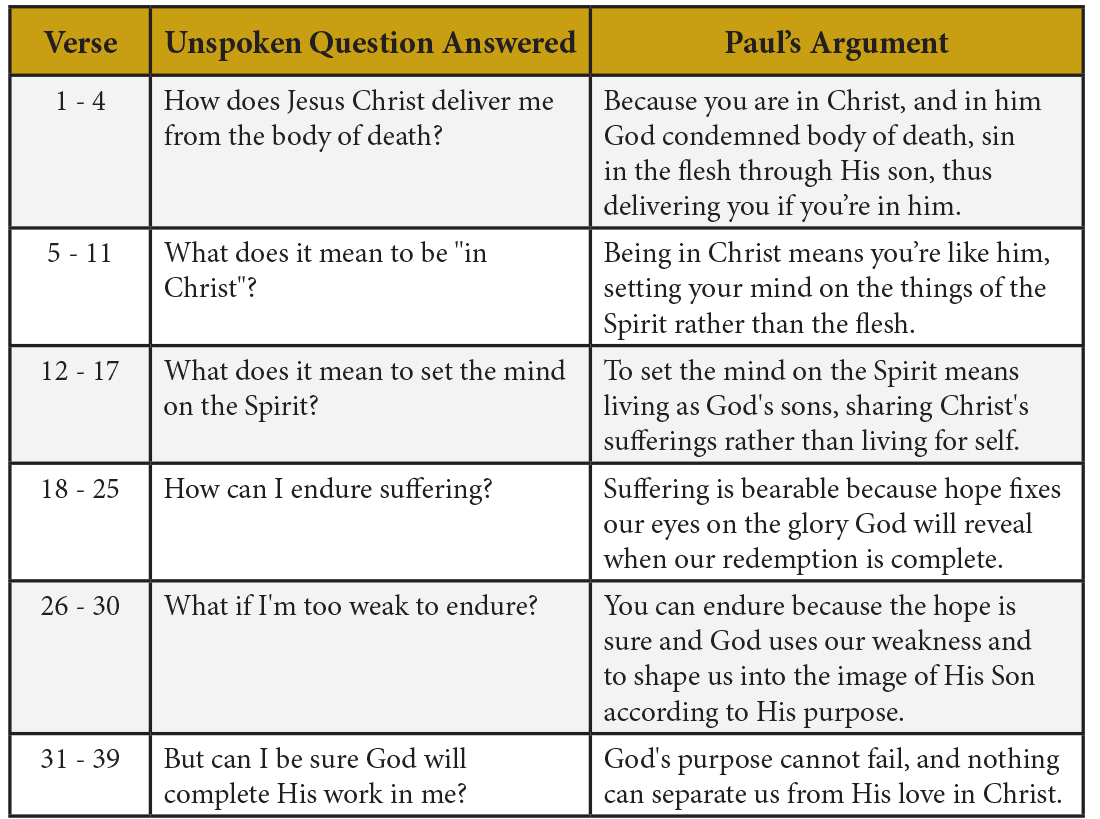
Let’s start to get into some detail. So, again, we ask the question: why is there no condemnation for those in Christ Jesus? The short answer is because God didn’t condemn Christ, so likewise he won’t condemn those “in Christ.”
But let’s look at how Paul establishes this in Romans 8:2 (KJV): “For the law of the spirit of life in Christ Jesus hath made me free from the law of sin and death.”
From this verse, we are presented with further questions: how is Paul made free, and what is he made free from? It is clear that he is not free from a desire to sin. Chapter 7 made that evident enough. Paul, as he writes, is still mortal and will die. So, what is Paul free from exactly?
The answer, as he says, is condemnation or the “law of sin and death.”
If life is found in Christ, we shouldn’t be surprised to find that the law of death or condemnation is derived from Adam. Turn to Genesis 3:17, 19, where we read about how all humanity fell into condemnation in the first place.
“Then to Adam…In the sweat of your face you shall eat bread, till you return to the ground, for out of it you were taken; for dust you are, and to dust you shall return.” (NKJV).
First, let’s state the obvious. The Law holds no solution for the condemnation contained in this passage. There’s no solution found in good works either. That was a big problem in Judaism. For all their legal rigor, rules, regulations, and traditions, they still couldn’t get around the third chapter of the Bible. But it is not just the Jews’ problem. For most of Christianity, the sentence to return to dust does not matter because they believe salvation is bodyless. Who cares if the body turns to dust as long as the soul is in heaven?
So, the Jews have no solution in the Law for the sentence in Genesis 3. Christians, with their doctrine of the immortal soul, do not need to care about it. But for Paul, this condemnation matters, and he wants freedom from it.
For Paul, the sentence of Genesis 3 collectively affects all Adam’s children, both Jews and Gentiles. Since they all share a common problem, they logically require a common answer.
Moreover, it is this condemnation that Paul personally wants to be free from: the law of sin and death, the finality of dust. “For dust you are and to dust you shall return.” (Genesis 3:19). This is the death sentence. This is the condemnation.
So, what is the solution? We are told in Romans 8:2-3,
For the law of the Spirit of life in Christ Jesus has made me free from the law of sin and death. For what the law could not do in that it was weak through the flesh, God did by sending His own Son in the likeness of sinful flesh, on account of sin: He condemned sin in the flesh. (NKJV).
The solution is profoundly simple: “He condemned sin in the flesh.”
Now pause and think for a moment: God condemned sin in the flesh. But I thought sin condemned us. How was sin condemned? Simple… sin was condemned when its source was permanently destroyed in Christ’s flesh at death, coupled with Christ being raised and made free from sinful nature’s effects and consequences!
To destroy sin in the flesh, it required that God send his Son in the likeness of sinful flesh. What is the “likeness of sinful flesh”? Most Christians think that the word “likeness” means “similar,” but not “the same.” As in, Jesus’s flesh was “similar” to sinful flesh, but he did not actually have sinful flesh. You would have to conclude this (even though it is wrong) if you believed Jesus was God, because how could Jesus, as God, have sinful flesh? If Jesus was born into sinful flesh, then he deserved to die. But if he deserved to die, he could not be a substitute. How could he die in place of sinners (the substitutionary idea) when he was under the same sentence and curse as the rest of us? Many Christians, therefore, conclude that Jesus’s flesh was only “like” ours but not the same.
This is the wrong interpretation of the word “likeness.” So, which one is right? Paul is using Old Testament language to show that Jesus’s flesh was exactly like ours by inheritance from our common father Adam.
This meaning of the word “likeness” becomes clear when we cross-reference Genesis 5:3. “When Adam had lived a hundred and thirty years, he became the father of a son in his own likeness, after his image, and named him Seth.” (RSV).
In contradiction to the common Christian point of view, Seth’s flesh wasn’t “like” Adam’s, but also somehow different from his. The flesh bore the same sinful urges and consequences for Seth as it did for Adam. Seth inherited from Adam all the consequences of the judgment in the garden. This inheritance is carried in the word ‘likeness’.
Logically, then, from Seth forward, we are all born in Adam’s likeness and image. We all inherit the nature Adam was cursed with after his sin, and it was into this likeness (the likeness of sinful flesh) that Jesus was born. That’s Paul’s point.
Why is it called “sinful flesh”? Because human nature naturally desires to sin. Not because the physical substance of our bodies literally sins, or because flesh is itself sin, but because human nature in its present condition has a tendency toward sinful desires. It is a nature that arose because of sin and that continually gives rise to sin. In this sense Paul uses sin as a figure of speech for the power of sin at work within human nature.
In Christ’s body, sinful nature has been destroyed. Thus, Paul says in Romans 8:3 (NKJV), “He condemned sin in the flesh.”
But how? We’ll need to take that up in our next article.
Ben Brinkerhoff,
Christchurch North Ecclesia, NZ
Thank you Brother Ben for this article on our sinful nature. When you think of all the times that our Lord Jesus was tempted and always answered from the word of His Father through knowing Moses words to Israel when they were going through the wilderness. He suffered so much knowing the majority of Israelites were only interested in his miracles and knowing the way he would be put to death. May we continue to read our bibles daily and become more like Jesus.