The Characteristics of Babel
Prophecy isn’t meant to stay academic. By identifying the core characteristics of “Babel,” this article shows how Scripture calls us to examine pride, trust God’s care for His people, and apply prophecy personally.
 Read Time: 7 minutes
The previous article considered Daniel 2, Daniel 7, and Revelation 13 as pictures, not of world empires, but the groups that would continue Babel’s legacy. We ended the article with a question: how does this all relate to our own lives? Learning about this history and seeing the prophecy unfold can be exciting, but sometimes it feels academic. This article will seek to answer that question, first by considering our approach to Scripture in general, then by examining Scripture’s portrayal of Babel’s characteristics.
A General Approach
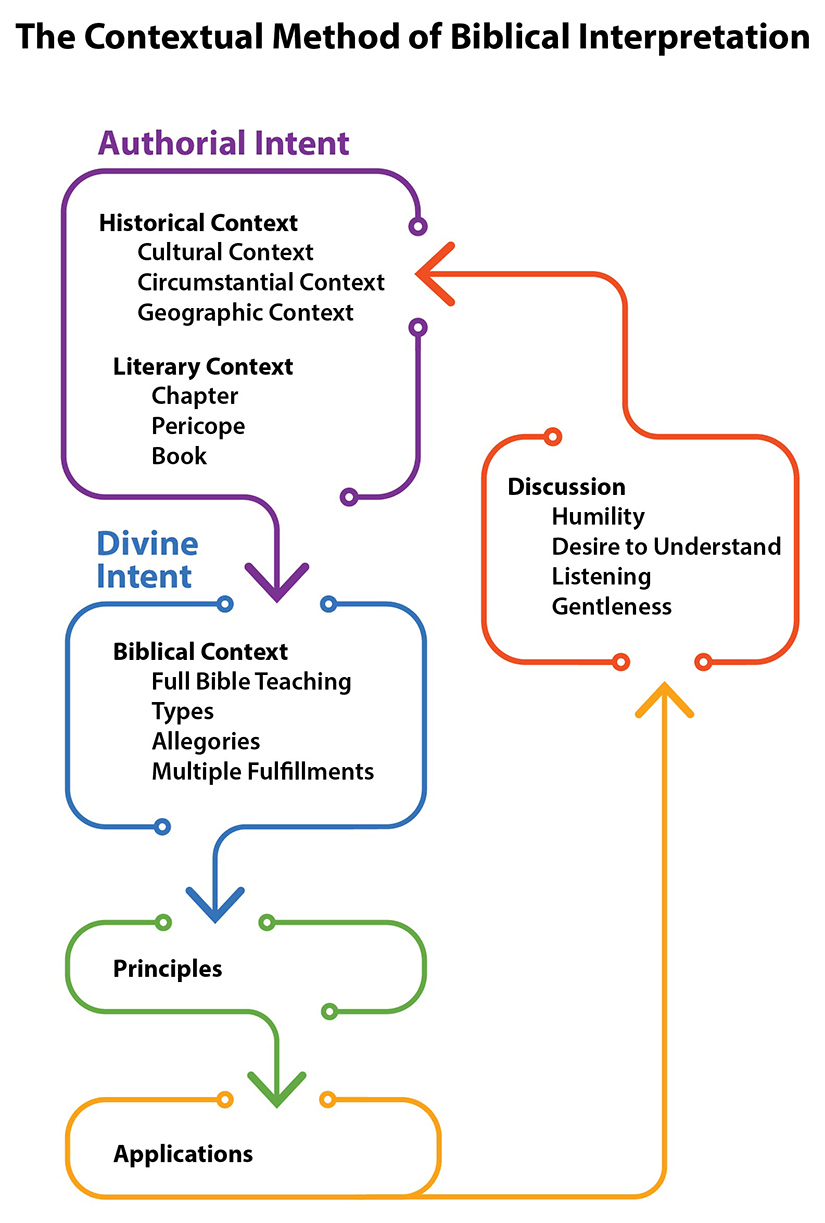 In my book The Bible in Context, I attempt to present a framework for systematically approaching the Bible (see graphic). Essentially, this approach begins with the facts, and we gather the facts by considering various aspects of the passage’s context (historical, literary, and Biblical). These allow us to understand both what the human author meant in writing, and what God, the Divine Author, meant—sometimes the Divine intent is so much greater than the human authors would have understood (1 Peter 1:10-11). After grasping the facts, we can move on to the principles. A principle is a timeless truth—it applies in all contexts and all circumstances. Thus, I can read the Bible today and grasp the same principles the apostle Paul grasped, as well as the same principles the law of Moses taught. Principles are purposefully broad, including: trust in God, God is present, love your neighbor, and serve one another. From principles, we move on to applications, which are specific to each person and their individual context. My application of trusting God will look different than yours, because there may be some things where I really struggle to trust, whereas you may find those things fairly simple. Or, different historical circumstances may create different opportunities for applying a principle. Think about life in ancient Israel. How would loving your neighbor look different there than it does today? Today, I try to love my neighbor by discussing the Bible with my coworkers at university, so that they may come to know the gospel. However, in ancient Israel, everyone already believed in the gospel, so showing love would have looked different—one Israelite preaching to another would have seemed rather odd.
We are bound together as a community by our shared understanding and love for principles, rather than their applications. Sometimes applications may look the same, but simply being a global community means that all of us will have different circumstances in which to apply these shared principles.
Why are we discussing all of these things in relation to Babel and prophecy? Because, unless we establish the distinction between principles and applications, the meaning of prophecy for us today can confuse us. Prophecy teaches us principles. It doesn’t teach us applications. We have to develop those applications on our own, and then, as the graphic above illustrates, we discuss our interpretations and their applications with each other. Then the process begins again. Therefore, this article will unearth principles, but the applications are for us to determine individually—and I hope that as you think about those applications, you’ll share them with the rest of the community via letters to the editor.
Scripture’s Portrayal of Babel
As noted in the previous article, Scripture refers to both Babel and Babylon as Babel. From Genesis through Malachi, God wants us to see one rebellion and one group. This singularity is the kingdom of men. But, if Daniel 2 and 7 both present that kingdom, why did God specifically choose these five empires to be part of “Babel”? Surely other empires were not necessarily more moral than these five, nor did they stave off rebellion against God while these five encouraged it. What is it that really held these five empires, Babylon, Persia, Greece, Rome, and the Catholic Church, together as Babel?
Consider how Scripture often presents Babel:
- Then they said, “Come, let us build ourselves a city and a tower with its top in the heavens, and let us make a name for ourselves, lest we be dispersed over the face of the whole earth.” (Genesis 11:4).1
- It is you, O king, who have grown and become strong. Your greatness has grown and reaches to heaven, and your dominion to the ends of the earth. (Daniel 4:22).
- You said in your heart, “I will ascend to heaven; above the stars of God I will set my throne on high; I will sit on the mount of assembly in the far reaches of the north; I will ascend above the heights of the clouds; I will make myself like the Most High.” (Isaiah 14:13-14).
The first of the above passages presents the words of the builders of the Tower of Babel—they sought to reach heaven, and in this way, show their strength. The second quote speaks of Nebuchadnezzar and his dream of the tree, in which Nebuchadnezzar grew and reached heaven. He fulfilled what the builders of the tower had not been able to do. Finally, the third shows what went on in the king of Babylon’s mind: he sought to make himself like God. Thus, the building of the tower and the growth of Nebuchadnezzar’s empire was not just to show strength, but it was to become like God, hence God’s destruction of the tower, and the cutting down of Nebuchadnezzar’s tree after Nebuchadnezzar boasted of his empire’s greatness (Daniel 4:30). Scripture marks Babel as an empire filled with pride and a desire to be like God.

But there’s more to Babel than just pride—because all worldly empires overflow with narcissism:
Sit in silence, and go into darkness, O daughter of the Chaldeans; for you shall no more be called the mistress of kingdoms. I was angry with my people; I profaned my heritage; I gave them into your hand; you showed them no mercy; on the aged you made your yoke exceedingly heavy. (Isaiah 47:5-6).
Israel is a hunted sheep driven away by lions. First the king of Assyria devoured him, and now at last Nebuchadnezzar king of Babylon has gnawed his bones. Therefore, thus says the LORD of hosts, the God of Israel: Behold, I am bringing punishment on the king of Babylon and his land, as I punished the king of Assyria. (Jeremiah 50:17-18).
I will repay Babylon and all the inhabitants of Chaldea before your very eyes for all the evil that they have done in Zion, declares the LORD. (Jeremiah 51:24).
In each of these passages, God explains His wrath toward Babylon, as they had destroyed His people. Whereas many nations swell with pride and seek to be like God (cp. Ezekiel 28:2), this attitude toward God’s people is somewhat unique. Thus, perhaps God chose these specific groups as the five empires of Babel because not only did they show exceptional pride, but in their pride, they sought to destroy God’s people. In fact, both of these characteristics appear in the prophecies that detail these five phases. In Daniel 7, the little horn, or fifth phase, speaks “words against the Most High” and wears “out the saints of the Most High.” (Daniel 7:25). In other words, it attempts to be like God, and it fights against God’s people. Revelation 13 presents the same picture; as noted previously, Revelation 13 shows the fifth phase as well. Just like the little horn, the beast of the sea spoke “haughty and blasphemous words,” uttering “blasphemies against God, blaspheming his name and his dwelling, that is, those who dwell in heaven.” (Revelation 13:6). In the very next verse, John wrote that the beast made “war on the saints and [conquered them].” (v. 7).
Why did God choose these empires as the five empires of Babel? These nations sought to replace God with themselves and attempted to destroy God’s people.
Conclusion
So, what does all of this mean for our lives? First, Scripture teaches us principles; therefore, we won’t see specific directions on what choices we should make today or tomorrow. We must determine those applications based on the principles. Second, understanding the main characteristics of Babel enables us to recognize the overarching behaviors that define a group as part of that rebellion against God, and thus, helps us understand how we, too, should live. God hates pride—that’s a principle. Therefore, we should ask ourselves how we show pride in our own lives. Have we tried to replace God in our thinking? Do we recognize and acknowledge what God does and what He provides?
On a more positive note, the second characteristic of Babel teaches a powerfully encouraging principle: God cares about what happens to His people! When we struggle or when we feel beaten down by wave after wave of frustrations, we sometimes (oftentimes?) want to blame God. Nevertheless, the principle here, that God cares about what happens to His people, reminds us that these struggles exist because sin exists. God isn’t trying to crush us. He cares about us and uses these circumstances to teach us and shape us.
While this article established Babel’s characteristics, it didn’t prove that these five empires actually embodied those two characteristics—that historical consideration, if it held, would certainly bolster this interpretation of Daniel 2, 7, and Revelation 13. Thus, in the next article, we’ll see how history supports this conclusion: these five empires sought to replace God and fought against His people.
Ultimately, Scripture must change our lives. In considering Babel, we’ve seen principles. We’ve seen God’s feelings about pride, and we’ve seen God’s love for His people. But our consideration cannot stop there. This juncture is where Bible study becomes personal. Now that we’ve discussed the principles, our job as individuals is to examine how these principles apply. How is it that I may give in to pride? How do you? How can that be remedied? How do we show that we know God cares for us? How do we show that we know God cares about other believers? As we close this article, our examination of prophecy cannot be academic—it must move us to be different people. Armed with our principles, let us apply them.
Jason Hensley
1 All quotations, unless otherwise noted, are from the English Standard Version
RULES FOR STUDYING THE SCRIPTURES
First. In any doctrine taught by types or shadows, the anti-type must always correspond with the type, and the shadow with the substance.
Second. In studying the Scriptures, consider that the New Testament is a commentary on the Old.
Third. Never be afraid of results to which you may be driven by your investigations, as this will inevitably bias your mind and disqualify you to arrive at ultimate truth.
Fourth. Investigate everything you believe: if it is the truth, it cannot be injured thereby; if error, the sooner it is corrected the better.
Fifth. Pursue this course with as much independence as if you were the only one concerned.
Sixth. Rely on no authority less than divine in so momentous an undertaking.
PROVE ALL THINGS: HOLD FAST THAT WHICH IS GOOD.
John Thomas, Herald of the Kingdom and Age to Come, 1859.