The Great Isaiah Argument
The discovery of the Great Isaiah Scroll reinforces Isaiah’s claim that fulfilled prophecy as well as Israel’s survival, point to a divine hand at work.
 Read Time: 5 minutes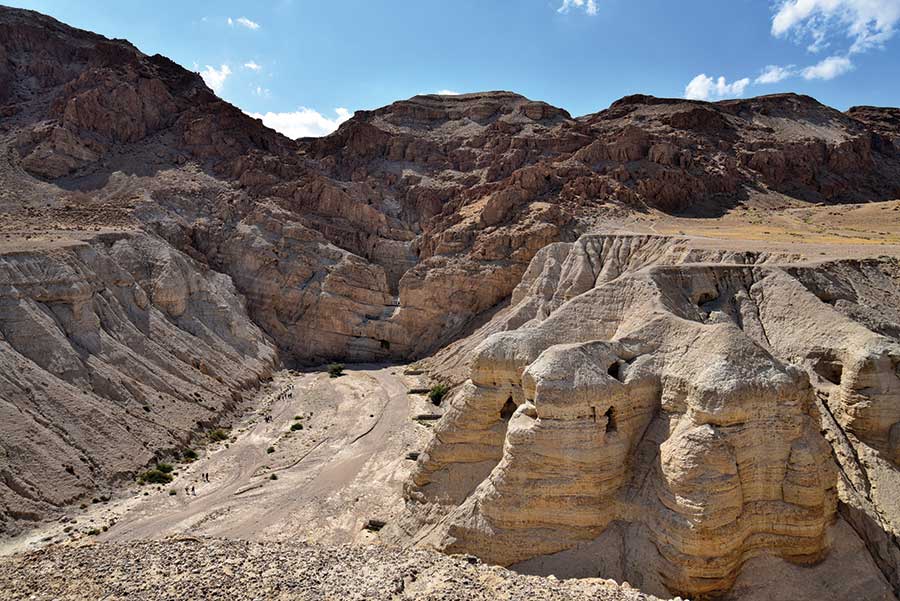
Leaving Ein Bokek, we traveled north on Highway 90 along the Dead Sea. Our destination? The Qumran National Park. As we wound our way up to the welcome center, the view was amazing! The blue waters of the Dead Sea contrasted with the reddish-brown cliffs of Jordan, which stretched on for miles.
We toured the remains of a town—a community that was active during the time of Jesus. As we stood among the ancient ruins looking west toward the mountains of Israel, we could see caves tucked away in the rocky landscape. It was here that Bedouin shepherds discovered pots filled with ancient scrolls. Although most of these scrolls had decayed over time, leaving only fragments of readable scraps, the scroll of Isaiah was found almost completely intact. This scroll is known today as the “Great Isaiah Scroll.”
One of the reasons this is a remarkable find is that Isaiah puts forth an argument—a contest to prove the existence of his God. It contains three elements: the challenge, the proof of a prophet, and evidence for future generations. It is known as the Great Isaiah Argument, found in chapters 40-48.
The Challenge
Isaiah starts with a challenge to Israel and the surrounding nations: “To whom then will ye liken God? or what likeness will ye compare unto him?” (40:18); “To whom then will ye liken me, or shall I be equal? saith the Holy One.” (40:25; see also Isaiah 43:10; 44:6; 45:5-6; 46:5-6). In these verses, Isaiah claims that Yahweh, his God, has no equal among the gods of the nations.
The criteria for this claim are found in 42:9: “Behold, the former things are come to pass, and new things do I declare: before they spring forth I tell you of them.” (See also Isaiah 41:21-23; 43:10-12; 44:8; 46:9-10; 48:3-8, 16). Isaiah bases his challenge on the ability to foretell future events. He argues that only the true God has this power, which distinguishes Him from all other gods.
The Proof of a Prophet
Among the Israelites, those who foretold future events were called seers or prophets. As the mouthpieces of Yahweh, they revealed events that God had made known to them. In the Law, the Jews were given a way to test these prophets to determine their authenticity:
When a prophet speaketh in the name of the LORD, if the thing follow not, nor come to pass, that is the thing which the LORD hath not spoken, but the prophet hath spoken it presumptuously: thou shalt not be afraid of him. (Deuteronomy 18:22).
Simple and effective, the test of a prophet is the fulfillment of their prophecy.
Speaking on God’s behalf, Isaiah reveals several future events. First, he informs King Hezekiah that Babylon will eventually conquer Jerusalem (Isaiah 39:6-7). A tragedy that occurred around 600 BC. Secondly, Isaiah offers hope by looking beyond the captivity.
In Isaiah 46:9-11, He reiterates the divine claim: “I am God, and there is none like me, declaring the end from the beginning.” To prove this, he speaks of “Calling a ravenous bird from the east, the man that executeth my counsel from a far country.” This “ravenous bird” is symbolic language for a specific individual whom God purposed to fulfill His will.
Who is this man? He is identified by name in Isaiah 45:1 as Cyrus, the king of Persia. God calls him by name long before his birth, prophesying that Cyrus would overtake Babylon peacefully through its river gates and decree that the Jews return to Jerusalem to rebuild the temple (44:26-45:4).
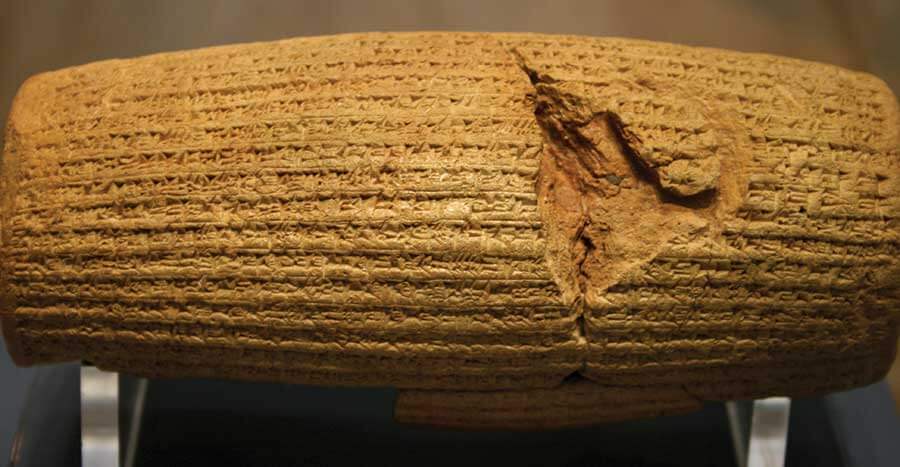
Remarkably, the Cyrus Cylinder confirms these prophecies. Discovered in 1879 and dating to approximately 538 BC, this clay artifact describes the Persian conquest of Babylon. On it, Cyrus recorded that they “enter his city Babylon without fighting,” his “vast army marched into Babylon in peace,” and that he “gathered all their inhabitants and returned to them their dwellings.”1
Isaiah prophesied these events around 700 BC, roughly 150 years before they occurred. Based on this miraculous fulfillment, the Jewish people accepted his writings into their Holy Scriptures as the words of a true prophet of the LORD. Historically speaking, had these words been written after the events took place, Isaiah would have been exposed as a fraud and rejected according to the very “test of a prophet” established in the Mosaic Law, which requires fulfillment of the prophecy to be vindicated.
Photograph by Mike Peel (www.mikepeel.net)The Evidence for Us Today
Lastly, Isaiah provides evidence for us to consider today. Chapter 43 is portrayed as a dramatic courtroom scene. Isaiah, acting as a legal representative for the Divine, stands to address the judge, the jury, and the assembled nations.
In his opening statement, he delivers the challenge (v. 9): “Who among them can declare this, and shew us former things?” In other words, who else can accurately declare events before they happen? Turning to the opposition, he demands that they produce their own evidence: “Let them bring forth their witnesses… or let them hear, and say, It is truth.” Finally, Isaiah turns back to the court. Pointing toward the nation of Israel, he declares the word of the Lord: “Ye are my witnesses, saith the Lord, and my servant whom I have chosen.” (43:10). The Jewish people are presented as God’s witnesses—the living evidence of His existence.
In verse 12, Isaiah points to history: “I have declared, and have saved, and I have shewed, when there was no strange god among you.” One only needs to look at their history to see the miracles performed on their behalf: the deliverance from slavery, the ten plagues, the crossing of the Red Sea, and the journey through the wilderness into the Promised Land.
For us today, the argument points to the modern nation of Israel. Verses 5 and 6 describe a global regathering:
I will bring thy seed from the east, and gather thee from the west; I will say to the north, give up; and to the south, keep not back: bring my sons from far, and my daughters from the ends of the earth.
This language describes a people returning from the ends of the earth. Though driven from their soil by Rome in AD 70, the Jewish people endured as wanderers for nearly 2,000 years, scattered throughout the world. Against all historical odds, they have returned to their land, bringing Isaiah’s prophecy to life. No other nation has survived such a vast dispersion only to reclaim its heritage. No other people have stood at the gravesites of so many invincible empires—from Babylon, Greece, Rome, Ottomans to Nazi Germany. While the world debates the region’s geopolitics, students of Scripture recognize a divine hand at work in Israel’s rebirth.
The Conclusion—the Living Witness
The Great Isaiah Argument is more than an ancient text; it is a challenge based on the visible movement of history. Isaiah’s core claim is that Yahweh’s existence is proven by His ability to declare the end from the beginning.
Today, the primary evidence for this claim is the nation of Israel. The fact that the Great Isaiah Scroll was preserved for millennia and discovered in 1947— just as the modern state was being born—adds a layer of timing that is hard to ignore. If a prophet could accurately foretell the 2,000-year survival of a scattered people and their eventual return, his words would carry unique credibility.
Watching Israel today isn’t just a study of politics; according to Isaiah, it is watching the witness on the stand, proving the existence of a divine plan. This plan doesn’t end with a return to the land but points toward a future of ultimate peace:
And it shall come to pass in the last days, that the mountain of the LORD’s house shall be established in the top of the mountains… and all nations shall flow unto it… and they shall beat their swords into plowshares, and their spears into pruninghooks. (Isaiah 2:1-4)
Kevin Leadbetter,
Richmond-Petersburg Ecclesia, VA
- “Cyrus Cylinder Translation,” Livius.org.