What’s In a Name?
Saul, David, Solomon, Uzziah, Hezekiah: what if their names were part of the message? The meanings behind the kings’ names reveal a deeper spiritual pattern.
 Read Time: 7 minutes
Scripture gives many details about the reigns of the kings of Israel and Judah. One detail, however, that many readers miss about these kings is the meaning of their names. The names of the kings of Israel and Judah provide instruction in addition to their assessment given by the Spirit. This article will thus consider what we can learn about these kings by examining their names, first the kings of the unified kingdom and then those of the divided kingdom.
Saul and David
The books of First and Second Chronicles provide an important assessment of the kings of Judah, in which we find the Hebrew word darosh, “resort to, seek.”1 This word is used in reference to Saul: “And inquired not of the LORD: therefore he slew him, and turned the kingdom unto David the son of Jesse.” (1 Chronicles 10:14). Take note of this word and what Chronicles is saying: Saul did not seek God.
To some, this assessment in Chronicles might present a contradiction with the record of Samuel: “And when Saul inquired of the LORD, the LORD answered him not, neither by dreams, nor by Urim, nor by prophets.” (1 Samuel 28:6). How could one book say that Saul did not inquire, while another says that he did? The answer is found in the Hebrew word. Instead of using darosh, 1 Samuel uses the Hebrew word shaal, “ask, inquire.”2 Therefore, Saul would ask God but would never seek Him.
We can add to this. Not only does the record say that Saul asked God but didn’t seek him, the word for “ask” in 1 Samuel 28:6 shares the same root with King Saul’s name— שָׁאוּל (Shaul), “asked for,” meaning “the one who has been begged for, the one who has been pleaded for.”3
If you remember Saul’s history, you’ll recognize just how much this name fits Saul’s life story. Samuel, when recounting Israel’s request for a king, said the following:
Is it not wheat harvest to day? I will call unto the LORD, and he shall send thunder and rain; that ye may perceive and see that your wickedness is great, which ye have done in the sight of the LORD, in asking you a king. (1 Samuel 12:17).
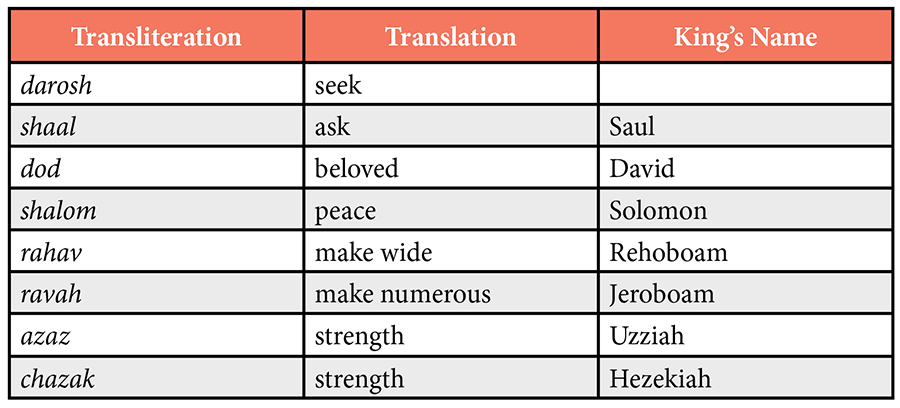 Here, the word “asking” is derived from the Hebrew word shaal, which again serves as the basis for Saul’s name. Therefore, the Hebrew highlights that King Saul was the king the people wanted in place of God. There is considerable Scriptural instruction on what we should ask God for, rather than what we seek. The people asked, but they asked amiss.
But isn’t that the crux of the human problem? We ask, and yet what we ask for isn’t what we really need. This problem even affected a godly man like Samuel. When God rejected Saul and sent Samuel to anoint “a man after mine own heart,” we see that Samuel believed the eldest, Eliab, was the chosen one. Nevertheless, God admonished Samuel, saying He refused Eliab, “for the LORD seeth not as man seeth; for man looketh on the outward appearance, but the LORD looketh on the heart.” (1 Samuel 16:7).
Here, even one of the most godly men, Samuel, had impaired judgment when deciding the things of the human heart. This quality shows us that our judgment can be highly deficient, and we should be careful not to rest on it. We often do not know how to ask as we ought.
Thus, the people asked for a king, and they received Saul, the king whose name means “ask,” and who repeatedly asked God for things but never actually sought Him. Saul’s name encapsulated his primary problem.
We can see this illustrated further when we go back to Chronicles. Just before the verse that declared Saul didn’t inquire of God, Chronicles stated that he “ask[ed] counsel of one that had a familiar spirit, to enquire of it.” (1 Chronicles 10:13). Here the word is again the Hebrew word דָּרַשׁ (darosh), so we see Saul seeking the spirits of the dead but not God.
David’s name contrasts with Saul’s. His name is Daveed in Hebrew, derived from the word dod, which means “beloved.”4 The people asked for Saul, whereas God selected David because He loved him. One who was loved by God surely must seek Him. Thus, unlike Saul who did not seek God, David then counseled his people to darosh after God in the Psalm that he delivered to Asaph at the dedication of the tent for the ark: “Seek the LORD and his strength, seek his face continually.” (1 Chronicles 16:11). The first “seek” here is the word darosh, while the second “seek” is a different Hebrew word, but with a parallel meaning.
Yet David did not just encourage this seeking once. He instructed his son, Solomon, to seek after God: “If thou seek him, he will be found of thee.” (1 Chronicles 28:9). Once again, David used the word darosh.
These little connections between the kings and their names are like a puzzle hidden in the Hebrew. And Scripture doesn’t just have these name-related messages in reference to Saul and David, it has them throughout its pages.
Solomon, Rehoboam, and Jeroboam
Consider Solomon’s name. God also elected Solomon to build the house in which He would place his name:
Behold, a son shall be born to thee, who shall be a man of rest; and I will give him rest from all his enemies round about: for his name shall be Solomon, and I will give peace and quietness unto Israel in his days. (1 Chronicles 22:9).
The Hebrew word for Solomon is Sholmo, which is a derivation from shalom, signifying peace. This is the exact word for “peace” used above when God says, “I will give peace and quietness unto Israel in his days.” So, we see these names are really significant; they aren’t just what people are called.
After Solomon, we have his son, Rehoboam, and his servant, Jeroboam. Their names sound similar because the meanings are related. The Hebrew word for Rehoboam is Rachavam, comprised of two words rahav, which means to “make wide” and am, which means “people.”5 Therefore, Rehoboam signifies “one who makes the people wide.”
Meanwhile, the Hebrew word for Jeroboam is Yaravam, which also combines two words: ravah, which means to “make numerous” and again am, which means “people.”6 Therefore, Jeroboam signifies “one who makes the people numerous.” In other words, their names mean almost the same thing.

From the record, both of these kings acted as if they wanted to fulfill the meanings of their names. Jeroboam was a people pleaser, not someone who focused on pleasing God. He wanted a kingdom filled with numerous subjects. Rehoboam was the same way. He was more concerned about the people than seeking God. “And he did evil, because he prepared not his heart to seek the LORD.” (2 Chronicles 12:14). And once again, he fell into the same trap as Saul. The word “seek” here is דָּרַשׁ (darosh); thus, he sought to enlarge the people, but didn’t seek God.
Uzziah and Hezekiah
Another significant name is Uzziah, whose Hebrew name is Uzziayahu. This word is made up of the word azaz, signifying “strength” or “might,”7 and God’s memorial name, Yah—thus meaning “Yah is might” or “Strength of Yah.” In accordance with that name, he indeed made God his strength: “And he sought God in the days of Zechariah, who had understanding in the visions of God: and as long as he sought the LORD, God made him to prosper.” (2 Chronicles 26:5). Did you see the word darosh there? He “sought God,” and “as long as he sought the LORD, God made him to prosper.” When he learned not just to ask of God, but to seek God, he prospered. He was indeed strong.
Yet as he prospered, he forgot who really was his strength: “But when he was strong, his heart was lifted up to his destruction.” (2 Chronicles 26:16). The word here for “strong” isn’t the same word as in Uzziah’s name. Instead, it’s derived from the Hebrew word chazak, which also means “strength.”8 He had forgotten God was his strength, and we sadly often do too.
Though Uzziah at one point forgot God was his strength, that same name somehow made its way into his grandson’s name. King Hezekiah’s name combines chazak with God’s name. It’s as though Uzziah, the strength of God, is being given another chance.
Nevertheless, there’s a type of poetic ending here with this name. Though Uzziah at one point forgot God was his strength chazak, that same name somehow made its way into his grandson’s name. King Hezekiah’s name, Chazakiyahu, combines chazak with God’s name. It’s as though Uzziah, the strength of God, is being given another chance. Both names signify “strength of God.” Just like Uzziah, Hezekiah sought God: “And in every work that he began in the service of the house of God, and in the law, and in the commandments, to seek his God, he did it with all his heart, and prospered.” (2 Chronicles 31:21). Yet unlike Uzziah, Hezekiah continued to seek God and made God his strength.
Conclusion
From the examples listed here of the kings of Israel and Judah, we can see there’s more to their names than just a series of letters. These names often reflect the divine assessment of their lives, whether or not they sought after God. The names characterize how Scripture describes them, showing that reading the Hebrew allows us to go even deeper than the English translation to see how only a Divine mind can weave together texts. Furthermore, it serves as a reminder: sometimes a king lived up to his name, and sometimes he didn’t. What made all the difference was his decision to seek God or merely ask. Thus, we too must make that choice. We will be those who seek.
Peter Trotter,
Dallas-Fort Worth Ecclesia, TX
- Richard Whitaker, Francis Brown, Samuel Driver, and Charles Briggs, Abridged Brown Driver Briggs Hebrew English Lexicon (New York: Houghton Mifflin, 1906).
- Ibid.
- Ludwig Koehler, Walter Baumgartner, M. Richardson, and J. Stamm, The Hebrew and Aramaic Lexicon of the Old Testament (Leiden, NL: E. J. Brill, 2000).
- William Holladay, Concise Hebrew and Aramaic Lexicon of the Old Testament (Leiden, NL: E. J. Brill, 2000).
- Ibid.
- Ibid.
- Ibid.
- Ibid.