A Magi’s Story
A first-person narrative told through the eyes of a wise man of Sheba
 Read Time: 6 minutes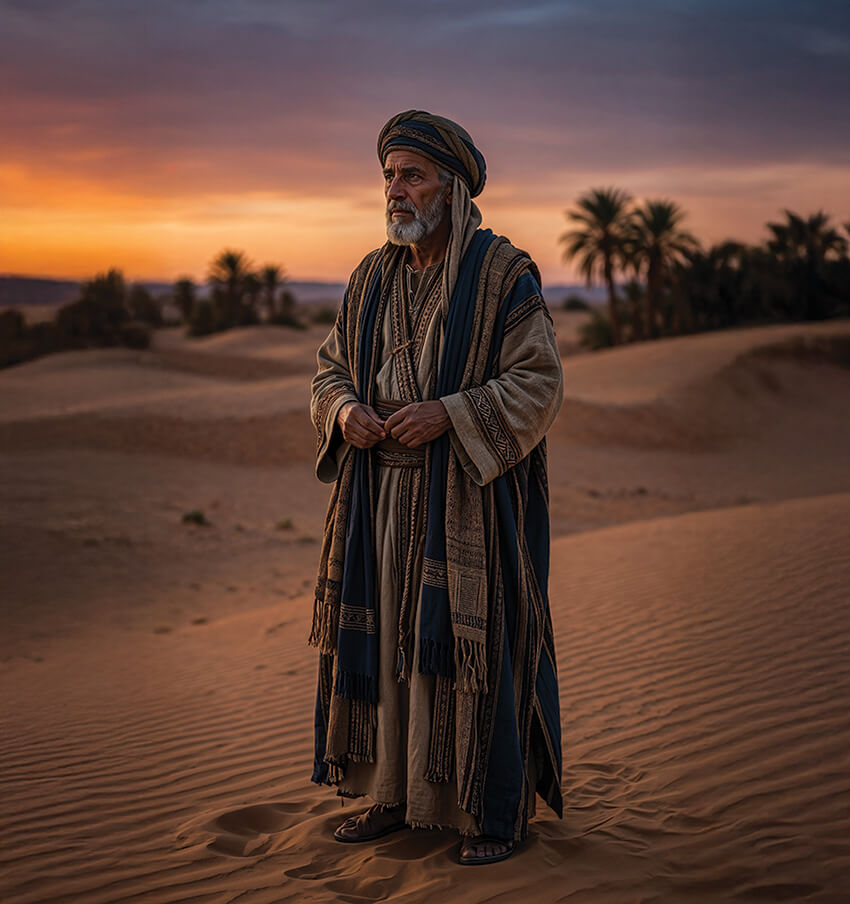
My name is Abdalmalek, which means “servant of the king,” and that is what I am. In fact, I’m the chief servant of Abdalah, the king of Sheba, a position that puts me in charge of all the other servants. I was among a 100 young men who showed great promise and were selected as administrators of the king’s dominions. I excelled in all our studies, in geography, history, languages, literature, medicine, business, and mathematics—above all the other candidates. After a few years, I became second in command to the king. I am also the leader of the “Magi,” the class of educated, or wise, men who rule the kingdom with the approval of King Abdalah.
I am not saying this to boast—that would be inappropriate for one who worships the God of Israel—but simply to explain.
Sheba is a region in the southwestern corner of the great Arabian Peninsula. Our people are called Sabeans, that is, people of Sheba. The region we live in is mostly desert, and it produces very little food. The oases, with their springs and wells, are few and far between. We Sabeans must live by trade with other peoples, and as a matter of fact, we do quite well in our business ventures.
We prosper because we are in the right place to be traders. We have guides who are familiar with all the oases along the trade routes. They know the people who live near them, and who can lead us safely through some of the most desolate places on earth. Our cities are located near the Great South Sea, where we have ships that can sail across it, visiting the coast of Africa and even sailing as far as India to the east. We also maintain ports on various islands in the sea, which helps our traders.
We can make a very good profit in buying and selling foodstuffs, incense, exotic fabrics, ivory, and strange and marvelous animals such as monkeys and peacocks.
Many, many years ago, our queen, Makeba, with her court, traveled to Jerusalem to visit Solomon, king of Israel, far to the north. The Israelite king had acquired a well-earned reputation for great wisdom, which he attributed to his god, whom he called the one true God. From their discussions together, our queen learned much of the history of Solomon’s people, and how their special God, Yahweh, or Yehovah, had protected and saved them over the centuries.
From Solomon, Makeba acquired copies of the Holy Writings, some of which were written by the king himself. She brought these precious manuscripts back to Sheba, where her scribes carefully copied them—so that her wise men could read and study the history, teachings, and commandments of the God of Israel. Fortunately, our language was very similar to Hebrew, the language of Israel, so that her subjects had little trouble understanding the Scriptures. From this study, many of our best scholars forsook the idolatry so prevalent around them and became believers in Judaism and the one true God.
This faith grew in Sheba and, to this very day, nearly all Sabeans are believers. Nevertheless, we do not persecute or penalize others who live among us and worship other gods. Every person must choose their religion. We have also found that tolerance in religious matters is good for business. It helps us when we trade with others, and also makes it easier for us to explain our faith to those who do not believe as we do.
I might add that we Sabeans have very close ties with Israel, and also with the people of Cush, or Ethiopia, on the nearby coast of Africa, because many of them are also believers in Yahweh. Much of our trade is conducted with them.
In my position, I oversee most of the other government servants, especially those who travel and trade. I am responsible for reviewing the account books and inventories of all goods bought and sold in India, Africa, or the Mediterranean. I am so thankful that those who work for the king and me are, almost always, honest and trustworthy. I attribute much of that to our religion, which discourages lying, coveting and stealing, and encourages honorable labor, hospitality, and caring for others, especially strangers.
My associates who lead the trading journeys on sea or land bring me more than financial reports. They also bring me reports on political affairs involving our trading partners. It is good to know as much as we can about those with whom we do business. A war or rebellion in any of these areas may mean we must stop trading there until we are assured it is safe and profitable to visit again. This situation brings me to the most important part of my story.
A Dream and a Message in the Night
As I already explained, one of our most important trading partners is Israel, and the Jews (as the people of Israel are called) believe in the same God whom we worship. However, in recent times, they have been greatly troubled by Roman soldiers, who have ruled the Jews and have decided who should be the king. Their most recent king, called Herod the Great, is a cruel, ruthless man, who on a whim might kill one of his wives or one of his children, or anyone else in his domain.
During the years that I have been the chief servant of King Abdalah and second in the kingdom, I have occasionally accompanied trading caravans to see for myself how things are in other nations. Reports from trusted employees can be very helpful, but nothing is as good as firsthand knowledge. Recently, I decided to go along on the next trip to Israel.
As it turned out, another trip to Israel was not scheduled for at least a year, but I kept the idea in mind anyway. Maybe these subconscious thoughts about Israel and its wicked king affected my dreams during that interval. Or maybe, just maybe, one of the LORD God’s angels came to me as I slept. It is hard to say which of these is true; only the LORD knows.
One night, I dreamed of a great pillar of fire, so bright it could be seen for miles. Even as I slept, I knew what this was. The Jewish Scriptures had told of Almighty God making Himself known to the children of Israel in a great pillar of cloud and fire—cloud by day and fire by night. His guiding light led them out of slavery in Egypt and then on to their Promised Land.
The dream was so vivid that I saw myself riding through the desert on a camel, bound for the land of Israel, leading a long procession of camels laden with all sorts of goods.
I awoke in a state that I can scarcely explain. I was feeling a mix of excitement and fear. Was this upcoming expedition to Israel a good thing, a bad thing, or both? I had no idea—but certainly I could not have guessed what was about to unfold.
George Booker,
Austin Leander Ecclesia, TX
NOTES
Introduction: Yemen is a nation at the southern end of the Arabian Peninsula. Saudi Arabia borders it to the north, the Red Sea to the west, and the Indian Ocean to the south and east. In ancient times, Yemen was known as Sheba, the home of the Sabeans, a trading state that included parts of Ethiopia and Eritrea in Africa. Over its long history, the nation has had close ties with Judaism, and later with Christianity. Sheba is mentioned several times in the Old Testament, also as a trading nation, with some considerable wealth.
While popular opinion favors Babylon or Persia as the home of the “Magi,” or wise men, who came to bring gifts to Jesus, the eminent Jewish and Christian scholar Alfred Edersheim (1825-1889) offers significant proof for the Magi’s origin in Arabia. Specifically, he refers to the southern part of Arabia, where trading nations such as Sheba (Yemen) grew wealthy by trade with Africa, India, and other parts of the Middle East (Job 6:19; Ezekiel 27:22-23). The Life and Times of Jesus the Messiah (New York: Longmans, Green, and Co., 1915), chapter 8.
In Old Testament times, a queen of Sheba visited King Solomon in Jerusalem (1 Kings 10; 2 Chronicles 9; Matthew 12:42; Luke 11:31). It is generally assumed that this marked the beginning of Sheba’s connection with Judaism.
A Dream and a Message in the Night: Was the “star” (Greek: aster) simply a literal star, comet or constellation in the heavens? Or was it a very bright phenomenon created by God Himself as a sign? I favor this second possibility because the behavior of the “star” mirrored the actions of the great pillar of fire and cloud in the wilderness, which led the people of Israel out of Egypt and to the Promised Land. Literal stars appear to move through the heavens, but they certainly do not change directions, or actually stop over single houses, or disappear for relatively brief periods of time.
However, the glory of God’s presence did in fact lead the Israelites through the Sinai on their way to the Promised Land, and the same wondrous sign from God may have led the wise men to their destination. Harry Whittaker, Studies in the Gospels (Staffordshire, UK: Biblia, 1989), chapter. 11.
“Anatole,” sometimes translated “east,” may also signify the “rising” or appearing of any bright light (Revelation 16:12; Malachi 4:2). Thus “We have seen his star in the east [anatole]” (Matthew 2:1) could reasonably be translated: “We have seen his great light when it rose or appeared,” with no reference to a particular direction.