This article is part of the series: Building Relationships God’s Way
Building Relationships God’s Way: Part 3
Courtship, engagement, and marriage are considered through the pattern of Scripture, where lasting harmony grows from a relationship centered on Christ.
 Read Time: 11 minutes
Some of Scripture’s most beautiful poetry celebrates the love of a man and a woman. The Song of Solomon captures the tender joy of courtship in language that still moves us. God designed the male-female relationship to be one of life’s greatest blessings: a rich experience of companionship, love, and completion.
Our first article showed how our relationship with God is the foundation for every other relationship. Marriage, of all human relationships, most fully reflects that divine pattern. When Paul explained the bond between Christ and the ecclesia, he reached for marriage as the closest earthly picture: “This is a great mystery, but I speak concerning Christ and the church.” (Ephesians 5:32).
If marriage mirrors such high spiritual realities, the road toward it—courtship and engagement—deserves our most careful attention. Getting it right matters for our happiness now and our eternal good.
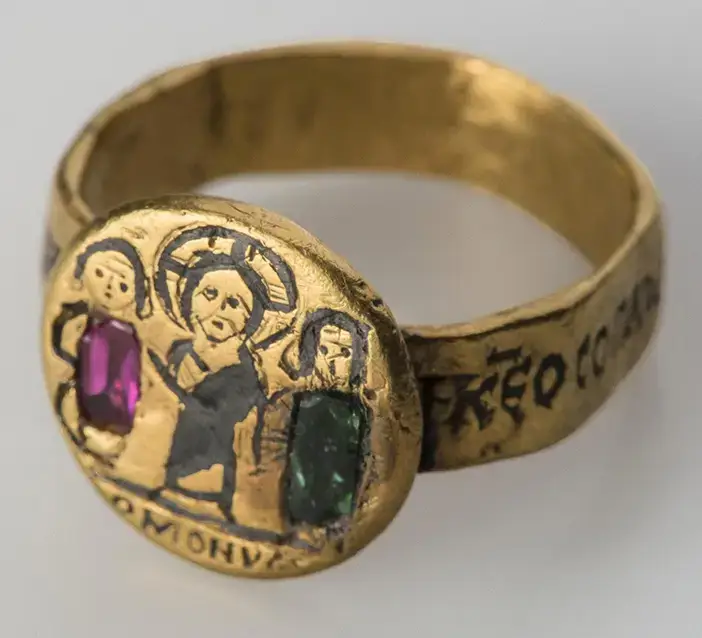
the couple as the bond that
holds them together.
A Ring That Tells a Story
In the State Hermitage Museum in St. Petersburg, Russia, there rests a beautiful artifact: a Byzantine gold wedding ring from around the 10th century AD. Its bezel shows three figures—a bride, a groom, and between them, hands resting on each of them, Christ himself. Around the band runs one Greek word: OMONOIA—“harmony” or “concord.”
The image carries great truth in miniature. Christ stands not as a distant observer of the marriage—a divine officer certifying the union—but between the couple, the bond that holds them together. The two gems, one for the bride and one for the groom, are held in place by the gold that enfolds them.
The inscription speaks of a shared mind and purpose. Marital harmony doesn’t happen by itself; it flows from Christ’s presence and blessing, received as a gift and pursued as a goal.
This is the threefold-cord principle made visible. A marriage with Christ at its center is, as Solomon declared, “not quickly broken.” (Ecclesiastes 4:12). The third strand changes the bond’s very nature, creating a stability that holds under pressure. That does not make a marriage between believers unbreakable—our painful ecclesial experience shows otherwise. But it gives a marriage its best chance to last and flourish, upheld by the strength of God Himself.
Let us turn, then, to the first marriage in Scripture, and what God intended by it.
God’s Purpose for Marriage
“It is not good that man should be alone,” God declared at Creation. “I will make him a helper comparable to him.” (Genesis 2:18). From the beginning, marriage was designed to meet our need for companionship. Amid Eden’s abundance, Adam still lacked a companion. He remained incomplete until Eve stood at his side.
Marriage serves several divine purposes. It gives companionship—a partner to share life’s joys and sorrows. It provides the setting for raising godly children, passing the torch of faith to the next generation; “Children are a heritage from the LORD, the fruit of the womb is a reward.” (Psalm 127:3). And supremely, it pictures Christ and his bride, the ecclesia.
Understanding these purposes shapes how we approach marriage. It is far more than a social contract or romantic adventure; it is a divine institution with eternal significance. Those who enter it thoughtfully, with God at the center, position themselves for the blessing it was designed to give.
The Pattern: Mental, Moral, Physical
Once again, the divine pattern that governs all thriving relationships finds its clearest expression in courtship and marriage. The progression from mental to moral to physical—each stage building on the last—shapes a relationship that endures, and prepares it for the fruit God intends.
Consider Ruth and Boaz. Their relationship began with mental recognition. Boaz noticed Ruth’s character—her devotion to Naomi, her faithfulness in gleaning: “It has been fully reported to me, all that you have done for your mother-in-law since the death of your husband.” (Ruth 2:11). This was no infatuation; it was appreciation rooted in knowing her worth.
From that mental foundation grew moral commitment. Boaz pledged himself to Ruth’s protection and provision; Ruth showed hers by approaching him with the request for redemption—a bold act of faith in his character. The covenant was made, intentions declared, legal matters settled.
Only then came the physical union and its fruit: “So Boaz took Ruth and she became his wife; and when he went in to her, the LORD gave her conception, and she bore a son.” (Ruth 4:13). Notice the order—mental, moral, physical, fruit. Not arbitrary. By divine design.
This order protects the relationship. When the physical runs ahead of the mental and moral, the foundation is weak, and love built mostly on attraction crumbles when tested. Where understanding and commitment come first, the physical becomes the beautiful expression of a love already proven and pledged.
Courtship: Building the Mental Foundation
The purpose of courtship is to discover whether two people can build a life together—whether their minds unite, their values align, and their paths merge toward the Kingdom. That takes time, conversation, and honesty.
Wise courtship means getting to know one another across varied settings. How does this person handle stress? How do they treat those who can do nothing for them? What is their walk with God, their convictions, their way of handling conflict? Such questions are answered only through sustained interaction.
There are four conversations to have before you marry. Each touches an area that can quietly undermine even the strongest marriage; faced honestly while dating, each becomes a foundation stone instead:
- Shared spiritual perspectives. A spiritually minded believer is scarcely better off marrying a spiritually dead partner than an outright atheist. We need not be mirror images of each other, but the goal should be to marry someone who will lift you spiritually. As a wise brother once said, “Always aim to marry someone more spiritual than you.”
- Shared views of family. Relationships with in-laws, parents, and siblings can bring great blessings or great strain on a new marriage. Undue extended-family influence can unsettle a newly married couple’s fragile harmony. What is needed is a shared vision of a united walk together. Courtship is the time to set expectations and boundaries where the marriage’s health needs them.
- Shared views on children. This is perhaps more pressing today, when a couple’s expectations may differ from those of earlier generations. Children were once assumed to be the natural fruit of marriage; today’s pressures make that far less certain. Each partner’s view—whether to have children, how to raise them, and how many—should be discussed thoroughly during courtship, to spare future pain.
- Shared views on money and daily living. Money—from the pinch of poverty to the excess of wealth—always presses on a marriage. Unreasonable demands, who works and for what, inheritances, and clashing habits of spending and saving can each threaten a young home. Look for a partner who uses money wisely and generously, building one new unit rather than defending separate interests. The red flags lie at both extremes—craving riches, or having little sense of duty to provide. Both, as Agur prayed, threaten our spirituality (Proverbs 30:8-9).
It is good to watch family dynamics at this stage. Visit one another’s homes and see how your potential spouse treats parents and siblings, for these patterns often predict the future. A young man disrespectful to his mother may struggle to honor his wife; a young woman who never learned patience with siblings may find marriage’s daily irritations hard to bear.
Through it all, keep the boundaries that belong to this stage. Courtship is mental exploration—conversation, observation, growing understanding. Keep physical expression modest, reserving fuller affection for the commitment that makes it right. This guards you both from the pain of premature intimacy in a relationship that may not last.
Marriage Only in the Lord
Of all the decisions of courtship, the choice of whom to consider matters most. Scripture is clear: believers should marry fellow believers. Paul wrote that a widow “is at liberty to be married to whom she wishes, only in the Lord” (1 Corinthians 7:39), a principle that reaches all who seek marriage.
Why the restriction? Because marriage creates the most intimate of human unions—“The two shall become one flesh.” (Mark 10:8; compare Genesis 2:24). How can there be true unity when partners differ on life’s deepest questions? How can they walk together, unless they are agreed? (Amos 3:3). The believer’s first loyalty is to Christ, and marriage to an unbeliever sets that loyalty in tension with duty to one’s spouse.
The practical cost is real. An unbelieving spouse cannot share the disciplines that sustain faith—daily Bible reading, prayer, ecclesial fellowship. They cannot model faith to children, nor offer the peculiar comfort of a shared hope in hard times. Their influence, however gentle, tends, over the years, to draw the believing partner away from wholehearted devotion. God is no longer the third cord, the settled arbiter of right and wrong; each instead does “what is right in his own eyes.” (compare Judges 21:25)
Scripture gives sobering examples. Solomon, for all his wisdom, was turned from devotion by his foreign wives. In Nehemiah’s day, the men of Israel were rebuked because mixed marriages left their children unable to speak the language of their faith. Spiritual compromise follows relational compromise. Do not imagine you will be the exception—marriage to an unbeliever will always dilute your spirituality.
For those who find the options within the ecclesia few, trust in God’s providence is essential. He who said, “It is not good that man should be alone,” can provide a suitable partner in His time. Patient waiting, joined with active involvement in the wider community, positions us to receive what God has prepared.
Engagement: Deepening Moral Commitment
Then comes the glad moment when mental exploration has confirmed compatibility, affection has grown, and engagement marks the move to committed preparation for marriage. This is the moral stage—declaration of intent, pledge of faithfulness, public acknowledgment that two lives are becoming one.
Engagement is not yet marriage. The physical union that belongs to marriage is still reserved for the wedding and beyond. Yet engagement changes the relationship: conversations grow more intimate, plans more concrete, and the sense of belonging to one another more settled.
This is the time for important preparation: talk openly about the practical matters married life will bring—finances, living arrangements, child-rearing, ecclesial involvement, in-laws. Such conversations head off the painful surprises that unspoken expectations create.
Wise couples also use this season for spiritual preparation. Study together what Scripture teaches about marriage, and pray together for God’s blessing on your union. Seek counsel from mature married couples whose relationships you admire, or a wise older couple you both trust, to talk through marriage’s realities in confidence. This investment pays dividends for decades.
Through this glad season, each of you must be willing to end the engagement if deep issues go unresolved or doubts keep nagging, rather than pressing on for appearances’ sake. The adage still rings true: “Marry in haste, repent at leisure.” A little pain now is far better than a lifetime of hurt.

Marriage: The Complete Union
Marriage brings the pattern to its glad completion. The mental understanding and moral commitment that have grown now find physical expression in husband and wife’s union on their joyful day: “Therefore a man shall leave his father and mother and be joined to his wife, and they shall become one flesh.” (Genesis 2:24).
This “one flesh” union is far more than physical intimacy, though it includes it. It is the complete merging of two lives—mentally, morally, physically—into something new: a partnership, a household united in purpose. What affects one affects both; what belongs to one belongs to both.
Jesus stressed its permanence: “What God has joined together, let not man separate.” (Mark 10:9). Marriage was never meant to be dissolved when trouble comes. It is a covenant that mirrors God’s own faithfulness, and that permanence brings security; knowing the relationship will endure frees a couple to invest in it fully, come what may.
Because God is our Creator, He understands perfectly what serves our good. Embracing His pattern, even where it runs against the world’s priorities, is the surest path to a marriage that is happy, healthy, spiritually fulfilling, and fruitful. Moses says as much, urging Israel “to keep the commandments of the LORD and His statutes which I command you today for your good.” (Deuteronomy 10:13). The world may call these principles outdated; by grace, we know better.
A Model of Christ and the Ecclesia
Paul’s charter for the Christian home opens with a word to everyone: “submitting to one another in the fear of God.” (Ephesians 5:21). The Greek verb there, hupotassomenoi, governs everything that follows. Before Paul says a word to husbands or to wives, he says something to both of them together. Mutual submission is the ground on which a Christian marriage stands.
His extended comparison between marriage and the Christ-ecclesia relationship (Ephesians 5:22-33) is the gold standard for how husband and wife should relate. The husband is called to love his wife “as Christ loved the church and gave himself for her,” a self-sacrificing love seeking her blessing and sanctification even at personal cost.
The wife is called to submit to her husband “as to the Lord” (Ephesians 5:22)—a willing respect honoring his role as the leader of the family. This is a matter of function, not worth; Christ leads His ecclesia, and she follows in loving trust. There the likeness ends, for the ecclesia brings her Lord nothing He did not first give her. Husband and wife stand on level ground, two people of one frailty who need each other daily; and so they work together, encouraging one another and supporting one another.
When both fulfill their callings, the marriage becomes a living witness to spiritual realities. The world glimpses, in miniature, Christ’s love for his people. Children see daily the pattern of sacrificial leadership and willing trust that marks the divine relationship. The home becomes a school of faith, training the next generation by example.
Practical Wisdom for the Journey: From Courtship through Marriage
A few practical principles guard the road from courtship through marriage:
- Guard your heart. “Keep your heart with all diligence, for out of it spring the issues of life.” (Proverbs 4:23). Be slow to invest emotionally before compatibility is clear. A heart given too quickly may have to be painfully reclaimed.
- Maintain appropriate boundaries. Let physical expression match the level of commitment. Save for marriage what belongs to marriage. Avoid settings that cloud judgment. “Flee also youthful lusts.” (2 Timothy 2:22).
- Involve trusted mentors. Seek the counsel of parents, elders, and mature believers, who have walked this road and can see concerns youthful enthusiasm overlooks. Abraham’s care in finding a godly wife for Isaac (Genesis 24) models the wisdom of drawing others into this momentous choice.
- Keep God at the center. The threefold cord remains essential throughout: pray, study Scripture, attend meetings, and serve together. A relationship built around shared devotion to God has the strongest possible foundation.
A Glimpse of Glory
The male-female relationship, rightly ordered, offers a glimpse of glory. In the husband and wife’s mutual devotion, we see Christ’s love for His bride. In covenant faithfulness that endures through difficulty, we see God’s steadfast love. In children raised in the nurture and admonition of the Lord, we see the harvest of divine blessing.
Like that ancient Byzantine ring, with Christ standing between bride and groom, may our marriages remind us daily that the best relationships place Christ at their center—not merely as witness or blessing, but as the bond itself, the third strand that turns two fragile lives into one unbreakable union.
May all who seek to marry do so with reverence for its divine design. May those who have entered it nurture it with the care it deserves. And may our marriages testify to a watching world of a love higher than human passion—a love that sacrifices, endures, and points beyond itself to the eternal union between Christ and His people.
“Let your fountain be blessed, and rejoice with the wife of your youth.” (Proverbs 5:18).
David Fraser,
Pinetown Ecclesia, South Africa
-
All Bible references are from the NKJV unless otherwise stated.
Series