Reasoning From Scriptures
A report on outreach conversations and a debate with Unitarian Christian Alliance attendees in Australia.
 Read Time: 2 minutes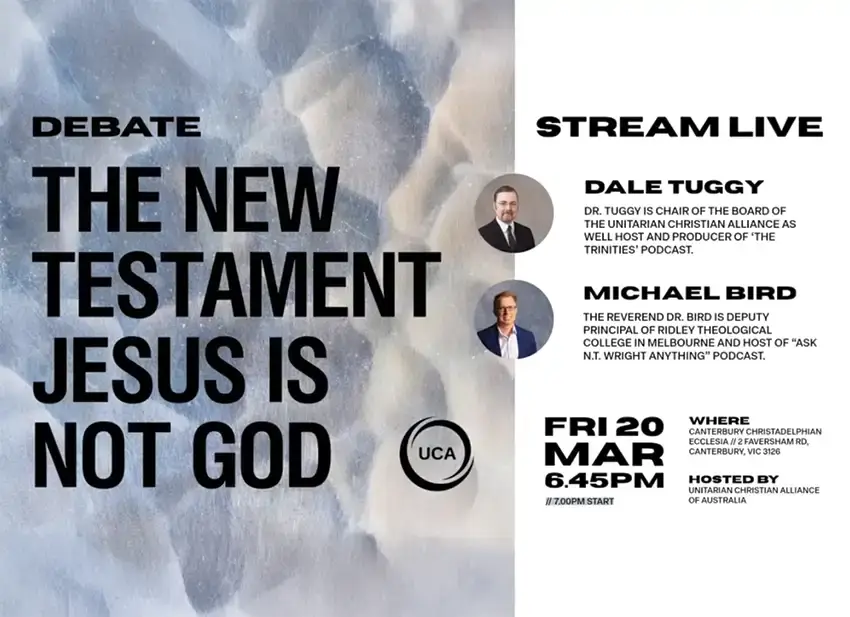
As Outreach Committee representative for the Canterbury Christadelphian Ecclesia in Melbourne, Australia, I recently had the privilege of organizing and hosting a weekend of engaging events in collaboration with the Unitarian Christian Alliance (UCA).
The UCA brings together individuals and churches united by a shared conviction in the One God of the Bible, who is the Father alone and in Jesus, His human Messiah. While members may differ on other theological points, the mission of the UCA and its growing membership is two-fold: to promote Unitarian theology and to connect like-minded believers across the globe.
Held over the weekend, March 20-21, the program featured a public debate, a series of presentations, and an introduction to Christadelphian beliefs.
The highlight came on Friday evening with the well-attended debate between prominent theologians Dr. Dale Tuggy, Board Chairman of the UCA, and Trinitarian apologist Rev. Dr. Michael Bird. The debate attracted an audience of over 120 attendees from both Unitarian and Trinitarian backgrounds, making it the largest group of visitors to a Christadelphian Hall in Melbourne for a very long time.
Dr. Tuggy argued for the case for the topic “The New Testament Jesus is Not God,” presenting a biblical Unitarian perspective. Dr. Bird responded with the opposite, articulating the Trinitarian understanding that has shaped mainstream Christian theology.
The discussion was conducted with respect and intellectual rigor, drawing on scriptural interpretation and historical developments in Christian doctrine, including the influential ecumenical councils spanning the fourth to the eighth centuries.
From a Christadelphian perspective, admittedly with some bias, Dr. Tuggy’s arguments appeared particularly compelling in their logical consistency with Scripture. Regardless of the debate’s outcome, the true value of the evening lay in its ability to prompt reflection on this foundational biblical topic. Live-streamed from our hall, the debate has reached a wide audience with around 10,000 views on YouTube nearly a fortnight on youtube.com/watch?v=EW-M1Tj83-8
On Saturday, the conversation continued in a slightly smaller setting with Dr. Tuggy sharing his post-debate review and engaging with audience questions. There were also two presentations: one by Sean Finnegan, a member of the UCA, on translation bias regarding the “Holy Spirit” (capitalization being one of the faux pas), and another presentation by local Melbournian, Brother David Alexander, who presented the gospel preached to Abraham and the consistent plan of salvation as expressed in Galatians 3:8.
While many of the Unitarian Christian attendees I spoke to have some key differences (but many similarities) in Bible interpretation on a range of topics, there was a shared agreement that there is one true God, our Heavenly Father, and that He had one Son, Jesus our savior, who died as a sacrifice for sin and is raised to glory at the right hand of the Father.
This common understanding is a great starting point for a deeper exploration of the Bible.
It is my hope and prayer that our Christadelphian community can continue to play a role in sharing the gospel with those who are earnestly seeking the truth of God’s Word.
Sam Crispin,
Canterbury Ecclesia, VIC