Three Lesson Review Games
Simple games with question cards and a grid board help Sunday school children review what they have learned.
 Read Time: 3 minutes

How Well Do You Know …?1
This is a review game that can be enjoyed after any set of Sunday school lessons. Prepare the review questions that you want to use and then write each one on a separate file card. Here’s what a card for “How Well Do You Know Genesis?” might look like:
When you are ready to do the review, spread all the cards face down on a table. Let the children take turns picking up one of the cards and reading aloud the question that is on it. If they can answer the question correctly, they keep the card. If not, they must return it face down on the table. When a question is missed, other students will want to pay close attention to where the card is placed. If they know the answer, they may pick it up when their turn comes around. The number of cards a student keeps is their score for the game.
The game is adaptable. It can be used with children of many ages. Question cards can be used over and over, and more cards can be added as time goes on. Using many cards makes the game quite challenging. A focused review, on the other hand, can be done with fewer cards. For example, if you want to review the life of Jacob and not the entire book of Genesis, simply use the Jacob cards.
Another Fun Review Game2
This game uses an easy to make game board. Draw a Lesson/Question grid on a piece of Bristol board or cardstock. Laminate the board to protect it. Children will be writing on the board, so have them use an erasable marker.
Letters across the top stand for the lessons you want to review. Numbers down the side represent individual review questions. Prepare your review questions and let the game begin.
| Lesson / Question | A | B | C | D | E | F | G | H |
|---|---|---|---|---|---|---|---|---|
| 1 | ||||||||
| 2 | ||||||||
| 3 | ||||||||
| 4 | ||||||||
| 5 | ||||||||
| 6 |
Children take turns calling for questions. For example, Rachel’s turn comes around and she calls for question C-4. You read the corresponding question, and if she answers it correctly she gets to put her initial in box C-4 on the grid. To earn a point, Rachel has to get her R in three consecutive boxes: horizontally, vertically, or diagonally.
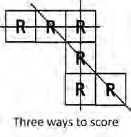
Meanwhile, other students may have other ideas. Like Tic Tac Toe or Connect Four, they may try to block each other’s progress when their turn comes around. It can make for an interesting game.
The Mystery of …!3
In this game, your students become detectives. Working together, their job is to accurately recreate a Bible story — the mystery — from a given set of clues. Clues relate to details of the story:
- the main characters,
- the scene of the story,
- story facts, and
- lessons for us.
Begin by writing clues of each kind on slips of paper and placing them in separate, unmarked envelopes. When you are ready to play, give the envelopes to the students and explain what they contain without divulging anything about the story. Students then open the envelopes one at a time, examine the clue each contains, and decide if the clue relates to a character in the story, the scene of the story, a story fact, or a lesson for us. Have them organize the clues accordingly. Once all the clues are known, have them retell the story, being careful to account for every detail. Don’t let them omit anything. Finally, have them read the story in the Bible and spot the “clues” as they are reading. Be sure to talk about the lessons for us.
This game can be adapted for a wide range of ages: more detailed clues for older children, fewer and simpler ones for younger children. If you want to be adventuresome and add some pop to the game, seal the clues in inflated balloons instead of envelopes. Needless to say, popping balloons to get clues will liven things up a bit.
Jim Harper (Meriden, CT)
- A Vernon B.C. Sunday School Teacher, “How Well Do You Know Genesis?”, The Joy of Sunday Schooling, Vol.5, No.1, 1995, pp.13-15
- A Vernon B.C. Sunday School Teacher, “Run a Fun Review Game”, The Joy of Sunday Schooling, Vol.5, No.1, 1995, p.16.
- Adapted from Melinda Flatley, “The Mystery of the Narrow Escape”, The Joy of Sunday Schooling, Vol.5, No.1, 1995, pp.20-21.