Exploring David’s Census: Part 2
David’s census raises searching questions about pride, responsibility, judgment, and mercy as the consequences of misplaced trust unfold.
 Read Time: 12 minutes
In this story of David and the census, God brings consequences upon the people. We might be asking ourselves, if David, an old man well-versed in the ways of God, already admitted to his sin, why are these consequences necessary? Some point out that it was not just David whom God had become angry with, as 2 Samuel 24:1 says God was already angry with Israel. Why, we cannot know for sure, but all Israel receives consequences—and when does God discipline a group for the sins of one man, if, in fact, it was only David who sinned? In any case, this discipline is necessary because part of our fleshy thinking only responds to consequences. We can intellectually understand a wrongdoing, but part of our flesh needs to see consequences. Additionally, it is precisely because David understands his sin that God can discipline him meaningfully.
When I studied behavioral psychology as an undergraduate, we examined surveys on parents’ attitudes toward consequences in recent decades. They revealed a lot of fear about using consequences, and reasonably so because if discipline is applied incorrectly, it doesn’t work and can have numerous negative unintended side effects. However, in the right circumstances, correction can be effective in shaping and changing behavior. There are many necessary conditions for this to be effective: consistency of application, applying consequences immediately after the behavior, and providing those disciplined with examples of what positive alternatives to the behavior look like. But arguably the most important condition is that the individual being disciplined understands why they are being disciplined.
Finally, this consequence stage connects to the process of threshing wheat, an important symbol David has to consider later on. Though David himself is spared from the plague, no doubt witnessing the pestilence spread throughout Israel had a great impact on a man who cared so deeply for his people.
Let us also consider the theological implications of the discipline and God’s wisdom in it. We saw in the record that God gives David a choice between seven years of famine, three months of being pursued by his enemies, or three days of plague/pestilence. We know why David picks the pestilence, because he trusts God’s mercy, but not the mercies of men (a wise choice, by the way). However, I would suggest that, in one way, it wouldn’t have made a difference which one he chose, and I’ll explain why. We know his sin, regardless of why he did it, was to take a census of the military, in other words, to learn how many men were stationed at the various garrisons around Israel.
Every single one of these options would have had the effect of rendering this knowledge null and void. If he chose famine, well, what good is a large army if you’ve got nothing to feed it? Soldiers don’t fight well on empty stomachs. Famine is outside of your control, David. I, God, am in control. If he chose to be pursued by his enemies, well, what good is a large army if your commander in chief isn’t around to give orders because he’s on the run from an enemy? Perhaps from another usurping descendant of Saul, or worse, one of his own kin. Rebellions are outside of your control, David. I, God, am in control. If he chose pestilence (which he did), it makes this statement: You just had your men spend 9 months and 20 days counting up your soldiers. What’s the use in knowing that number when a sickness can destroy 70,000 of them in just 3 days? And as a side note, I don’t think God told him how many were killed. For all David knew, it could have been more. The record in verse 15 says the plague spread “from Dan to Beersheba,” which, if you look at a map, seems to be from the far north to the far south. In other words, the entire area his men had traveled to do all the counting was rendered useless. Disease is outside of your control, David. I, God, am in control. It is, has been, and always will be God who gives life and preserves it, but also takes it away.
We have seen God provide very intentional, expertly crafted consequences for David’s actions, but discipline is not what brings us back into a relationship with the Almighty. A complete understanding of our failing, true remorse, repentance, a change of heart, and putting plans and safeguards in place to avoid failing in the same way again are all part of the atonement process. We can see David’s remorse as he pleads with God in verse 17,
And David spake unto the LORD when he saw the angel that smote the people, and said, “Lo, I have sinned, and I have done wickedly: but these sheep, what have they done? let thine hand, I pray thee, be against me, and against my father’s house.”
According to the Law, what would a man who had sinned do to ritually atone? Go to the priests with the appropriate animal and have them sacrifice it to make a sin offering or a trespass offering. We do not see God have David do this. God, through the prophet Gad, tells David in verse 18, “Go up, rear an altar unto the LORD in the threshing floor of Araunah the Jebusite.”
Why did God make such a command? What role did it play in David’s atonement process?
Some commentators focus on the city of Jerusalem. They emphasize that it was the site of the future temple and that God always intended it to be Israel’s capital city. This may very well be true, but I wonder: what does it have to do with David reaching a greater understanding of his sin and the need to change?
I suggest the symbolic reason has more to do with the name, Jerusalem, the city of peace. This would send a clear message that this is what God wants for David. My altar must be built in a city of peace. God may be saying that a certain kind of communion with Him can only be achieved when one’s mind is at peace, not preoccupied with war and defense against enemies.
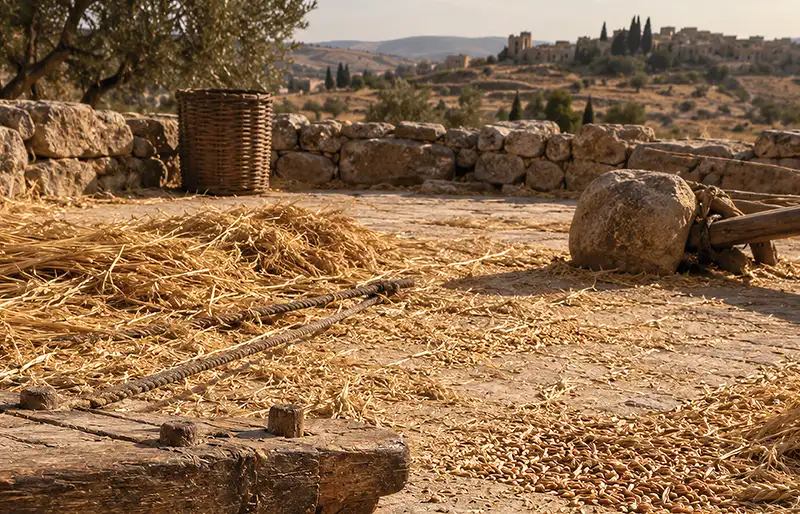
More important still, however, is the threshing floor itself. To understand the rich symbolism of the threshing floor, a brief description of the wheat harvesting process is necessary. First, there was reaping, or cutting down, the plants and bundling them together until it was time to thresh. In English, the word “threshing” is derived from “thrashing,” which we know means to beat or hit. This is exactly what was done to the crops to separate the edible part of the plant, the grain, from the inedible part, the chaff. This was done in many ways: hitting the plants against the ground and shaking them, hitting them with wooden flails, and having animals or people walk over them. All methods involved forcing the chaff from the grain. Finally, there was winnowing, which represented the last stage of separating the wheat from the chaff. The grain farmers would toss the material that had been loosened in the threshing process up into the air by hand or by winnowing fork so that the lighter chaff would be blown away by the wind or by other workers nearby waving large fans, while the heavier, more valuable grain would fall back to the ground. Chaff still on the threshing floor could be collected and burned as fuel while the grain was gathered, washed, and later used for food.
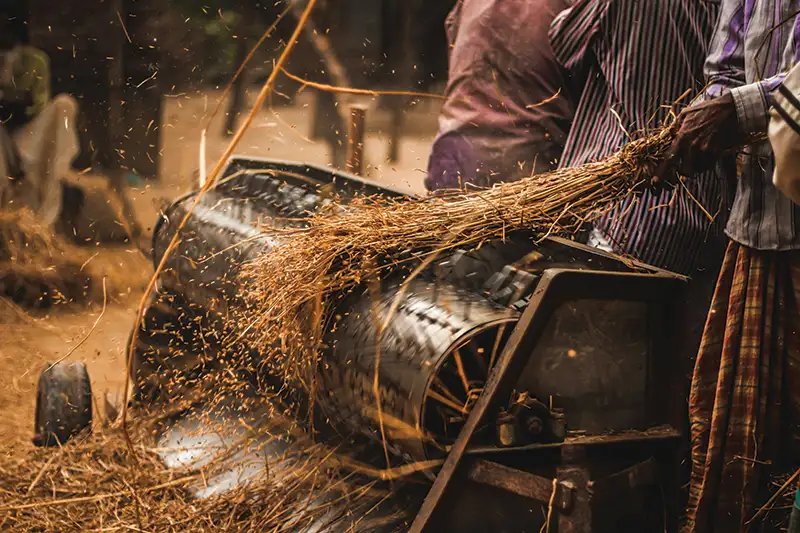
The Bible is filled with references to the spiritual significance of this process, but I’ve limited myself to just three examples of its use. Two of these come from the psalms, so we know the symbolic significance was not lost on David. Psalm 1:3 compares the godly to “a tree planted by the rivers of water, that bringeth forth his fruit in his season; his leaf also shall not wither; and whatsoever he doeth shall prosper.” But he says of the ungodly, “The ungodly are not so: but are like the chaff which the wind driveth away.” (v. 4). Again, in Psalm 35:5, David begs God regarding those who seek to kill him, “Let them be as chaff before the wind: and let the angel of the LORD chase them.” And, we have John the Baptist famously speaking of Christ in Matthew 3:11-12,
I indeed baptize you with water unto repentance: but he that cometh after me is mightier than I, whose shoes I am not worthy to bear: he shall baptize you with the Holy Spirit, and with fire: Whose winnowing fan is in his hand, and he will thoroughly purge his floor, and gather his wheat into the garner; but he will burn up the chaff with unquenchable fire.
While the spiritual metaphor can be applied to groups of people, righteous and unrighteous, I believe it can also be applied to a single individual. Within us all, there is good grain, the fruit of the spirit grown by God, but there is also chaff: that which is useless except to be burnt in the fire. Similar to the process of separating impurities from gold by heating, God, through trial, through spiritual threshing and winnowing, helps us separate what is valuable from what is worthless within us. David, just like the rest of us, required spiritual threshing and winnowing by God.
And yet, with some artistic liberty taken, I want us to consider extending the metaphor of the chaff a bit further. In many places in the Bible, it represents sin and that which is useless. But was the chaff always useless? God designed and created plants and all their parts, each with its own purpose and function. What did chaff used to be before it became chaff? Chaff is composed of the once-living pieces of the wheat plant, including the stem, leaves, and husk. The husk once surrounded the plant’s edible seed as a protective shell. In the earlier stages of the plant’s life, its purpose was to protect the grain from the elements, from disease, from certain insects or other creatures that would otherwise have consumed the fruit of the grain. As the grain grew, reached maturity, and the plants were harvested, the husk dried out and died, becoming chaff. So we see, in its own time and season, the husk, the chaff, had its purpose. There is a time for war, and a time for peace.
Within us all, there is good grain, the fruit of the spirit grown by God, but there is also chaff: that which is useless except to be burnt in the fire. David, just like the rest of us, required spiritual threshing and winnowing by God.
I extend the metaphor this way because I believe this is the exact spiritual position David was in. In his life, in his kingship, he played the role of the husk and the children of Israel the grain. He protected and defended Israel from those who would consume her, though, of course, we know it was God who was actually protecting them. But now, David has reached a time of spiritual harvest, a time when the protective warrior’s mindset needs to be threshed and winnowed. A time of peace both for Israel and within David’s own mind needs to be transitioned into. It is time for his old way of life, his old mindset, to be put away, cast off, to be sacrificed; it needs to cost him something. It is time for the husk to become chaff, blown away and burned up.
And what do we see David say and do when he arrives at the threshing floor? When Araunah offers to give David the land and materials for offering for free? He responds in 2 Samuel 24:24, “Nay; but I will surely buy it of thee at a price: neither will I offer burnt offerings unto the LORD my God of that which doth cost me nothing.” And what is the first offering he offers? A burnt offering, completely incinerated. No part of it was eaten by the offerer or the priest, and while this has so many symbolic connotations, here I believe it represents the burning up of his old mentality. And, incidentally, in the Old Testament, unlike other offerings, the burnt offering could atone for sins.
 But we find that David did not just offer burnt offerings. He also offered peace offerings. In contrast to burnt offerings, peace offerings were not associated with sin. They were offerings of gratitude, including gratitude to God for saving one’s life in some way. A part was offered to God, a part was eaten by the priest, and a part was eaten by the offerer, so that everyone was filled by this offering. It was voluntary and, according to some Jewish scholars, will be the only offering in the time of the Messiah’s Kingdom, when sin is gone from the Earth.
And yet, we have a symbol greater still than the threshing floor and offerings. God specifically sends David to the threshing floor of Araunah in Jerusalem to meet Araunah. Already, in the Mosaic legal context, Araunah has been cast in the role of a priest, despite not officially or ritually being one. In what ways was Araunah a priest? What kind of priest was he?
Let us first consider what he tells David in verse 22: “Let my lord the king take and offer up what seemeth good unto him: behold, here be oxen for burnt sacrifice, and threshing instruments and other instruments of the oxen for wood.” In the Chronicles account, he says in 1 Chronicles 21:23, “Take it [the threshing floor] to thee, and let my lord the king do that which is good in his eyes: lo, I give thee the oxen also for burnt offerings, and the threshing instruments for wood, and the wheat for the meat offering; I give it all.”
Consider the wheat. It took the right weather, time, and hard work to plant, reap, bundle up, and thresh. Freely given as an offering to be burned up or eaten, as in some cases with certain offerings. Consider the threshing instruments. Those cost money, time, skill, and hard work to build. Freely given as firewood to be completely burned up. The oxen? Those cost money, time, resources, and hard work to protect and feed. If you ask some farmers, there might have even been an emotional connection to them. Freely given to be completely burned up.
And there is the land. You might be thinking that the year of Jubilee might be just a few years off from when all land was returned to its original ancestral owners. He could have gotten it back. Not so. You see, Araunah, Ornan in Chronicles, was not a Jew. The record says he was a Jebusite dwelling among the Jews. I’m not sure how he remained there after David’s taking of Jerusalem. In any case, because Araunah was not a Jew, as far as I can tell, according to the Law, he was not eligible for his land to be returned to him in the year of Jubilee. And even if he was, we know he never took it back. It was never returned to him because this altar became the site of Solomon’s temple, a building considerably larger than the original threshing floor site. The Chronicles record gives another sobering detail in 1 Chronicles 21:20: he had four sons. Maybe other family members—we don’t know. What about their inheritance? Freely given away forever. Essentially, to be completely burned up, to them at least. What Araunah and his sons did for a living for the rest of their days is left a mystery in the Biblical record. Would it have been easy for a non-Jew living in the land to purchase property, wheat fields, and start over again? This is unclear, but after the threshing floor was sold to become an altar, it was clear the lives of Araunah and his family were changed in a single day.
True, Araunah was paid for what he gave up; he didn’t actually walk away from the deal with nothing, but we should not view him with any less reverence. Why? Because he was willing to do so. Abraham didn’t actually sacrifice Isaac, but he was willing to, and in doing so, he manifested God in one of the most direct and meaningful ways ever recorded in all of Scripture.
And so, in 2 Samuel 24, we have this beautiful picture of redemption. A man has sinned and is separated from God because he cannot let go of his former self. And God provides him with a man willing to sacrifice his possessions, his land, and quite possibly his entire way of life when he had done no wrong, so that the other man could have his sin forgiven. I think the parallel here speaks for itself in terms of how this story connects to why we are here this morning. Araunah is surely a type of Christ.
I have called Araunah a type, a symbol, but in one way, I was wrong to do so. I was wrong to do so because he is greater than a symbol. He is a manifestation. You see, symbols are powerful, but their power derives from their ability to connect to other images, emotions, and ideas already present in the minds of those who perceive them. Give them different contexts, and they have different meanings; gold can mean tried faith, but can also mean greed; scarlet can mean sin, but is also the color of the thread that Rahab used to save the Hebrew spies in Jericho; seven is the number of completeness, of creation, but also the number of deadly sins. Take away their contexts, their associations, and connections, and gold is just a shiny rock, scarlet is just a color, and seven is just the number that comes after six and before eight.
But a manifestation is far greater than a symbol. An object, a color, a number can symbolize the characteristics of God, but it cannot manifest them. Only a living, breathing, thinking being can be a manifestation. The Greek uses two words for manifestation: phanerosis, also meaning “an expression or exhibition,” and apokalypsis, meaning “a revelation.” A symbol has the power to remind, but a manifestation has the power to reveal God’s character and spirit. A manifestation is real.
What we do every week at the memorial table is a rather special circumstance, because the bread and wine are symbols of a manifestation. Yes, they are symbols of the body and blood of Christ, who perfectly manifested the Father’s character, but there is another form of God manifestation that Christ alludes to when he instituted the ritual of taking the bread and wine. At the Last Supper, Christ did not say in regard to the emblems, “Look at this,” or “Think about this,” or even “Talk about this in remembrance of me.” He said, “Do this in remembrance of me.” You might say, “Yes, the ‘Do this’ means to eat,” but eating is just the symbol. The letting go of self, the suffering for the sake of others, the giving up of a way of life, even one that was once useful for God’s purpose as David’s was: these are the manifestations. God has not promised us that manifesting him wouldn’t be hard or painful, but he has promised us it will be worth it.
I’ll close with two final passages. Matthew 19:27-29,
Then answered Peter and said unto him, Behold, we have forsaken all, and followed thee; what shall we have therefore? And Jesus said unto them, Verily I say unto you, that ye which have followed me, in the regeneration when the Son of man shall sit in the throne of his glory, ye also shall sit upon twelve thrones, judging the twelve tribes of Israel. And every one that hath forsaken houses, or brethren, or sisters, or father, or mother, or wife, or children, or lands, for my name’s sake, shall receive a hundredfold, and shall inherit everlasting life.
And Romans 8:18-19,
For I reckon that the sufferings of this present time are not worthy to be compared with the glory which shall be manifested in us. For the creation waits in eager expectation for the children of God to be manifested.
In this world, there are many symbols of God and of Christ: the cross, the bread, the wine. But when we look out into the world, there are so few manifestations. Suffer yourself to be one of them.
Brandon Entwistle,
Wuhan Ecclesia, China