“Held In His Hands” Book Excerpt: Chapter 2
This opening excerpt from Held in His Hands begins a story of danger, faith, and the light of the gospel in difficult circumstances.
 Read Time: 6 minutes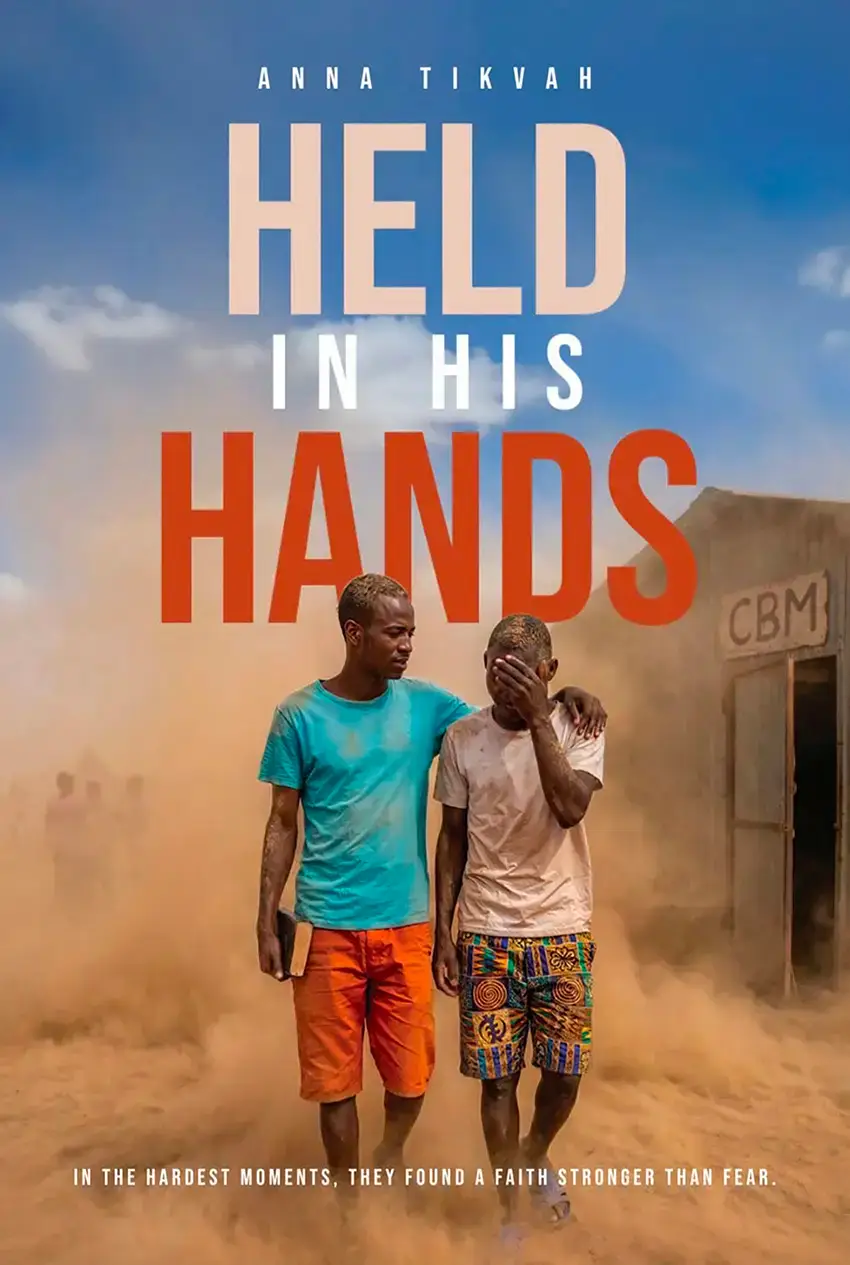
Chapter 2
David’s Story, From One to the Other
For weeks, the young men endured the ill treatment of the soldiers. If they were cross, or unhappy with the boys’ conduct, the soldiers would beat them with a pipe. The top officer would state the number of blows, and the others would inflict it. Fearfully, the boys tried their best to please, but there was never a word of thanks, and it didn’t take much to make the officers angry.
Often there was nothing to eat until a farm was raided. Then perhaps the rebels would come back with chickens, or a bag of maize, and there would be food for a day or two.
David missed his family dreadfully—Jean, Musa, Miriam, Zakaria, Jibu, and especially little Furaha. He missed fishing with his father on Lake Tanganyika and talking about life. Sometimes he thought about his mother’s promise that God was always looking after them, and recalled her words, “Amini katika Mungu, mwanangu—Trust in God, my son.” But if this was true, then why would God allow him to be captured by these brutal men and forced into a life where he would have to kill others for a cause he didn’t believe in? It seemed there would never be any way to escape, and his own life could be so easily snuffed out in a second should they make a mistake or displease the rebels. He felt that God had forgotten him. Mani kept praying to his prophet, but there were no miraculous interventions. Day after day, was full of worry and strict control, as the youths were trained to load the magazines and shoot the guns.
One night, after his third beating that week for minor mistakes, David lay on the dirt floor with tears in his eyes and bruises on his back. Once again, Mani was praying very hard to Papa Kimbangu, the Protector. David didn’t fully understand what his friend believed, only that it was similar to Christianity, except that a man— Simon Kimbangu, was an incarnation of the Holy Spirit.
Lonely and missing home, David thought about a conversation he’d had with his baba only a few weeks before his abduction. They had been out on the banks of Lake Tanganyika fishing for dinner. In his mind’s eye, David wistfully remembered his slim, dark-skinned father reeling in the slender, silver sardines, all the while keeping his eyes open for lurking crocodiles.
“I was the only son of my father,” Baba had told him as he baited his hook once more. “I had two sisters. My father and I were born in a small village called Ekala, near the far Western border of the DRC. For some reason, my father became the chief even though he was not from the chiefdom lineage, but when he passed away, I was only eighteen years old.”
“He died when you were eighteen?” David had asked, making sure the fish didn’t flip out of the pail.
“Yes, only eighteen…barely a man!” his father exclaimed, shaking his head in dismay.
As he cast his line out again, his father had continued the story, “I knew I couldn’t be the next chief, as I had no right to this, so I didn’t even attempt to take his place. But, once my father was buried, another chief was appointed, and this chief said that my father had stolen land. So, he took the property that my mother farmed and even the land that my father was living on before his death, and I was left with nothing! I hoped that someone from the family would stand up and support me, but I was driven out and told to never return. So, I fled here to Baraka.”
“That’s a long journey, Baba,” David had replied sadly.
“Right across the country!” his father had agreed. “But I love it here. I love the lake and the hilly regions of this area, and this is where I found your beautiful mother.”
Smiling, as he lay in the dark, David remembered his father had said this very fondly. He knew his father loved his mother.
“So, I want you to remember this, mwanangu,” his father had said, looking over to make sure his son was listening. “You must always work hard in whatever you do. Poor people have no rights. No one listens to them, and even when they simply greet others, it is assumed that they are begging. But even more importantly than this—you must always forgive everyone. I have forgiven my family, and my village, and this gives me great peace in my heart. Don’t hold onto grudges. Don’t try to avenge yourself—choose to forgive.”
Rolling over on to his other side, David winced in pain as his bruised flesh pressed up against the hard ground. Every day now there were so many opportunities to forgive.
Unable to sleep and desperately homesick, he tried to think of the beautiful stories his mama had told him about Heaven. It had always helped him fall asleep at home. She had said there were streets of sapphire, and a city of gold with many precious gems. Beautiful light would be shining everywhere. And there would be glorious music. They would see God in all His glory… and Jesus…
The next morning, the burly soldier, who they now knew as Bemba, blasted them out of their dreams, shouting, “Get up! Get out here immediately!”
Stumbling awake, the boys filed out of the makeshift shelters, dirty, tired, and hungry.
“We’re heading out to fight the government, and you had better not disappoint!” Bemba scowled. “Show yourself to be good soldiers and maybe we’ll make something of you.”
“But we aren’t trained,” Ntinu complained.
“You’ve had your training!” Bemba roared. “Quit your complaining, kid! You need to keep your mouth shut!”
Reacting to the look of dismay on all their faces, Duma, another one of the rebels, spoke harshly, “If you want to live, stop arguing and do as you’re told. You know how to shoot these guns. That’s all you need to know. Just kill as many soldiers as you can.”
Holding back the anger that was rising within his chest, David remained silent. He knew they were not prepared to go up against the trained Congolese army, and he could see that the other students felt the same way. They had been taught to shoot, but not how to hide, or when to run, or how to defend themselves. “This is the end,”
he thought bitterly. “We’re all going to be shot dead!” After one month with the rebels, what he had learned the most was that his life was no longer his to control. There was nothing he could do but obey orders or be shot dead. And now, even if he obeyed orders from one side, he would be shot by the other.
Mani gripped his arm. They shared a look of despair. There was no opportunity to encourage each other. The soldiers were forcing guns into their hands and telling them to march.
For twelve hours the young men and boys followed the rebels to a place called Kikonde. Disheartened, hungry, weary, and fearful of what the battle might bring, David couldn’t even say the Lord’s prayer in his mind, as he had been trying to do every day. It seemed God had completely forgotten them and abandoned them to the Devil. They were in a living hell. There was no one to appeal to, no one to bring hope.
That night they slept in the bushes, knowing the doomed battle was to begin at four in the morning. “Perhaps,” David thought, trying to comfort himself, “I’ll be in Heaven before the day is over!”
However, first he had to get through the nightmare. In the early hours of the morning, before the sun was up, they attacked the government camp. The plan was to capture the village before ten o’clock. Shots rang out, people died on both sides. Duma crumpled to the ground with a shot to his chest, only a few feet away from the boys.
David couldn’t bring himself to kill anyone. This wasn’t how his parents had brought him up to live. Young and afraid, he had no desire to take the life of another human being. Mani’s religion was completely against violence, so the two of them purposely fired their rifles towards non-living matter, hoping to empty their magazines as quickly as they could.
Suddenly, a loud shot rang out nearby, and the boys heard it whiz through air. Mani stumbled, cried out, and fell to the ground.
Running to his side, David was greatly alarmed. Blood was pulsing from Mani’s leg! His eyes were closed and he lay lifeless on the ground. “No! No!” David wailed, flinging himself down beside his injured friend. Rebels were fleeing from the government army to hide in the forest, gunshots were ringing out continuously, but there was no way David was going to leave his unconscious companion. Desperately, he yanked at his uniform, trying to tear off a piece of cloth to wrap around Mani’s leg, all the while, wary of the ongoing battle and the danger of lifting his head too high.
Frightened and confused by the counterattack, other schoolmates ran over to them. Terrified, they flung themselves down beside their wounded comrade, trying to stay as low as possible, hoping the fast-flying bullets would whiz past above their heads.
“Hey, you!” a voice called out angrily. A government soldier was standing over the group of boys with his gun cocked. “Whose side are you on?”
“Please,” David begged helplessly. “Our friend is hurt… badly. He might be dying! We don’t want to fight. We don’t want to be with the rebels!”
“And where did the rebels go?” demanded another soldier, running up.
Fearfully, David raised his thin hand and pointed to the bushes. “I saw some flee through there.”
“Shut up,” Ntinu scolded. Proudly, he answered back to the soldier, “Why would we tell you?”
One second later, Ntinu was hit with a bullet to the head. He didn’t have time to say another word. He would never speak again.
Instantly, the other young men cowered on the ground.
The soldier who had shot Ntinu so quickly, challenged, “Are you lying to me, you rebels? If you do, you’ll get what he got!”
“We’re students,” David pleaded earnestly. “They kidnapped us from school. We didn’t ask to be on their side. I didn’t shoot anyone! Please take us with you.”
Looking down at the blood pulsing out from the unresponsive teen’s leg, the soldier nodded. “We’d better get him to the hospital,” he agreed.
With great relief, the young men were very thankful to be captured. Mani was rushed to the hospital and the others were accepted as soldiers-in-training, for the government army.
Anna Tikvah