I am Peter
Peter reflects on his calling, failures, restoration, and the difficult path of learning to follow Jesus with humility and courage.
 Read Time: 5 minutes
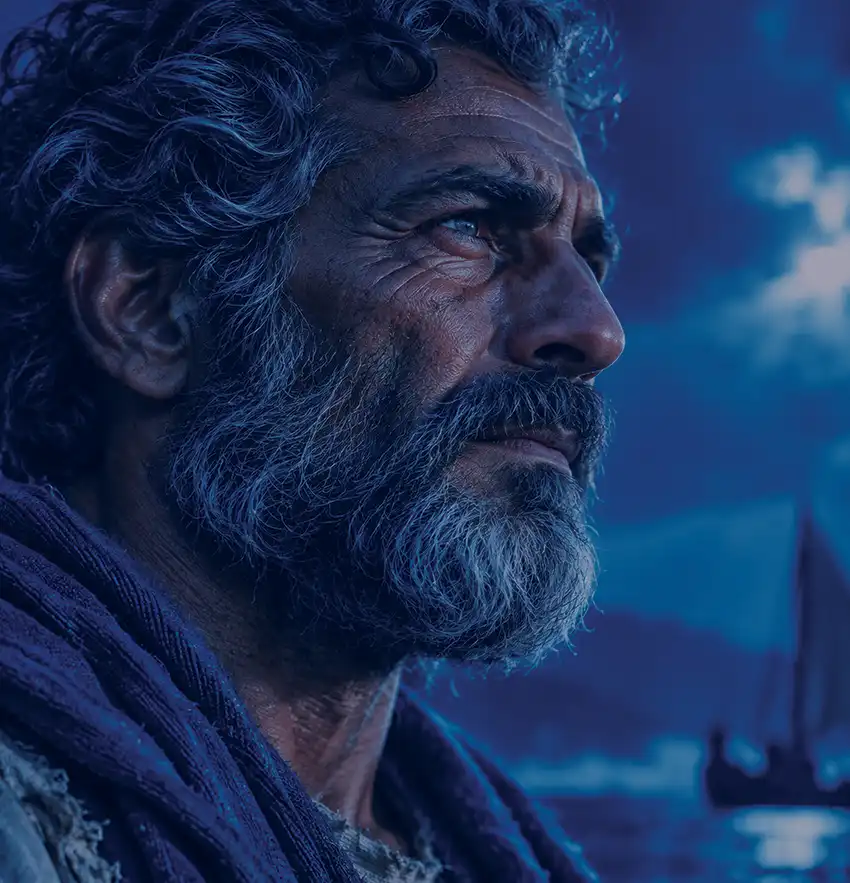
My name is Peter. I have had other names, Simeon (or Simon) and Cephas, but these earlier names mean little to me now—they are part of an earlier life that I have left behind or outgrown, like a child maturing into adulthood. Nevertheless, I should tell you something about what I was in the beginning before I can tell you who I have become.
As you can imagine when you see me now in my later years, I was a big, strong man when I was young and when the Lord Jesus Christ called me. Some men would be proud of such strength, and I must say that I was very proud of myself at that time. I could lift heavier nets of fish than any other fisherman. I could defeat any man in a wrestling match, and I did, sometimes with little or no provocation. I was loud, boisterous, and prone to losing my temper—who was going to stand up to me when I did? If pushed or cornered, I could unloose a string of curses that would make men blush or hide. Who would say “No” to me?
Some of these traits made me a natural leader among the other fishermen in Bethsaida. But I am sorry to say that I was not a good leader in those early days. Good leaders do not boast; they do not rush to conclusions. Good leaders do not make foolish choices based on whims. Instead, good leaders are calm and thoughtful; they consider their actions before making a decision; and they think of their followers before they think of themselves. Finally, after a number of years, I have learned from my great Teacher something of what it means to be a leader.
I was boastful. I leaped to wrong conclusions. And I made foolish choices which even now, many years later, cause me shame.
Then my brother Andrew came to me one day. We had been listening to John the Baptist, the preacher at the Jordan River. He had called all men and women to repent, and he had prophesied that the day of the LORD was coming, and coming soon. Andrew said to me, “We have found the Messiah”—that is, the Christ, the Son of God.
So I went with Andrew, and he took me straight to Jesus, who had been baptized earlier by John the Baptist, and had now returned from his long sojourn in the desert. When we arrived, he was talking to a group of men and women near the Sea of Galilee. This Jesus looked for all the world like a very ordinary man. But as he saw me approaching, he turned from his audience and spoke directly to me. He was very casual, I thought, as though it took him only a moment to evaluate me: “You are Simon son of John… ”—that was my regular, everyday name—but he didn’t stop there. He added: “Now you will be called Peter.”
This name meant “rock” or “stone”. First I thought he was referring to my size and strength, like a rock. But I learned that my new name meant a lot more than that. It just took me quite a while to understand what this wonderful man had in mind for me. Quite a while, and quite a number of foolish thoughts, foolish words, and foolish actions. And I may not be finished with that foolishness, even now.
You see, I grew up thinking I was special. I was bigger and stronger than the other boys, and I took my superiority and leadership for granted. Then I met Jesus, a man the likes of whom I had never met before. I had never imagined that such a man could even exist among other people. His strength, unlike mine, was in his heart, his eyes, and his words. And his strength was manifested in a supreme love without pretense, a love that had no bounds and would pay any price and make any sacrifice to help others.
I wanted to impress him so much. But I made the ridiculous mistake of trying to show him how special I was. Time after time, I tried to impress him, and time after time I stumbled and fell. My failures came regularly, often after what seemed to be a success. Several years afterward, this up-and-down discipleship came to a final low point, when I found myself lying on the cold ground in a dark garden, crying like a baby and thinking that I had lost everything, including my own soul.
Only then, after dismal days and tortured nights, during which I contemplated ending my miserable existence—only then did a risen Jesus send for me and show me the light of a new day, a new world, and a new existence.
This new world required a new Peter. I had seen my Master perform more miracles than I could count—wonders such as the feeding of thousands with a loaf or two, the transfiguration with Moses and Elijah, and the raising of Lazarus. But the greatest miracle, from my perspective, was this: When the old man who was myself died a painful death in Gethsemane, then my new man was born out of what remained, raised from the valley of death’s shadow by the loving hands of Jesus. The new man knew less than the old man thought he knew! The new man was not nearly as strong as the old man thought himself to be! But the new man who is “Peter” belongs to Jesus Christ and is in the process of being recreated as his devoted servant. And now the new Peter is “strong” only in the sense that I know where my true strength may be found—not in my arms and my legs, but in my heart, where Jesus is king. In my own weakness, and my recognition and acceptance of that weakness, I will become strong in my Lord, the Messiah.
Oh, what a journey I have had so far, and there may be rough spots yet to come. When Jesus walked on the waters of Galilee and came toward our boat, I decided it would be a good idea for me to walk on the water too. I tried and failed, and I only looked presumptuous and ultimately foolish. Why did I do such a thing? Perhaps to elevate myself above the others, which was ridiculous considering Jesus’s teachings. In any case, Jesus saved me at the last moment, and I felt even more foolish, but I did not learn my lesson.
Another time, Jesus asked all of us, “Who do others say that I am?” To this there were various answers… John the Baptist, Elijah, Jeremiah. But when Jesus asked us, “Who do you say that I am?”, then I answered right away: “You are the Christ, the Son of the living God.”
When I answered Jesus’s question ahead of my fellow-students (for that is what we were, and still are), I felt so proud when he commended and blessed me. (Yet there was no reason for pride; I should have felt humility and gratitude.) Then, before we could scarcely turn around, I had been tripped up by my own tongue when I presumed to rebuke Jesus and give him advice he did not need at all. That presumption earned me a harsh rebuke, which seemed to wipe out my would-be accomplishment of only a few minutes before. I was ashamed when he called me “Satan,” as though I were his enemy. Why, oh why did I have to open my mouth so much? There was so much I still had to learn!
Then I listened to our great Teacher explain to us the principles of forgiveness, and I just had to ask a silly question: “Lord, how many times shall I forgive my brother when he sins against me? Up to seven times?” Why did I think that we should put a limit on forgiveness? If I had only examined myself, then and later, and realized how many separate acts of forgiveness I would need, all by myself, I would have slapped my hand over my mouth. My “Up to seven times?” condemned me practically from the start. If there were no more than seven opportunities to be forgiven, then what hope did anyone have? And what hope did I have, particularly?
But, dear brothers and sisters, the wonder of my experiences is not that I was so silly and thoughtless; it was that Jesus loved me anyway. Me! There is no greater miracle than that—that a self-centered, foul-mouthed fisherman could be embraced and forgiven by the sinless Son of God, not just once, not just seven times, and not just seventy-seven times. And the wonder of it too was that it took me so long to realize what a miracle it was. But we’ll consider that together next time.
George Booker,
Austin Leander Ecclesia, TX
References:
- “Cephas” means rock or stone in Aramaic, a common language in first-century Israel.
- There is some guesswork in Peter being a big, strong man. But such a description suits what we do know about him for sure, e.g., that he was outspoken, loud, presumptuous, and prone to cursing. And he could lift heavier weights of fish than the other fishermen could (John 21:11).
- Andrew was the first to introduce his brother, Simon Peter, to Jesus, the Messiah (John 1:40-44).