Recognizing Opportunities
Daily life is full of opportunities to serve, encourage, and speak about the hope God has given us when we are willing to notice them.
 Read Time: 7 minutes

There are many things in life that can keep us from being the disciples we want to be. Whether it be physical limitations, personal struggles, or insecurities. But one of the biggest things that keeps us from doing good is failing to recognize opportunities. From small kindnesses to large ones, we have a million opportunities to help one another or brighten someone else’s day. Sometimes our call to action is obvious, as it was in the parable of the Good Samaritan. The priest, the Levite, and the Samaritan are all presented with a clear opportunity to help the robbed and beaten man left on the side of the road. The priest and Levite, supposed to be that man’s spiritual leaders, did nothing while the Samaritan, who had every reason not to bother, went above and beyond. We are all called to be like the Samaritan, but our opportunities to act are often subtler and easier to miss.
Not every opportunity just appears on the side of the road. We are called to reflect the character of Christ and spread the good news of God’s love, not just to wait for those opportunities to present themselves. And we can only do that by being invested in others’ well-being. Sometimes we can get so wrapped up in our own struggles that we fail to look up and see that everyone is struggling in their own way. Far from dividing us, that should be our call to be kind to one another. Jesus says in Matthew 25:
I was an hungred, and ye gave me meat: I was thirsty, and ye gave me drink: I was a stranger, and ye took me in: Naked, and ye clothed me: I was sick, and ye visited me: I was in prison, and ye came unto me. Then shall the righteous answer him, saying, Lord, when saw we thee an hungred, and fed thee? Or thirsty, and gave thee drink? When saw we thee a stranger, and took thee in? or naked, and clothed thee? Or when saw we thee sick, or in prison, and came unto thee? And the King shall answer and say unto them, Verily I say unto you, Inasmuch as ye have done it unto one of the least of these my brethren, ye have done it unto me. (vv. 35-40).
What Jesus offers here isn’t a specific checklist of things you should care about; they are examples of the many ways we can care for one another. He’s telling us to look for ways to love one another.
Trying to be a kind, reliable, and considerate person is something we all struggle with, though some aspects may come more naturally to some than to others. Whether it be the attentiveness to notice when others could use a hand, the diligence to not get distracted by our own concerns, or the understanding and care to actually have a relationship with others, or just to make sure people understand we are there for them, all of these require a dedication to others. And, perhaps most of all, not being so afraid of making a mistake that we fail to do anything.
I’ll admit I get jealous sometimes of the people who just seem to know the right thing to say when someone is hurting, or who can see and prepare for how someone might need help before a problem even happens. They’re not things I’m great at, but everybody struggles with them. We’ve all had a million times when we realize “after the fact” that “Ah, I should have done something there,” or that I should have handled that differently.
But the first step to doing good is to want to do good. We need to make it our goal, when we come to church, go to work, or go anywhere else, to make our first thought, “How can I show the same love to others that has been shown to me?” If we begin our day looking inward at ourselves and our own concerns, and don’t keep our gaze up, looking for opportunities to do good, how can we ever see when someone else needs a hand? And even if our first thought of the day is positive and compassionate, we need it to remain in our minds as the day goes on, not get distracted, and not forget our purpose as representatives of our Lord.
That’s much easier said than done, of course. The effort to change can be hard, but like anything else, it’s about building a habit. Our basic instinct at birth is to care for ourselves. We are called to function all the time to become more than that. To work so that thoughtfulness becomes an ever-greater part of who we are. That purposeful training of our mind to become more like him is what our Lord expects of us. We learn by doing, and that mindfulness becomes more instinctual as we go.
Jesus expresses this mindset in the parable of the talents. The master in the parable gives his servants money according to their ability and tells them to go trading with it and earn more. What God is looking for from us, of course, isn’t earthly currency but the proliferation of his Word and the care of his people. And so, I find the idea of using trading as a metaphor for our work in faith interesting because trading does not guarantee profit. Sometimes you lose money in trading if you’re not careful or if something just goes wrong. The trader needs not only the willingness to earn money when the opportunity arises but also to put real thought into what they’re doing.
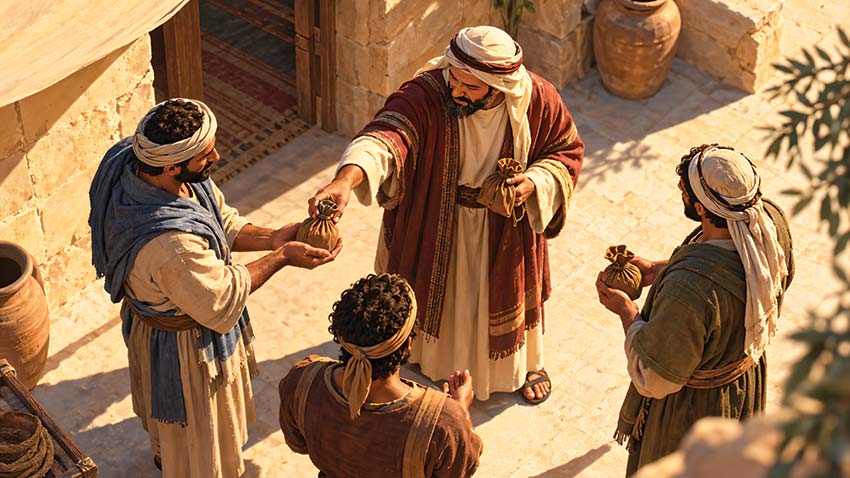
I’d always found this parable a little odd because it says the talents are given out according to people’s ability. But of course, when trading, it’s a lot easier to earn money when you have more money to start with. Both the servant who starts with five talents and the one who starts with two (double their amount) are welcomed into the joy of the Lord. So is the one who starts with five particularly more impressive? I think it’s important that, by the end of the parable, the servant with five talents, who has earned his master five more, is now the servant with ten talents. The master hasn’t taken those five talents he earned and spent them elsewhere; that servant is now responsible for those ten talents (and is then given one more). By the same logic, the servant who started with two talents is now the servant in charge of four talents, which may, from there, turn into eight talents or sixteen, and so on. It’s about our growth in faith and responsibility. We start with what we can handle at that time, but it must grow from there. As it says in Mark 4:30:
What shall we say the kingdom of God is like, or what parable shall we use to describe it? It is like a mustard seed, which is the smallest of all seeds on earth. Yet when planted, it grows and becomes the largest of all garden plants, with such big branches that the birds can perch in its shade.
God has planted that seed of the Kingdom, of hope, grace, and love, in each of us, and it can grow and bear fruit beyond anything we could ever do with our own strength.
 But the last servant hid his talent in the ground. Why didn’t he, as the master says, put his talent in the bank if he was too afraid to trade with it? It seems like a blatantly obvious idea to anyone who puts any thought into it, but that’s the point. His failure to do the obvious bare minimum speaks to how little thought the servant actually put into it. The servant was so afraid of his own failure, or perhaps believed so little in his capacity to do a good job, that he didn’t pause, think about it a little, and realize that he could at least put the money in the bank if nothing else, and instead buried the talent in a field and refused to think about it. Because he misunderstood who his master was. God is far more favorable to a servant who has tried their best and failed than to the one who refuses to try.
Because sometimes we will fail. We’ll say the wrong thing, miss something we should have noticed, or just not know what the right thing to do is. But we can’t let the fear of messing up overwhelm our ability to represent our Lord. We need to have faith in our capacity through Christ to do good. We have put on the body of Christ. Whether we think we are worthy of that title or not, we are God’s chosen servants to enact his will. Because while I may have no power of my own, “I can do all things through Christ who strengthens me.” We can’t deny our ability, through him, to do what is right with the opportunities we have been given. Even if our first step is just putting the money in the bank, we need to be thinking about and looking for that next opportunity to do God’s will and to care for his children.
There are an endless number of ways we can show love when our eyes are sharp and on the lookout. Jesus lists several in Matthew 25. A few more ways we can find those opportunities and take advantage of them include:
- Praying for Open Eyes: Ask God daily to help you notice the subtle opportunities you usually miss. We improve by being intentional and persistent.
- Focusing on One Area First: Instead of trying to be everything to everyone immediately, choose one avenue of service, focus on mastering it, and then build outward.
- Overcoming Hesitation: Work on avoiding procrastination, often the biggest barrier to kindness. We can get so wrapped up in thinking we’re not the right person for the job that we allow the opportunities right in front of us to remain undone. The right person for the job is the one who actually does it. You’ll usually find afterward that it wasn’t as undoable as you thought.
- Keeping Practical Tools On Hand: Carry cash on you for immediate needs. Keep a box of blank cards and postage on a shelf at the hall so anyone can send a quick note of encouragement. Helping is far easier when we are already prepared for it.
- Being Ready to Preach: Prepare a quick “elevator speech” in your mind so you aren’t caught flat-footed when an opportunity arises to offer help or share your faith.
- Taking Stock of Your Strengths: God gives different talents to everyone. Honest assessment of your personal strength lets you see good places where you can serve—whether that’s having a car to give rides, computer repair, yard work, cooking, writing, babysitting, hospital visits, or simply being available for a phone conversation.
- Setting Up Ecclesial Resources: Work with your ecclesia to establish a small food pantry before a crisis hits, or set up a “Have/Need/Can Do” board in the hall so members can easily match skills with needs.
- Working Together: Ask a brother or sister to accompany you or keep you accountable; doing good together makes taking that first step far less intimidating.
- Asking: Sometimes the simplest answer is the right one. We get the most opportunity to do good when others know they can turn to us for help.
Of course, the greatest example of that for us is our Lord Jesus Christ—who went out of his way to show love to publicans, sinners, Samaritans, and all those who were reviled or forgotten, no matter what people thought of him for it. To heal the lame, the sick, and the unclean, and to guide the lost back to God. Jesus didn’t just have the power to help people; he was always doing it. That profound compassion is a better exhortation than anything that can be argued with words.
We might not have the miraculous ability to cure the blind or heal the sick, but just as Jesus embodied his Father through his actions, we are to strive to embody him. To look for every opportunity to bring others closer to God. To be someone who people will run to when they need help.
True kindness and compassion come from the boundless love of our Lord and the sacrifice of his son for our sake. We don’t ever want to make the mistake of allowing our own insecurities or beliefs about our limitations to block our ability to share the same compassion we have been given. Because: “I can do all things through Christ who strengthens me.”
Joshua Sullivan,
Boston Ecclesia, MA