The God Who Saw Hagar
Hagar’s story reveals a God who sees the overlooked, hears the distressed, and meets people with compassion in the wilderness.
 Read Time: 7 minutes
One of the things that continually strikes me about Genesis is its straightforward, raw honesty. If I were to write an account of the beginning of something huge and important, I’d probably focus on all the positive things that people did: bravely heroic acts, moments of beautiful kindness, stunning examples of success—that kind of thing. That’s exactly what Genesis doesn’t do, because Genesis is the story of God’s love and mercy, not human bravery or kindness or success or anything else. Rather, Genesis recounts the lives of complex and complicated people whose lives are messy and who don’t get things right much of the time—and yet in spite of all that, God still works with them, calling them to be part of His family.
Genesis is also a story that unfolds on multiple levels: it is full of symbolism and allegory and sets themes that weave throughout all of Scripture. It is also the story of two paths: the path of life and the path of death. And finally, it is the story of individuals: God working with people as individuals, calling each one to Himself. And on that level, it’s also the story of choices: amid all the good and bad actions we see among the characters of Genesis, each one has a choice. Do they turn to God or away from Him? Do they repent and accept His forgiveness, or do they go their own way? Each person must decide how they will respond to God.
Every man and woman in Scripture has their own story, but a theme that winds through them all ties them together: a greater story of God working with each one, because of His love for His creation. We see this in the life of a woman who appears in the Genesis narrative for only a short time, yet whose role changes history even today.
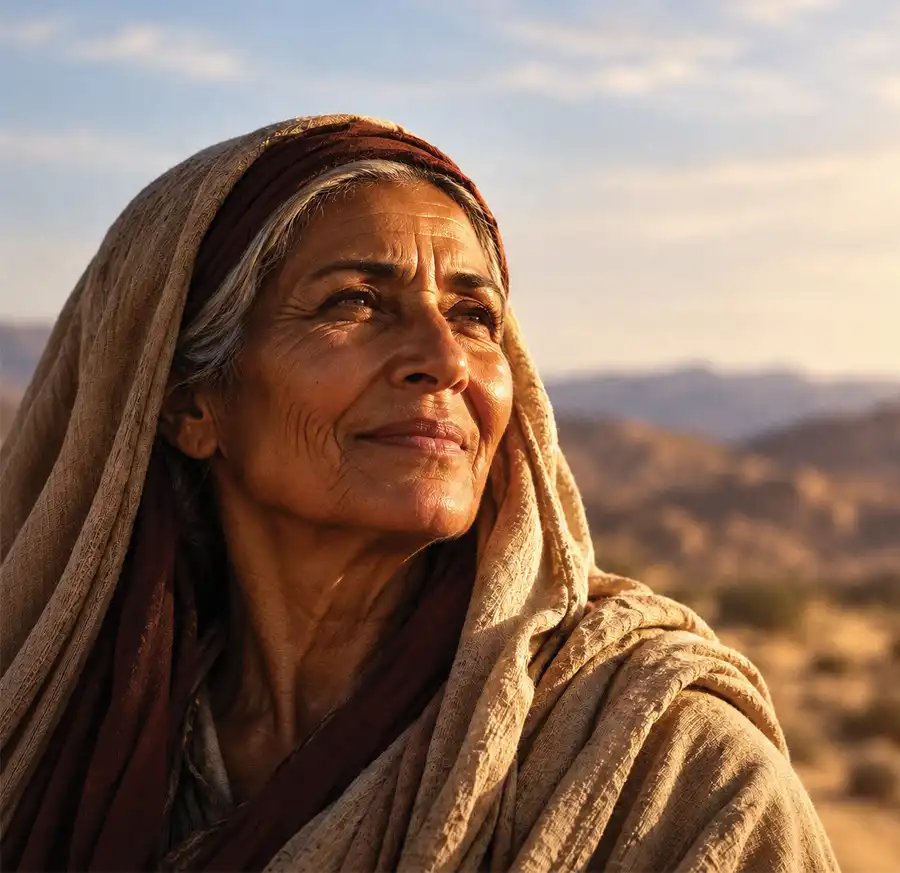
Hagar enters the account of Abram and Sarai in Genesis 16, when we’re first introduced to her as an Egyptian slave. We’re not told her backstory, but from those few details we know that, in terms of societal standing, she’s the lowest of the low. She’s a slave, a woman, and a foreigner—a combination of factors that give her no status or rights. But suddenly she emerges on the scene in chapter 16 as a major player in the story, as Sarai takes the fulfillment of God’s promises into her own hands and initiates a plan for Abram to have children nominally for her through Hagar. All goes according to plan at first: Abram goes along with Sarai’s suggestion; Hagar gets pregnant. But then the direction of the story shifts. Hagar’s relationship with Sarai, whatever it was before, is now quite bad. Genesis 16:4 tells us that Sarai now “was despised in her eyes.”1 The word “despised” is most often translated as “cursed.” Hagar was cursing Sarai, and in response, Sarai treated Hagar undeniably badly. The Hebrew word for “dealt harshly” is elsewhere translated as “afflicted” and used many times to describe the Egyptians’ treatment of the Hebrew slaves (definitely not a good thing to be associated with!). So now Hagar is even more vulnerable than ever before: in addition to being a slave, a woman, and a foreigner, she is pregnant by her master and afflicted by her mistress.
At this point, no one’s handling anything very well. Hagar is cursing Sarai, Sarai is afflicting Hagar, and all of this is in an effort to do what, again? Oh, that’s right. Have a son for Abram so God’s promises can be fulfilled.
It’s not going very well so far.
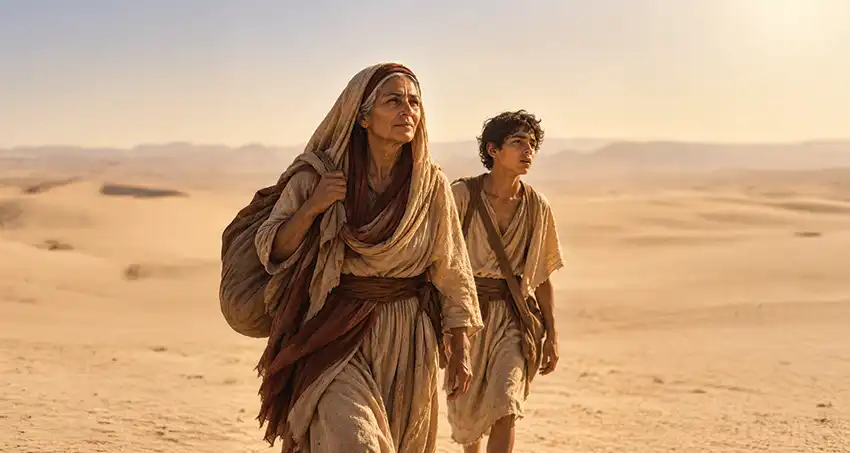
Hagar responds to Sarai’s treatment by running away. But in the midst of this mess, God is loving and merciful—and He is working with Hagar in her most vulnerable, lonely moment, calling her to Himself, calling her to be more than what society sees her as. He’s working to show her that His plans are greater than she could ever imagine. And He’s working with her to shape her and bring her into His family.
God sends an angel to find Hagar in the wilderness. The angel talks with her and tells her what to do next (which is to return to Sarai—probably not what she wanted to hear!). And not only that: the angel gives her a promise as well. To many, Hagar would’ve been below their notice—but not to God. Just as God told Abram that his descendants would be innumerable, He has now given His angel a message to pass on to Hagar: “I will surely multiply your offspring so that they cannot be numbered for multitude.” (16:10). She will indeed have a son, and God names him: Ishmael, “God will hear”—for God has heard Hagar. It wasn’t going to be an easy road for Hagar or her son: the angel goes on to tell Hagar that this Ishmael of hers would be “a wild donkey of a man” whose hand will be “against everyone.” (16:12). And yet, Hagar responds with a declaration of her faith: “You are a God of seeing… truly I have seen him who looks after me.” (16:13). God has seen and heard Hagar, the slave from the land of Egypt, and has called her to be part of His family. In response, she praises Him for looking after her. As instructed, Hagar returns to Abram and Sarai, and there Ishmael is born.
Years pass as Ishmael grows up, and we hear no more of Hagar until after the birth of Isaac, when Ishmael is fourteen years old. When Isaac is weaned, Hagar and her son reenter the story: at a feast celebrating Isaac, Ishmael mocks his young half-brother. Sarah asks for Hagar to be sent away, and although Abraham hesitates, God instructs him to allow it. And so Abraham sends Hagar and Ishmael off.
Hagar and Ishmael travel in the parched wilderness until their supply of water runs out, and Hagar fears the death of her son. For the second time in the record, God sends an angel to Hagar to encourage her and give her strength for the journey, reminding her, “I will make him into a great nation.” He shows her a water source, alleviating her fear of death. From there, the mother and son live in the wilderness until the time comes for him to marry. At this point, there’s so much reason for hope: God has twice sent an angel to rescue and comfort Hagar, and Genesis 21:20 tells us “God was with the boy.” Ishmael is Abraham’s son, and God has made promises about him. And yet the following verse is the only direct indication we’re given of what path Hagar ultimately chooses for herself and her son of promise: “His mother took a wife for him from the land of Egypt.” (Genesis 21:21). In choosing an Egyptian wife for him, she tied him to her Egyptian roots, to the rejection of the God of Abraham.
That’s the last we hear of Hagar in Genesis, but her story’s not over. As with so much of the book of Genesis, the story of Hagar plays out on multiple levels:
- There’s the big-picture story of two family lines at their very beginnings. These two family lines, from Ishmael and from Isaac, will play out throughout all of history—even today and until Christ’s return.
- There’s the allegorical aspect of her story: the two family lines of Ishmael and Isaac represent slavery and freedom.
- Finally, there’s the personal level: God was at work with Hagar as an individual, calling her to be a part of His family.
Let’s dive into each of these ideas.
Two Family Lines
When Sarah wanted Abraham to cast out Hagar and Ishmael in Genesis 21, God told Abraham that while “through Isaac shall your offspring be named,” He wasn’t going to forget Ishmael: “I will name a nation of the son of the slave woman also, because he is your offspring.” (Genesis 21:12-13). The line of Ishmael and the line of Isaac would both grow into great numbers, and the sons of Isaac, Jacob and Esau, would continue the division: Esau would marry into Ishmael’s family line, whereas Jacob would continue the line of the promises to Abraham and Isaac. Eventually, the enmity that began between Ishmael and Isaac would grow into the hostility we still see today between their descendants.
The Allegory
Hagar and Sarah are an allegory of something much bigger than either of them as individuals: they represent slavery and freedom; the law of Moses versus the grace we have in Christ. This is laid out for us in Galatians 4:
For it is written that Abraham had two sons, one by a slave woman and one by a free woman. But the son of the slave was born according to the flesh, while the son of the free woman was born through promise. Now this may be interpreted allegorically: these women are two covenants. One is from Mount Sinai, bearing children for slavery; she is Hagar. Now Hagar is Mount Sinai in Arabia; she corresponds to the present Jerusalem, for she is in slavery with her children. (Galatians 4:22-25).
In writing to the Galatians, Paul expanded the idea of these two family lines beyond natural descendants and into something symbolic: it’s the story that’s been playing out since the very beginning, one of life or death, freedom in Christ or bondage.
God Works on a Personal Level
But finally, there’s another layer to this story. Ultimately, this isn’t a story about Hagar, the slave. It’s a story about God. God’s angel appeared twice to Hagar, encouraging her and supporting her—and correcting her, too—because God shows His love for us by correcting, redirecting, and guiding us. Throughout the Genesis record of her life, we see God working with Hagar as an individual, calling her to be part of His family. God works with human choices and actions—some motivated by faith; some not—to shape the events of thousands of years, and to teach countless generations the lessons of spiritual freedom and slavery through the allegory of Hagar’s life—and yet He also works with us as individuals, as He did with a single Egyptian slave woman alone in the desert, far from home. To God, Hagar was more than a player in the grand story of these two family lines that would shape history and stand as a symbol of life or death. Hagar was someone to whom God sent an angel, made promises, protected, and encouraged. And more than anything else, this tells us about God: He is a God of love and mercy, and He is working in people’s lives.
But what of Hagar? It’s hard closing her story without a happy ending. The last time we see her in Genesis, she’s chosen a wife for Ishmael. She’s gone back to Egypt—away from the family of faith. As far as we can tell, she rejected God’s efforts to reach out to her, to bring her to Him—and instead chose to return to the land of her ancestry, away from the God who saw her and heard her and called her to Him.
More than anything else, we learn from the story of Hagar that God is working on so many levels at the same time. He is always working for His eternal purpose and divine plan. And yet He is a God who is near to those whom He calls. As Hagar learned in the wilderness, He is a God who sees.
The story of Hagar, then, is bigger than just one person. It’s not just the story of Hagar, just as no story in the book of Genesis is solely about the complex and messy lives of the people in it. It’s about God. It’s the story of who God is, a story that we see repeated over and over again throughout all of Scripture and in our own lives as well: our God is a God of mercy and love.
Ruth Hensley,
Simi Hills Ecclesia, CA
- All quotations, unless otherwise noted, are from the English Standard Version.