When Hebrew Speaks Greek
Hebrew words, poetic patterns, and word order leave traces in the Greek New Testament. Reading the two together can bring familiar passages into sharper focus.
 Read Time: 6 minutes
The first Biblical Hebrew book I ever read was a 1955 textbook I received as a teenager. In the book’s preface, R.K. Harrison noted that his old Hebrew professor began each lecture with the words: “Gentlemen, this is the language which God spoke.”
There can be no doubt that the Hebrew of the Old Testament is God-given, and this article briefly demonstrates that the Hebrew Bible also provides the foundations and structure for the inspired Greek New Testament.
For example, the New Testament contains hundreds of Hebrew words transliterated into Greek, which have carried over into our English versions. Words such as “satan,” “sack-cloth,” “rabbi,” “amen,” and “hallelujah” are Hebrew words used in the Greek New Testament and, consequently, by us in English today.
We also know that the inspired patterns of Hebrew Old Testament poetry are found throughout the Greek New Testament. The basic unit of Hebrew thought, parallelism, is frequent throughout the Gospels and the Epistles, such as in the Lord’s prayer:
Lead us not into temptation
But deliver us from evil
The second statement comments on and expands the first, forming a joined couplet or parallelism.
A more complex development of this is inverted parallelism, or chiasmus. The table below shows John 1:1-2 in Greek and English, demonstrating that this passage is a chiasmus, as is much of the poetry of the Hebrew Old Testament. This one has a center point focused on theon/ Θεόν (God).
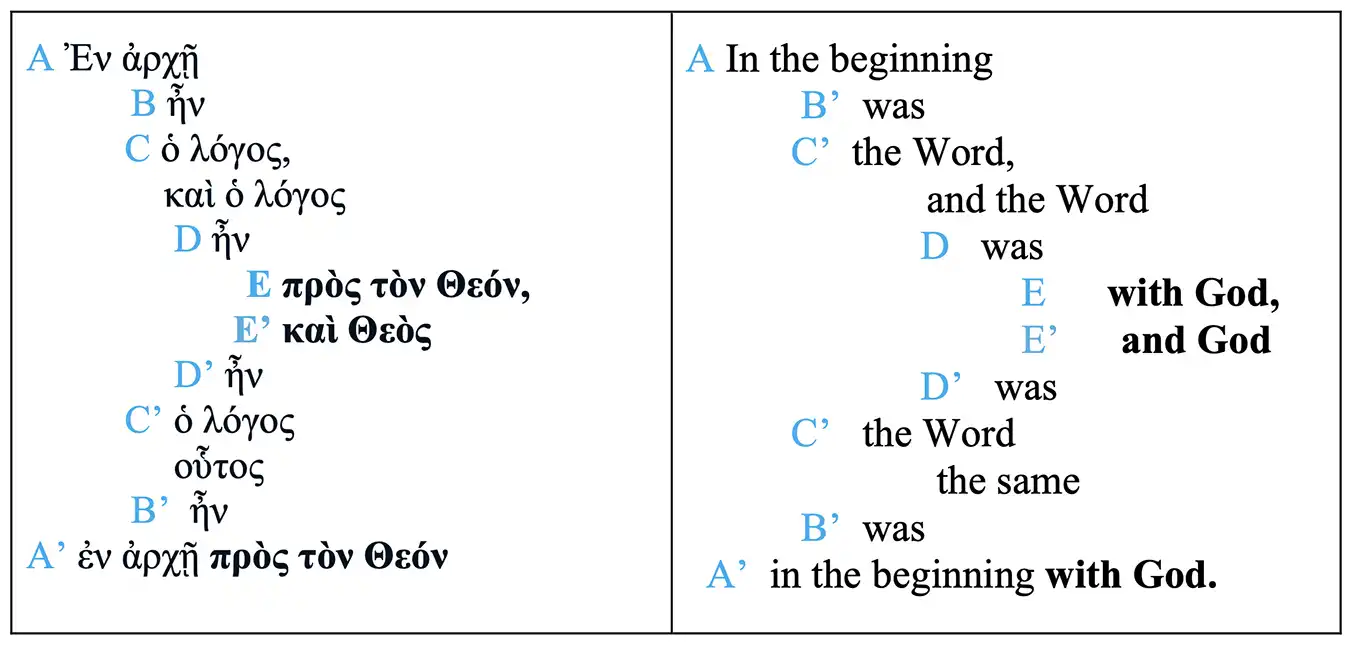
John 1:1 provides another example of how the order and arrangement of words in the Greek New Testament can be seen to follow Hebrew norms. The Greek text omits the definite article and can be literally rendered “In beginning.” This follows the Hebrew structure of Genesis 1:1, where the definite article is absent and can also be literally translated as “In beginning.” Though the style of Genesis 1:1 is normal in Hebrew, it reads as peculiar in Greek, and the unusual sentence structure therefore directs the Bible student back to the Hebrew of Genesis 1 to understand what God is communicating in John 1.
A further example of Hebrew word order in the Greek appears a few verses later in John 1:6, where the English phrase “whose name was John” looks like the following in the Greek text: ὄνομα αὐτῷ Ἰωάννης, and literally means “name to him John.” While any English reader will find this word order strange, and not something we would say in daily English, Greek scholars will tell us it is just as strange in Greek. However, this word order follows the succinct Hebrew style of announcing a name. In Hebrew, “name to him John” is the normal way of speaking, and this demonstrates what we see repeatedly: Hebrew not only underpins the Greek text in poetic patterns and style, but also in word order.
This relationship between the Old and New Testament texts is so prevalent that when Robert Lindsay translated the Gospel of Mark into Hebrew, he found that the New Testament Greek consistently provided him with the correct word order for his Hebrew translation.1
Since I became aware that Hebrew word order underpins the Greek text, I have tried to use this when studying passages of Scripture. Sometimes, the word-order link is clear in our English Bible translations. But more often than not, our English versions obscure what would otherwise be an obvious link, a signpost that would prompt the Bible reader to go back and study the Old Testament passage on which the Greek is commenting.
I will give one example of this Hebrew-Greek word-order parallel that I observed by slowly reading the book of Romans in Greek. Once you notice the Greek word order, the obvious link to a Hebrew Old Testament passage jumps out of the text (even though our English versions obscure it in both the Old and New Testaments).
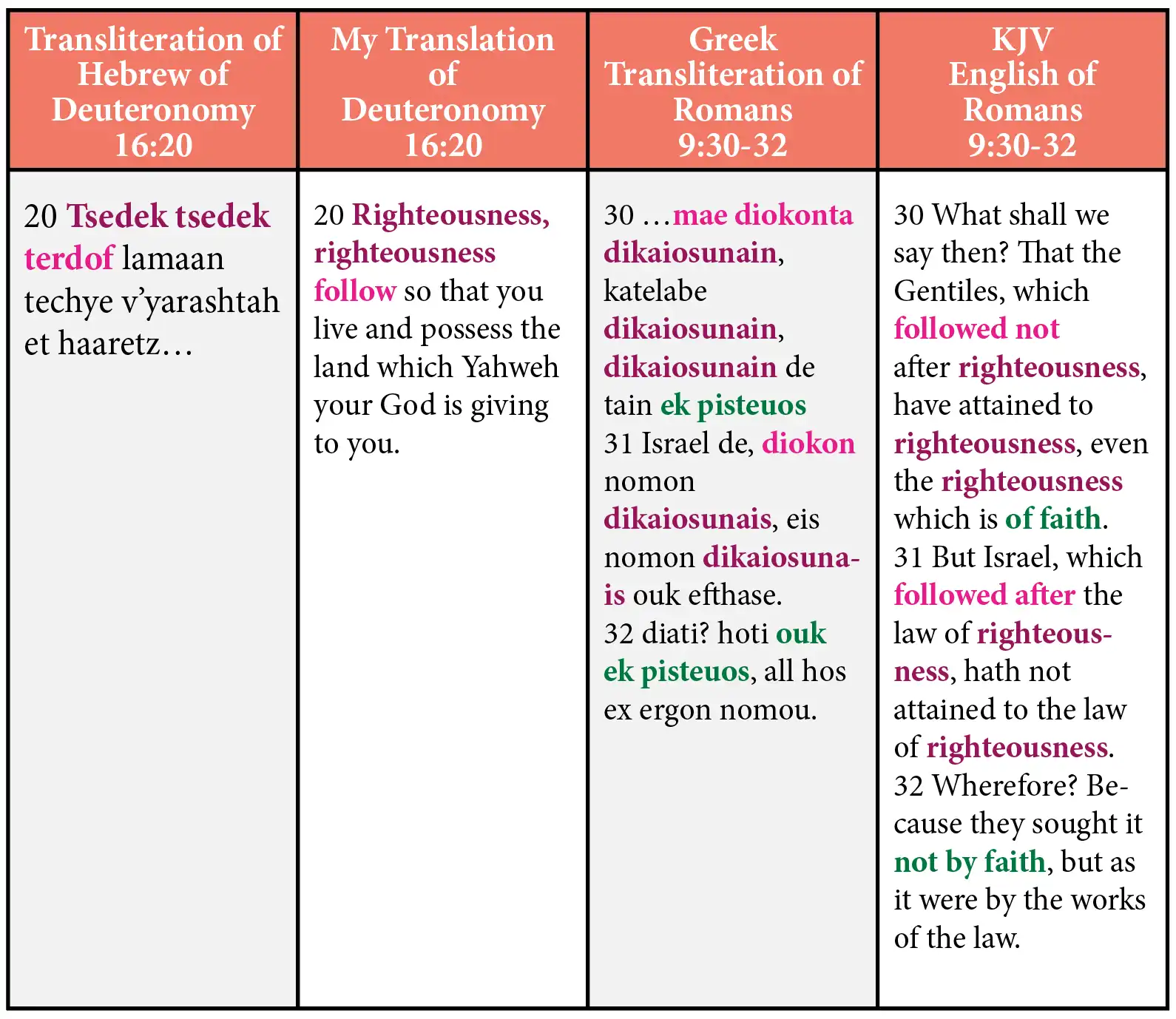
When Romans 9:30 is read in the Greek, the double use of the word “righteousness” is striking as written below: “What shall we say then?, the gentiles which followed not after righteousness, have attained to righteousness righteousness of faith.” (my translation).
The English versions all insert connecting words between the repetition of “righteousness” and so obscure the exact structure found in Deuteronomy 16:20. An English version reading of Deuteronomy 16:20 gives a translation of “that which is altogether just you shall follow,” but as the KJV (Cambridge) margin notes, “altogether just” is simply “justice justice” or “righteousness righteousness.” Deuteronomy 16:20 literally translated would be “righteousness righteousness follow.”
God instructed Israel, as His people, that they would occupy the land because of His righteousness, not their own (9:4, 5, 6). The repetition of “righteousness” in Deuteronomy 16:20 should have caused every Israelite to ask what righteousness they should follow. Isaiah 51:1-2 picks up the theme by instructing those who “follow after righteousness” to look to Abraham and Sarah, who found God’s righteousness through faith, rather than trying to prove their own righteousness. The passage later emphasizes this same righteousness: “Hearken unto me, ye that know righteousness, the people in whose heart is my law.” (Isaiah 51:7). Romans describes how the mistake of the Pharisaical mind was to seek to demonstrate their own righteousness by keeping the law instead of understanding the need to live by faith. By “following” what they thought was the way to righteousness, “by the works of the law,” Israel had not attained to God’s righteousness.
By contrast, the Gentiles, who in past times “followed not” after righteousness, have now heeded the instruction of Deuteronomy and followed the righteousness of God, not by works of the law but by the obedience of faith. So, it can be said of them that the Gentiles have now attained to “righteousness righteousness of faith.” And the argument in Romans moves on in chapter 11 to explain how the Gentiles are now grafted into the tree of the hope of Israel because they “stand by faith” (Romans 11:20), whereas, for a time, the branches of natural Israel are broken off because of “unbelief.”
Therefore, the doubling of the word “righteousness” in proximity to the command to “follow” creates a word-link bridge across the two languages of the Testaments and powerfully reinforces that God’s inspired instruction has remained the same over millennia.
See Romans 9:30-32 aligned against Deuteronomy 16:20 below:
Beginning to Read the Bible in Hebrew and Greek
In this 500th year since William Tyndale’s English New Testament reached the shores of England, we cannot overstate the immense privilege we have had for so long, to read the Word of God so faithfully translated into our own language, English.
Nevertheless, sometimes our English Bible versions can veil the Bible message, and by peeling back the English to see what underpins it, we can see how clearly and simply the Hebrew and Greek word orders can make plain the profound teachings across the Testaments written by our Heavenly Father.
Since I have no formal training in Hebrew and Greek, I can understand how accessing and comparing the original texts can be daunting and, at times, seem impossible. However, I implore you to see how you really can investigate God’s word in this way. Many online Bible versions offer an “interlinear” function that places the English translation of a word underneath the original Hebrew or Greek. With these tools, the Bible student can clearly see the word order (including word repetition). You can test this yourself with the table shown above; the repetition of the same order of sounds in the original languages is clear when you pause to evaluate the words.
I can assure you that a little Hebrew and Greek knowledge can go a long way in Bible study, and there are plenty of self-study guides to help you grasp the basics. Once you move past the hurdle of learning a new alphabet, you will find reading the sounds of the Hebrew or Greek texts really enjoyable, and you will see how many words you already know through your Bible knowledge and your knowledge of English.
Remember, no one will put you on the spot; this is not a timed test. Anyone who has tried to learn another language knows the hardest parts are active listening and real-time speaking. After that comes writing with all the nightmarish challenges of grammar rules. But with Bible study, you can set those skills aside and focus on the much more passive skill of reading.
You can take as much time as you want. No matter how slowly you read the text or compare words, it will yield fruit in due season. In fact, slower Bible reading is preferable as it aids more careful and diligent consideration; when one is less familiar with Hebrew and Greek, it can lead us to analyze each word in turn, which can give truly wonderful insights and comparisons across Old and New Testaments to support the reading of our main English Bible (as I’ve tried to demonstrate with the examples above).
We started by quoting Professor Harrison’s description of Hebrew, but for some years I have amended his words to better reflect the cross-Testament character and urgency of the Biblical message to all: Hebrew and Greek are the languages in which God speaks. Hear His message.
Mike Jenner,
Rugby Ecclesia, UK
-
Robert, Lindsay, A Hebrew Translation of the Gospel of Mark: Greek-Hebrew Diglot with English Introduction (Jerusalem: Dugith Publishers, 1973).