Written Beforehand: Why Old Scrolls Matter
A groundbreaking study using AI and refined carbon dating suggests the Dead Sea Scrolls may be older than previously believed. This reinforces our confidence in the reliability and prophetic nature of Scripture.
 Read Time: 10 minutes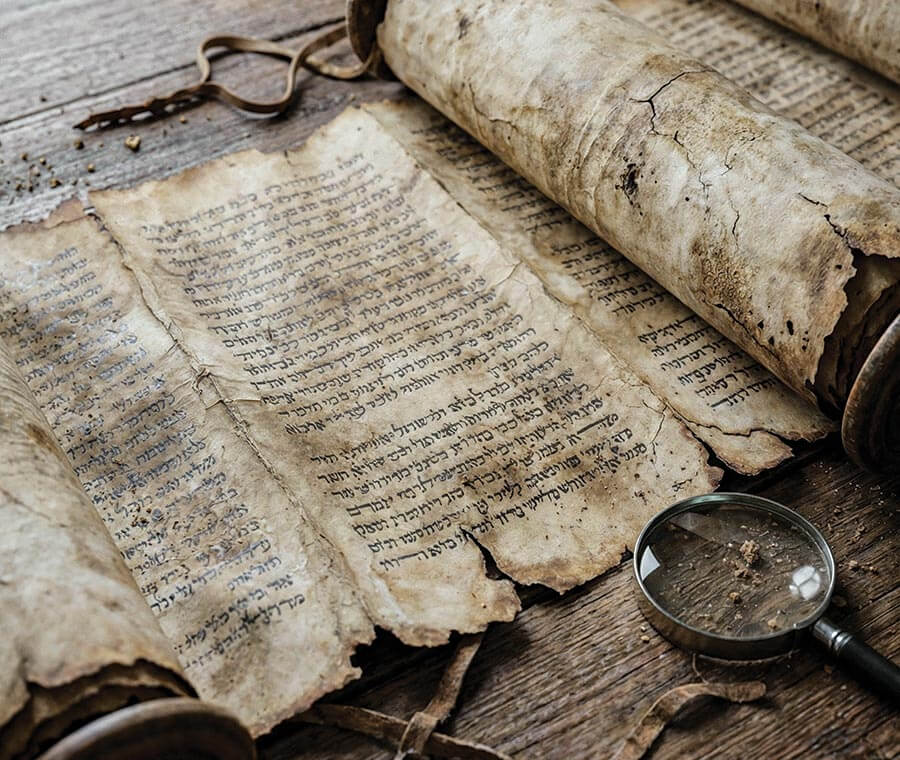
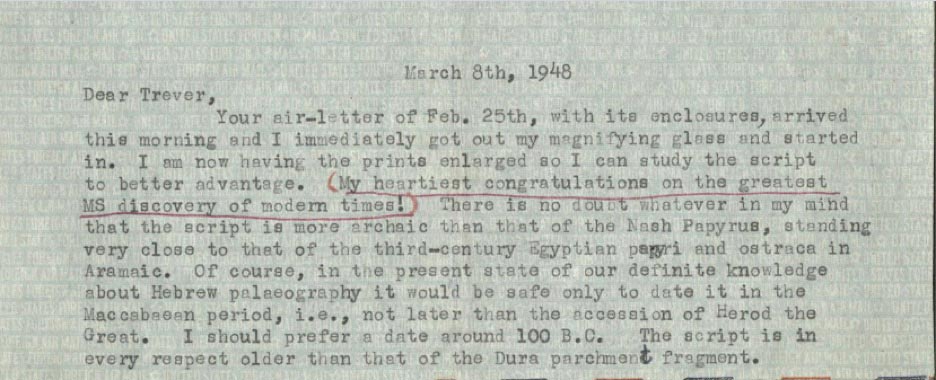
It was early 1948. Mar Samuel, the head of a monastery in the Old City of Jerusalem, presented the first four newly discovered Dead Sea Scrolls to John Trever, an American researcher in Jerusalem, and Trever felt a sense of awe. He took pictures of what he believed would profoundly change Biblical scholarship and then sent them to William Albright, his superior, who was on sabbatical at Johns Hopkins University. Albright wrote back:
Albright was right. While Trever himself didn’t find the scrolls, this collection would certainly become one of the greatest manuscript discoveries of modern times, if not of all time. The caves at Qumran, where the majority of the Dead Sea Scrolls were found, have yielded almost 1,000 scrolls and tens of thousands of fragments. And, just as Trever and Albright realized, this discovery would indelibly change the course of Biblical studies. They did so first by proving that the Hebrew manuscripts underlying the text we use today are accurate (in part by using the Great Isaiah Scroll, which Kevin Leadbetter discusses later in this issue). They did so again by demonstrating that at least two different Hebrew texts for certain passages existed simultaneously, explaining why the Septuagint sometimes diverges from the Hebrew used today. Nevertheless, their most significant impact may yet be to come. Just a few months ago (June 2025), researchers published a new study with profound implications. The study focused on the dating of the Dead Sea Scrolls.
You might wonder why the topic of dating old scrolls would find its way into an editorial. Isn’t our faith living, active, and relevant? So why do we care about old scrolls?
 Dating the Dead Sea Scrolls
Scholars possess numerous tools for dating manuscripts—and today, these techniques are significantly more advanced than what William Albright could use from his office at Johns Hopkins, thousands of miles away from the scrolls. As he wrote above, Albright studied the lettering on the scrolls. By doing so, he could compare the lettering to other known manuscripts, such as the Nash Papyrus and the Dura parchment fragment. We refer to this comparing of scripts as paleography. While it can certainly help determine a range of time in which a document could have been written, it is not an exact science. Thus, Albright stated above that the scrolls would date to “the Maccabaean period.” He couldn’t give an exact year, though he suggested they were written around 100 B.C.
Furthermore, paleography has significant limitations. While scripts follow general trends, not everyone conforms to them. For instance, previous American generations often wrote in cursive, so seeing a letter in cursive helps identify it as a letter from an earlier generation. Yet, what about those who didn’t write in cursive? Or those from younger generations who liked writing in cursive? Paleography can offer suggestions, but it is limited by the fact that not all people write the same way across generations.
Thus, as carbon dating developed, it offered another means of dating the scrolls. Even more, by bringing the paleographic and carbon dates together, scholars could check their work and feel more certain about their conclusions. In a number of cases, using both methods, scholars dated many of the Dead Sea Scrolls to the first and second centuries B.C. These dates, in themselves, take our breath away, considering that almost no other Biblical manuscripts have been found that date back before the time of Christ. But, while something can be old and interesting, that doesn’t necessarily mean that it’s relevant.
So what’s the connection to today? Well, carbon dating also has its problems. Just like paleography, it isn’t exact and gives a range of time. Even more, carbon dating can be thrown off when a researcher inadvertently measures a contaminated object—essentially measuring the carbon-14 in the wrong substance. That’s what was realized recently: scholars found that many of the date ranges for the Dead Sea Scrolls, determined by carbon dating, were based on contaminated manuscripts. Mladen Popović, the head author of this most recent study, explains: “The problem with earlier tests [on the scrolls] is that they didn’t address the issue of castor oil… Castor oil is a modern invention, and it was used in the 1950s by the original scholars to make the text more legible. But it’s a modern contaminant, and it skews the radiocarbon result to a much more modern date.”2 Consider that last sentence: the Dead Sea Scrolls might actually be older than initially realized.
Popović and his coresearchers published the findings of their study in an academic paper entitled “Dating Ancient Manuscripts Using Radiocarbon and AI-based Writing Style Analysis” in June 2025. Instead of relying on human paleographic analysis, they decided to use Enoch, an artificial intelligence model they trained to analyze ancient handwriting. Thus, their study approached dating the scrolls in two ways: carbon dating (accounting for castor oil) and paleography by AI. Their results are shown in the chart that follows.
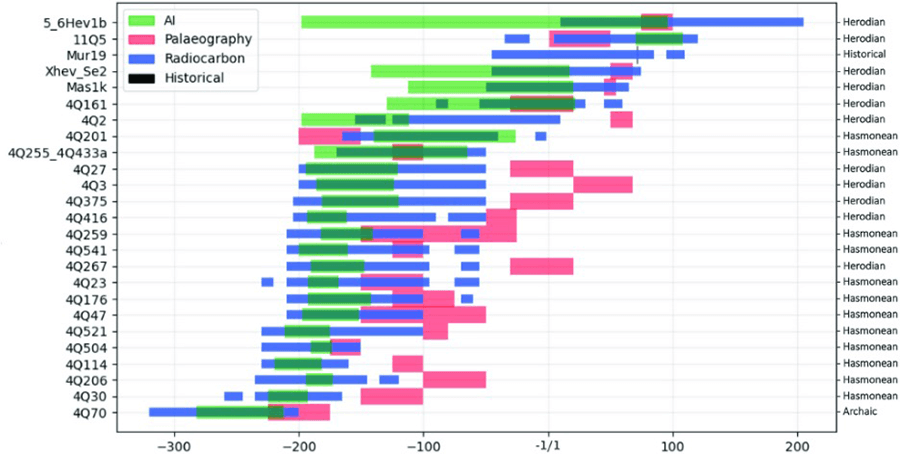
The numbers at the bottom represent centuries. The negative numbers are B.C., while the positive are A.D. The numbers and letters on the left are the names of different Dead Sea scrolls.
Mladen Popović, Maruf A. Dhali, Lambert Schomaker, Johannes van der Plicht, Kaare Lund Rasmussen, Jacopo La Nasa, Ilaria Degano, Maria Perla Colombini, Eibert Tigchelaar, “Dating ancient manuscripts using radiocarbon and AI-based writing style analysis,” PLOS One, June 4, 2025.
While this table might not appear to mean very much at first glance, it demonstrates that almost all of the manuscripts tested appear to be older than initially thought. The previous paleographic analysis dated the manuscripts to either the first or second centuries B.C. (and in some cases, the first century A.D.). Nevertheless, the revised carbon dating and Enoch dating placed most of these manuscripts at least a century later than the paleographic analysis.
When this study first entered the mainstream media, it created some explosive headlines. One writer entitled his post, “Dead Sea Scrolls May Have Been Written By Original Authors Of The Bible.”3 Popović himself made a similar statement.4 This claim may sound too good to be true. Could it be that Jeremiah or Ezra or Nehemiah actually wrote the text of one of the Dead Sea Scrolls?
Unfortunately, headlines are often sensationalized, and researchers’ statements can be taken out of context. This redating only pushes the authorship of these scrolls back to the third century B.C., and by that time, the Biblical record had entirely closed. The latter period of the Old Testament wrapped up around the turn of the sixth to the fifth century. So what did Popović mean when he stated that some of the Dead Sea Scrolls might date to the time of their author? Like many scholars, Popović believes the Biblical text was written centuries after it claimed to be written.
The Book of Daniel provides an example of this. Because Daniel’s prophecy in chapter 11 so accurately reflects Antiochus IV’s campaign against the Jews, scholars have suggested that this chapter (as well as others connected to it), must have been written while the events were taking place, sometime in the 160s B.C.: “The third apocalypse (originally only 10:1-12:4) was written by a third author shortly before the summer of 165 B.C. when he expected a third campaign of Antiochus against Egypt (cf. Dan 11:40-44), which as a matter of fact did not take place.”5
Scholars often approach prophecy in this way—declaring that the prophecy must have been written either after the event or during the event, but it couldn’t possibly have been written before. While this new dating of the Dead Sea Scrolls does not allow Daniel to have been the author of any of the specific Dead Sea Scroll manuscripts themselves, it does create an interesting situation for this scholarly approach to dating prophetic manuscripts. Looking at the chart on page 5, 4Q114 (the fourth from the bottom) is a manuscript of the Book of Daniel. Specifically, it is a fragment mainly containing Daniel 11. Popović and his team dated it to just around 200 B.C.
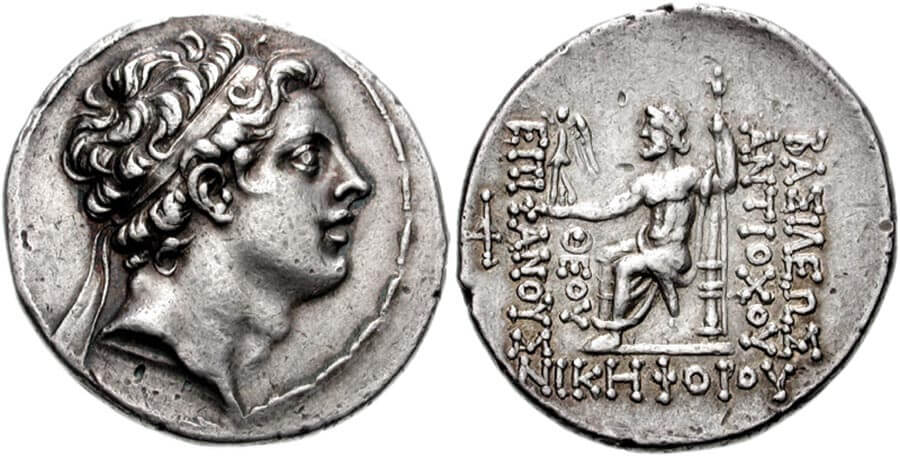
Attribution: Classical Numismatic Group, Inc. http://www.cngcoins.com
Just think about what that means. Scholars have dated the Book of Daniel to the 160s B.C. because Daniel 11 clearly gives a detailed account of Antiochus IV. And yet, this study suggests that 4Q114, a copy of the Book of Daniel from Qumran, dates to around the time of Antiochus’s birth. In other words, somehow, Antiochus’s very actions against the Jewish nation were recorded before he ever even thought about them. How could that be possible?
I think we know.
In this issue of the Tidings
This month we present numerous articles focused on taking the Word of God as the Word of God. We look at how to make it practical in your life. David Fraser continues his series on relationships. Tim Pommer considers Biblical examples of leadership. Maritta Terrell begins her discussion of Mary and Martha and how the story of these two sisters reflects on our own approaches to Christ. In the “Stuff that Works” column, Steven Cox and Alphonce Kyallo explain how we can use new tools to bridge the language barrier and share the gospel. In the Mothers’ column, Nancy Brinkerhoff encourages us to make praying for our children a habit. Our magazine’s mission is to support you as you change your life and follow the steps of the Lord.
But it’s also intended to provide a solid doctrinal and Biblical foundation upon which you can build those changes. Thus, this issue not only focuses on the practical, but also on the theoretical. In “Back to the Original,” Peter Trotter discusses how the names of the kings of Israel and Judah relate to their stories. Kevin Leadbetter examines the Great Isaiah Scroll and the argument for God’s existence that it presents. Remi Wigzell explores Christ’s humanity, Ben Brinkerhoff continues his series on Romans 7-8, and Andrew Weller finishes his series on Titus. Through these articles, we encourage going deeper and appreciating that depth in Scripture.
Finally, there is one other theme in this issue: the hand of God. Continuing on the theme from last month of “Why I’m a Christadelphian,” Isabella and Julio Sotomayor tell their story of conversion and how God brought them into this community. Chris and Martha sales discuss a new upcoming Bible school. Jim and Jean Hunter write about the Bible School in El Salvador, and Martin and Lois Webster give an update on the brothers and sisters in St. Lucia (even requesting that we get involved, if we can). In “Thoughts on the Way,” George Booker creates a fictionalized depiction of one of the shepherds who heard of Christ’s birth. In this issue, we focus on the practical, we build on the doctrinal, and we appreciate the providential.
So why an editorial on old scrolls? Because these scrolls remind us of why we do all of these things: because we know what the scholarly community so often struggles to see. The Word of God is truly the Word of God. That conviction makes the practical matter. It makes the doctrinal relevant. And it makes the providential powerful. That’s why we care about old scrolls.
Jason Hensley
- William Albright to John Trever, March 8, 1948. Exhibit Location On View in Ronald Reagan Presidential Library and Museum, Simi Valley, CA.
- Mladen Popović, quoted in Jacopo Prisco, “AI analysis of ancient handwriting gives new age estimates for Dead Sea Scrolls,” CNN Science, June 7, 2025.
- Benjamin Taub, “Dead Sea Scrolls May Have Been Written By Original Authors Of The Bible,” IFLScience, June 4, 2025.
- Mladen Popović, quoted in Jacopo Prisco, “AI analysis of ancient handwriting gives new age estimates for Dead Sea Scrolls,” CNN Science, June 7, 2025.
- Louis Hartman and Alexander A. Di Lella, “The Book of Daniel,” The Anchor Bible (New York: Doubleday, 1977), 13-14.