Book Review: “The Word Became Flesh”
The Word Became Flesh explores how Jesus fully expresses God’s mind, purpose, and authority. It unpacks John’s Gospel, showing Jesus as the ultimate expression of God’s will and message.
 Read Time: 2 minutes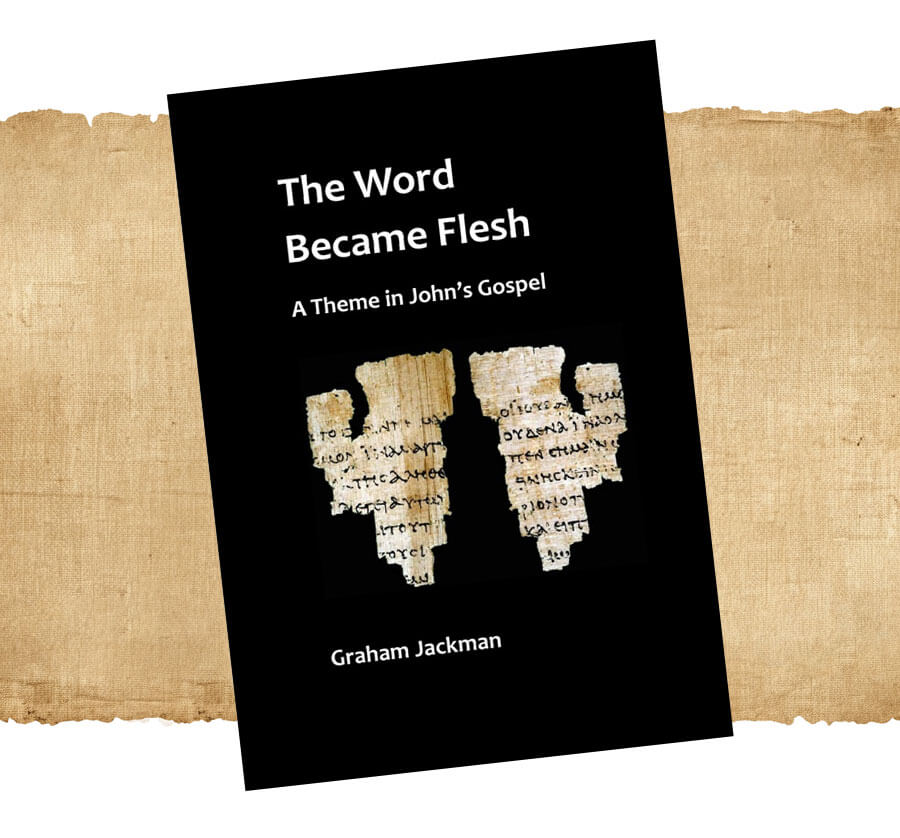
The Gospel of John stands apart from the other New Testament gospels, with its extended discourses, its omission of many incidents reported by the other gospels, and its emphasis on the spiritual significance of Jesus’ miracles and teaching. In The Word Became Flesh, Brother Graham Jackman explores these differences and draws out the unique message of John’s Gospel for readers today.
As the work’s title suggests, a key focus of Brother Graham’s book is the interpretation of the prologue to John’s Gospel (John 1:1-18). In two key chapters, chapters 3 and 4, he first counteracts the Trinitarian interpretation of the prologue put forward by many contemporary scholars, and then sets out a positive case for Jesus as the embodiment of God’s revelation to the world. Among many helpful ideas is Brother Graham’s use of the Jewish concept of the shaliach—an agent or emissary—to illustrate the relationship between God and Jesus as presented in John’s Gospel. Like such an agent, Jesus is both subservient to the Father, but also comes with the Father’s full authority.
Beyond his analysis of John’s prologue, Brother Graham argues that the phrase “the word became flesh” encapsulates a much wider theme of John’s Gospel. The gospel was written to show how Jesus is “a new form of speaking on God’s part” (p. 11)—the ultimate articulation of God’s mind, will, and purpose. In a chapter defending the historicity of John’s Gospel, Brother Graham argues that the writer intended to demonstrate to early Christians the significance of Jesus’s earthly ministry in the retrospective light of his resurrection. The gospel shows how the words and deeds of Jesus, which were not understood by disciples at the time of Jesus’s ministry (e.g. John 14:5, 8; 16:17-18) were made clear after he had risen (John 16:25).
Brother Graham’s work is also notable for its in-depth engagement with the work of many scholarly commentators on John’s Gospel. He draws on what is valuable and illuminating in such works, as well as critiquing their adherence to Trinitarian orthodoxy in their interpretation of the Gospel. This balanced approach is a helpful illustration of the way in which, as a community, we can engage with wider Biblical scholarship while maintaining our distinctive doctrinal understanding. Some readers unfamiliar with the kind of scholarly ideas discussed may find some sections of Brother Graham’s book less easy to read, but they may find chapter 6 especially useful. It provides an overview of the whole gospel, emphasising its purpose of calling men and women to faith in Jesus Christ (John 20:31).
Finally, in chapter 7, Brother Graham concludes by arguing that the Gospel of John is itself an example of the ‘word’ becoming ‘flesh’. Besides being a record of God’s revelation in Jesus, it is a work of literary and artistic beauty, whose language and symbolism have the power to affect readers spiritually and emotionally—and thus to inspire them with the faith the Gospel seeks to communicate. The spiritual purpose of John’s Gospel is therefore also a practical one: to lead its readers to deeper faith and greater love, following the example of Jesus.
James Andrews,
Kenilworth Ecclesia, UK