Gethsemane
The garden of Gethsemane becomes a place to learn faithful surrender when God’s path is painful, uncertain, or different from the one we hoped for.
 Read Time: 8 minutes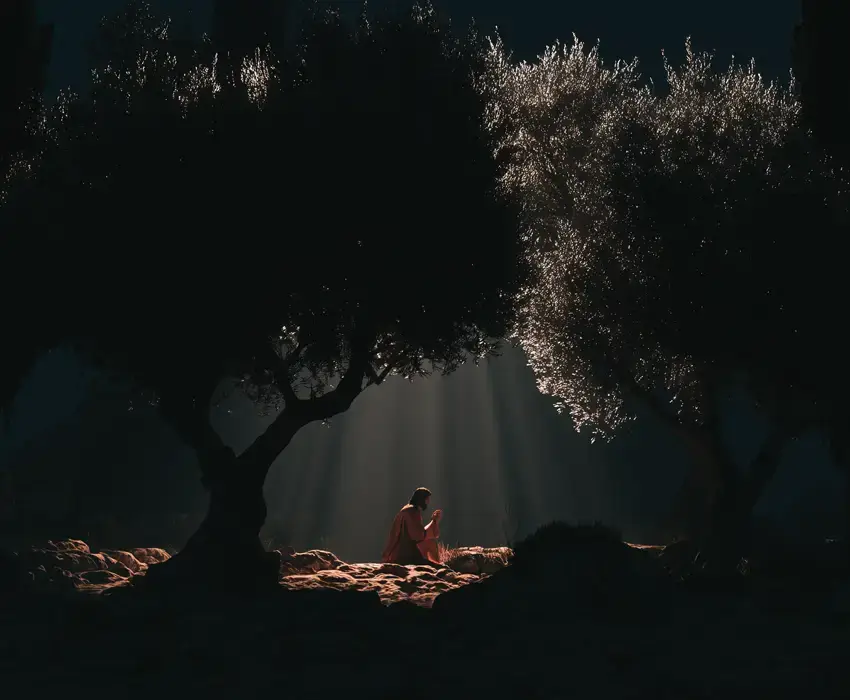
There is a hymn that says, “When my love for God grows weak, when for larger faith I seek, then in thought I go to thee, Garden of Gethsemane.”
It’s probably not my first go-to when my love for God grows weak, or where for larger faith I seek, but we would all do well to go there in those moments. When you look back on the year past, maybe some things have happened in your own garden where you were terrified, afraid of giving something up. Maybe in the year ahead, you’re nervous that there’s going to be a turn in the road, a twist, a place where God calls you that has a roadblock, a detour, something that you didn’t think was going to happen.
Have you ever wrestled with something where it was quite clear the direction God wanted you to go, and even though it was not what you planned, you knew God was leading? We faced a bit of that with my company’s recent decision to move us to the US for a while. We’re sure there will be elements of it that will be a trial, but we also see some elements of joy on the other side, and we are trusting God for that. But it was scary. There are scary things about being called into a place when a lot seems to be going wrong.
You might wrestle with God in that. You might wrestle with God about being called to this road you didn’t want to take. This uncertainty isn’t about the mechanics or the scope of providence, but the idea that God leads us in a way that sometimes we don’t want to go, when we clench our fists, wrestle at the sky, and say, “Lord, can there be another way?” “Not my will, but Yours be done.” (Luke 22:42).1
God knows the trials, and He bids us to them to grow, and we wrestle with that. Not everything that parents require, they enjoy. You must go to the dentist. You must go through certain things that even a parent knows might involve some pain. It might be uncomfortable, but you need to go this way. The Lord, on his way to life, was bid to go the way of the flaming sword. To get back to the garden, he had to go the way of the flaming sword. And so must we, inevitably, in our lives.
When our love for God grows weak in those moments, when we feel like we need larger faith to get through, Gethsemane is a great place to go to be encouraged, strengthened, and to right our minds about how we should wrestle with God and prevail.
The Longest Night
As I was piecing this together, I had to look at all four gospels to see the sequence of events that happened in the garden. First, the Last Supper. Picture it in your mind: about 7:00 to 9:00 pm. There’s a meal, teaching, and prayers, all conveniently summarized in John 13 through 17 in explicit detail.
Then, about 10:00 or 11:00 pm, they all take a walk across the Kidron Valley. This is a real place. It’s a real valley. The disciples really did not know what was about to happen. And so they sang a hymn. We are told in Matthew and Mark that music was a big part of getting prepared for what was going to happen in that garden. There’s a great exhortation for us there. When you’re about to go through a difficult time, use spiritual music to fill you and strengthen you. It reminds me of Isaiah 61:3 (KJV): Put on “the garment of praise for the spirit of heaviness.” Praise brings perspective.
So they arrive in the garden. Jesus prays three times, and the people he asked to be with him during his time of trial were asleep. Luke notes in particular that they were sleeping not just because they were physically tired; they were emotionally tired. They were sleeping for sorrow (Luke 22:45). Yes, it was late at night, but when you’re sorrowful, you just want to go to sleep. You’re emotionally drained.
That period of prayer lasted for about an hour. Then, around midnight to 1:00 am, Judas arrives. Next come the trials before the high priest, Peter’s denial, and the rooster crowing during the third watch, just before the dawn. As soon as it was morning, Jesus is sent off to Pilate, which was about 3:00 to 6:00 am. What a night!
Wrestling with the Will of God
You often don’t think this is literally happening in the middle of the night. It is not only physically dark, but a dark moment for the Lord. In his evening meal, he instituted the bread and the wine. He washes the disciples’ feet. He tells Peter that he’s going to deny him. He foretells Judas’s betrayal. Just think about how heavy that upper room was for the disciples. It was an overload for them.
But when he gets to Gethsemane, it’s not just the disciples who are sleeping for sorrow. Jesus himself says, “My soul is very sorrowful, even to death.” (Matthew 26:38 ESV).
In your life, have you ever been so sad that you feel like you might just rather not be around? That’s a very confronting question to ask, but I know that’s true for many. When you’re so sorrowful because you can’t quite see the other side, and you just feel like you can’t make it. So what does Jesus do? He does what we all should do, which is pray, and then pray again, and then pray again.
Jesus went with them to a place called Gethsemane. He said to his disciples, “Sit here while I go over there and pray.” (Matthew 26:36). Going a little farther, he fell on his face and prayed, saying, “My father, if it be possible, let this cup pass from me; nevertheless, not as I will, but as you will.” (Matthew 26:39).
Sometimes in our wrestling with God, we ask if there is another way. And when no answer comes, or an opposite one does, we must, at some point, accept that this is the way. Even if it may be the way of grief in your life, there’s no harm in asking. But sometimes God’s answer is no. Even the Lord wrestled with this, but you see his perspective change. He submits. He surrenders. He says, “My Father, if this cannot pass unless I drink it, Your will be done.” (Matthew 26:42). It seems that this second time, he’s really got to convince himself of this. And sometimes we need to do it twice, too. Maybe seven times. But the Lord prayed the same thing over and over: “Not my will, but yours be done.” (Luke 22:42).
The True Victory
The word Gethsemane means an “oil press.” I like oil and wine, and I’ve seen both oil pressed from olives and wine pressed from grapes. It’s not a fast process. The result of that process, compared with using a large machine, is a much more refined product. The process of extracting in that slow, increasing pressure yields something that otherwise would not be yielded. Gethsemane was an olive grove. When you walk into Gethsemane, it is a lonely place in a valley. You can look across and see Jerusalem, still unbelieving. And you think: the Lord won his victory right here in the garden.
Now, you wonder why I say that. Why not say he won on the cross? Because I don’t think the Lord won the victory over sin on the cross. It was finished upon the cross, but the victory was won in the garden. It was the victory that we must all figure out how to win for ourselves. It’s the victory over our own will—submission to God.
The true battle, the moment, the crossroads where the Lord had to win, was in the garden. He even said, “Do you think that I cannot appeal to my Father, and He will at once put at my disposal more than twelve legions of angels?” (Matthew 26:53). “Shall I not drink the cup that the Father has given me?” (John 18:11 ESV) . That is the ultimate victory. And that’s the victory we must all win this coming year, to bring our wills into the will of God. We accept that God’s sovereign hand is upon us. We accept that the crucible is for silver and the furnace is for gold (Proverbs 17:3). The Lord presses the hearts and tests us.
If anyone has seen The Passion of the Christ movie, one thing I really appreciated was its depiction of Christ in the garden. A snake comes out from an olive tree. As an angel strengthens the Lord, he stands up and smashes the head of the snake with his foot. I remember going through so much at the time, and when I saw that moment, I just about cheered in my seat because that’s exactly what happened. He crushed the head of the serpent. That crushing of the head of the serpent—the thinking of the serpent—didn’t happen when he crushed his body on the cross. He crushed the head of the serpent in the garden.
In Genesis 3, the first covenant in Eden is made in a garden. When the snake came into that garden, rather than conquering it and saying, “Not my will but yours be done,” Adam and Eve succumbed to the serpent’s thinking. They lost the battle. Gethsemane is the exact opposite of what happened in Genesis 3. Jesus gained victory over the serpent’s thinking. That’s why from that point on, when you see the Lord, he has confidence. He’s in control. He’s literally preaching from the cross. That’s because he had already won. He won in the garden.
The Place for Friends in Suffering
Jesus didn’t pray alone. He chose close friends to be with him. He withdrew from them about a stone’s throw (Luke 22:41). Why a stone’s throw? Because they were close enough to be with him and see, but not close enough to say or hear anything. They watched the Lord commune with his Father. It was an extremely intimate moment the Lord had with his Father, and an angel appeared from heaven to strengthen him (Luke 22:43).
If you have watched the series The Chosen, you may have seen in the last episode of the last season how they depicted it: bringing to the Lord’s mind the place where Abraham wrestled with sacrificing Isaac. Perhaps he was thinking about the future glory. Hebrews 12 specifically says that we look to Jesus, “who for the joy that was set before him endured the cross.” (Hebrews 12:2 ESV). That endurance began in Gethsemane. In that moment, he was strengthened by visions. In Psalm 16, which we know was on the Lord’s mind, it says: “You will not abandon my soul to sheol… in your presence there is fullness of joy.” (Psalm 16:10-11 ESV). The Lord was strengthened by a vision of the future. The resurrection was on the other side.
I hope that for you, there’s a place—an altar that you can return to, where you do business with God by yourself. And if you have one of those places, try taking someone with you. Have someone there. Maybe they’re a stone’s throw away, or maybe they’re right there by your side.
We have angels in our lives, too. It reminds me of when David was running from Saul. Where is the promise? Where is the crown? He accepted God’s timing, but he needed strengthening. And who showed up? Jonathan. It says that Jonathan, Saul’s son, rose and went to David in the wood and strengthened his hand in God (1 Samuel 23:16 ESV). It doesn’t always have to be an angel coming from heaven in those times where we’re wrestling with God. Sometimes it’s a friend. Jonathan knew David well enough to realize he needed to go to him. And I have an exhortation for you: when you see someone struggling, go to them. Don’t wait for them to ask for help.
Conclusion
Our lesson, even if it’s in an olive press, is that when we reach our own Gethsemane, it will not be easy. That wrestling in prayer produced hematidrosis, a phenomenon in which Jesus literally sweated blood (Luke 22:44). Sometimes, we are going to wrestle with the plan of God right down to the point where blood comes out. But God will provide the strength to get through it. “Trust in the LORD with all your heart, and do not lean on your own understanding. In all your ways acknowledge Him, and He will direct your paths.” (Proverbs 3:5-6).
Beyond where Kidron’s waters flow,
Behold the suffering Saviour go
To sad Gethsemane;
His countenance is all divine,
Yet grief appears in every line.
He bows beneath the sins of men;
He cries to God and cries again,
In sad Gethsemane;
He lifts his mournful eyes above—
“My Father, can this cup remove?”
With gentle resignation, still
He yielded to his Father’s will,
In sad Gethsemane;
“Behold me here, thine only Son;
And Father, let thy will be done!”
The Father heard; an angel there
Sustain’d the Son of God in prayer,
In sad Gethsemane;
He drank the dreadful cup of pain,
But rose to life and joy again.
And so will we.
James DiLiberto,
Canterbury Ecclesia, VIC
-
All quotations, unless otherwise noted, are from the New American Standard Bible.
You commented:
“He withdrew from them about a stone’s throw (Luke 22:41). Why a stone’s throw?”
Typically, the serpent-like head of Goliath was also a stone’s throw away from David.