Giving the Sense
Shawn Moynihan reflects on careful Bible teaching, showing how clarity, context, and reverence help Scripture become understandable and alive.
 Read Time: 8 minutes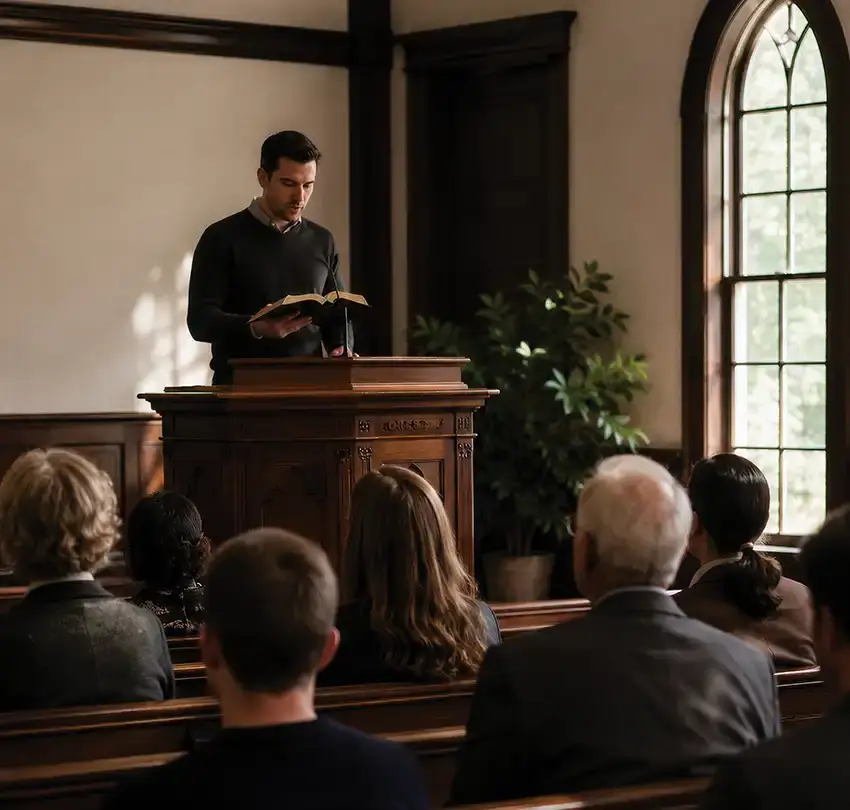
Public reading of the Bible has always been an essential part of the ecclesia’s communal worship. Paul directs Timothy to focus on this: “Until I come, pay attention to the public reading of the Scriptures.” (1 Timothy 4:13 CJB). The use of the noun form and the definite article (found elsewhere only in 2 Corinthians 3:14 and Acts 13:15) indicates that in the first century, “The Reading” was a technical term for the formal reading of Scripture during the ecclesia’s worship. By using this specific noun, Paul is identifying the “reading slot” in the ecclesial order of service.
As a community that strives to replicate the beliefs and practices of the first-century ecclesia, it’s good to know that we are carrying on an important practice from that time. However, it is also important to recognize that many things have changed since Timothy unfurled the scroll to read aloud to the Ephesian ecclesia. In Timothy’s day, texts were much scarcer than they are today; listeners were not following along with the oral reading by using their personal scroll. Even over the last 20 years, circumstances have changed dramatically with the advent of portable technology. My grandfather brought a satchel to meeting—containing Young’s, Strong’s, and several different translations. I bring a cellphone that contains all those resources, plus many more.
However, one thing is unchanged: public reading is a communal activity. John emphasizes that public reading requires more than just the reader: “Blessed is the one who reads aloud the words of this prophecy, and blessed are those who hear.” (Revelation 1:3 ESV). The reader, the presider, and all audience members have important roles to play in ensuring that the reading is impactful.
What is the “best practice” for each of these roles in 21st-century ecclesias? But before exploring each role, it’s helpful to pause and reflect on why we read Scripture aloud.
Why Read Aloud as Part of the Worship Service?
God designed our brains to reap tremendous benefits from participating in communal reading. For the one reading aloud, there is increased retention of information.1 For audience members, just listening to a text being read aloud—without following along by visually processing the text—has been shown to dramatically increase what cognitive scientists call “Global Processing” (i.e., comprehending the text’s major concepts and themes). Moreover, simply listening facilitates what cognitive scientists have termed “Narrative Transport” (i.e., the feeling of being “lost in the story”). Therefore, even if the audience members don’t open their Bibles to follow along, simply listening enables them to grasp the main ideas and to be enmeshed in the narrative.
However, there are also powerful benefits for audience members who follow along in their own Bibles while simultaneously listening to the text. Cognitive scientists call this approach “Immersion Reading,” which has been shown to increase retention of information because it activates the occipital lobe (visual), temporal lobe (auditory), and the frontal lobe (executive function) simultaneously, creating a more robust neural network for the information.
By embedding the public reading of Scripture into our communal worship, God wisely created a structure for a deeper understanding of His Word.
The Role of the Presider
The presider of the Memorial Service or a Bible class can do several things to facilitate the effective public reading of Scripture. If a component of the public reading is from the Reading Companion, it is straightforward to inform potential readers of their task. If the reading is connected to the exhortation or class, then the presider must clarify if the exhorter or teacher has any preferences regarding the version to be read. If so, then the presider needs to share that preference with the reader.
Perhaps the presider’s most important task is not to wait until the last minute to find readers for the service. Whenever possible, contacting potential readers in advance is the best approach. In my experience, texting is the most efficient and effective way to get readers for the service. A simple text (e.g., “Can you please read Matthew 15 (KJV) for Wednesday Night class?”) sent the day before provides the requisite preparation time.
The Role of the Reader
The purpose of reading the Bible aloud is to create a shared experience of God’s Word. Such a shared experience creates a common understanding. This outcome is why Moses engaged in this practice (Exodus 24:7) and why he commanded it to be done every seven years (Deuteronomy 31:10-13). Joshua followed this practice (Joshua 8:34-35), and it was a key component of Josiah’s reformation (2 Kings 23:2; 2 Chronicles 34:30).
Ezra’s reading (Nehemiah 8:1-8) provides the most detailed example. He stood on a wooden platform and read the Law—from daybreak until noon—to the assembled people. Because the assembly was so large, Ezra had help from others. Ezra and his colleagues “read from the book, from the Law of God, clearly, and they gave the sense, so that the people understood the reading.” (Nehemiah 8:8 ESV).
Ezra and his colleagues provide the standard for readers:
- To read clearly
- To give the sense
- To enable the assembled listeners to understand
To Read Clearly
Reading clearly begins before the reader gets to the podium. Here are some important preparatory tasks. First, determine the kind of text you will be reading. If it is a narrative, you will want to bring attention to the events and to any dialogue. If it is a poem, you will want the inherent parallel structure of Hebrew poetry to be reflected in your reading. In 1888, The Christadelphian provided this advice:
The Scriptures contain every variety of composition that can be imagined: narrative, such as we have in Genesis, Ruth, and the four New Testament records; history, such as we have in Kings and Chronicles; poetry, such as we have in the Psalms; controversy, such as we have in Job; prophecy, proverbs, epistolary, and many other kinds of literary matter. To apply one style of reading to all these, is simply to murder the sense; or at the least to put it in a state of eclipse. Things should be so read, that the meaning is transparent to the listener.2
Match the reading to the text structure. This approach avoids semantic homicide and makes the meaning clear.
Second, scan for any challenging names (of people or places) and look up the correct pronunciation. Sometimes, you have options regarding pronunciation. For example, the word “Achaia” can be pronounced uh-KAY-uh (an English transliteration) or uh-KY-uh (more faithful to the original koine). Either one is okay; just pick one and be consistent in your reading. Third, if you are reading from the KJV, pay attention to any Jacobean words or phrases that are not in common usage today. Determine their pronunciation; for example, the word “concupiscence” (Romans 7:8; Colossians 3:5; 1 Thessalonians 4:5) is a classic example of a Jacobean word that has entirely vanished from contemporary English.
While you are at the podium, clear reading is the product of several factors. If the podium has a microphone, adjust it as needed before speaking. If the sound system is less than ideal, do a quick sound check (e.g., “Can you hear me at the back of the hall?”) before beginning the reading. Clarity is greatly enhanced by “bookending” the reading. Begin with a brief introductory statement (e.g., “Reading together Galatians chapter two”) and end with a brief concluding statement (e.g., “So reads Galatians chapter two”). Each ecclesial environment has its own level of formality in communal worship; however, in general, the reader should have minimal interaction with the audience—the emphasis is on the text.
When reading aloud, clarity is enhanced by the effective use of your voice. Don’t speak at the person in the front row; aim your voice at the “third wall”—the back wall of the room. Avoid “uptalking” (ending sentences with a rising pitch) by ensuring your pitch drops slightly at the end of a declarative sentence to signal to the audience that the thought is complete. Although your reading speed should vary, in general, you should read at a slightly slower speed than your normal speaking rate.
To Give the Sense
Effective public reading follows Alexander Pope’s advice that “the sound must seem an echo to the sense.” Treat your reading like a driver treats a road. Simple sentences can be read at a brisk, energetic pace. Complex, multi-clause sentences require you to “downshift.” Avoid a metronomic, steady beat. Speed up slightly through the “connective tissue” of a sentence (transition words like “and”): “And the Spirit of God moved upon the face of the waters. And God said.” (Genesis 1:2). And slow down significantly on the “meat” of the sentence (or the focal point): “Let there be light: and there was light.” (v. 3). When reading a phrase in parentheses or an aside, slightly increase your speed and drop your pitch. After a particularly profound statement, stop completely for three seconds. Make a conscious effort to read the final three words of every paragraph slower than any other part of the text. This shift provides a “soft landing” for the listener.
Sometimes the reader metaphorically veers off the road. A reader can make an error by either misreading the text or mispronouncing a word. If this happens, simply correct yourself once: “Excuse me, [correct word]” and move on. Profuse apologies detract from the text. At other times, a reader’s voice can crack or need clearing. Pausing to take a sip of water allows the reader to continue without distracting the listeners. One way to handle bumps on the road is to expect that there will be interruptions in the audience while you are reading. When the inevitable interruptions occur, a brief pause allows everyone to refocus on the text.
Giving the sense of the text requires the reader to pay attention to the vocabulary, especially key terms. For example, a reading in preparation for an exhortation entitled “Taking Up the Cup” would appropriately emphasize this word: “Likewise also the cup after supper, saying, This cup is…” As noted previously, if reading from the KJV, be aware of any words whose meanings have shifted in modern usage. For example, in the KJV, “conversation” refers to one’s “conduct” or “way of life,” not a verbal talk. Similarly, “prevent” means “to go before” or “precede,” not “to stop.” Knowing these meanings will help you provide the correct emphasis.
To Enable the Assembled Listeners to Understand
In the account of Ezra’s reading (Nehemiah 8:1-8), we see that the public reading of Scripture, as part of our communal worship service, requires the listeners to participate as well. As discussed above, there are two ways for listeners to engage with the text:
- Just listening to a text being read aloud—without following along by visually processing the text.
- Following the reading in their own Bibles, simultaneously listening to and reading the text.
Either one—or a combination of both—is an excellent choice for listeners. Just listening enables our brains to act as a video production studio, imagining the events and concepts found in the Bible. Conversely, if listeners follow along with the oral reading by reading the text at the same time, they are immersed in God’s Word.
There is one major obstacle to listener participation—the listener’s attention span. Although handheld technology exacerbates short attention spans, the use of paper copies of Scripture does not guarantee sustained focus. It is also important to recognize that is sometimes appropriate for the listener to veer off to pursue an aspect of the reading. We all have had this experience; we see something “new” in a chapter that we have read many times. Diverging on this new trail is called “tangential leaping.” The listener’s task is to balance the imperative of following the reading with the need to deepen a new connection to Scripture.
The Impact of Communal Bible Reading
When the reading is done well, the impact on all those present is palpable. Ezra’s example is illustrative. In Nehemiah 8, the public reading created a renewed community: intellectually, emotionally, and spiritually. The reading caused the community to “rejoice greatly, because they understood the words that were declared to them.” (Nehemiah 8:12). Let us all, as readers and listeners, use the Divinely ordained practice of public Scripture reading to become a renewed community.
Shawn Moynihan,
Cambridge Ecclesia, ON
- It is interesting to note that silent reading did not become a common practice until long after the first century AD.
- Robert Roberts, “Public Bible Reading,” The Christadelphian, 25 (286), 1888, 118-120.