The Spirit of Diotrephes
Not all threats to faith come from outside. The spirit of Diotrephes shows how control, pride, and misuse of authority can quietly damage a community from within.
 Read Time: 8 minutes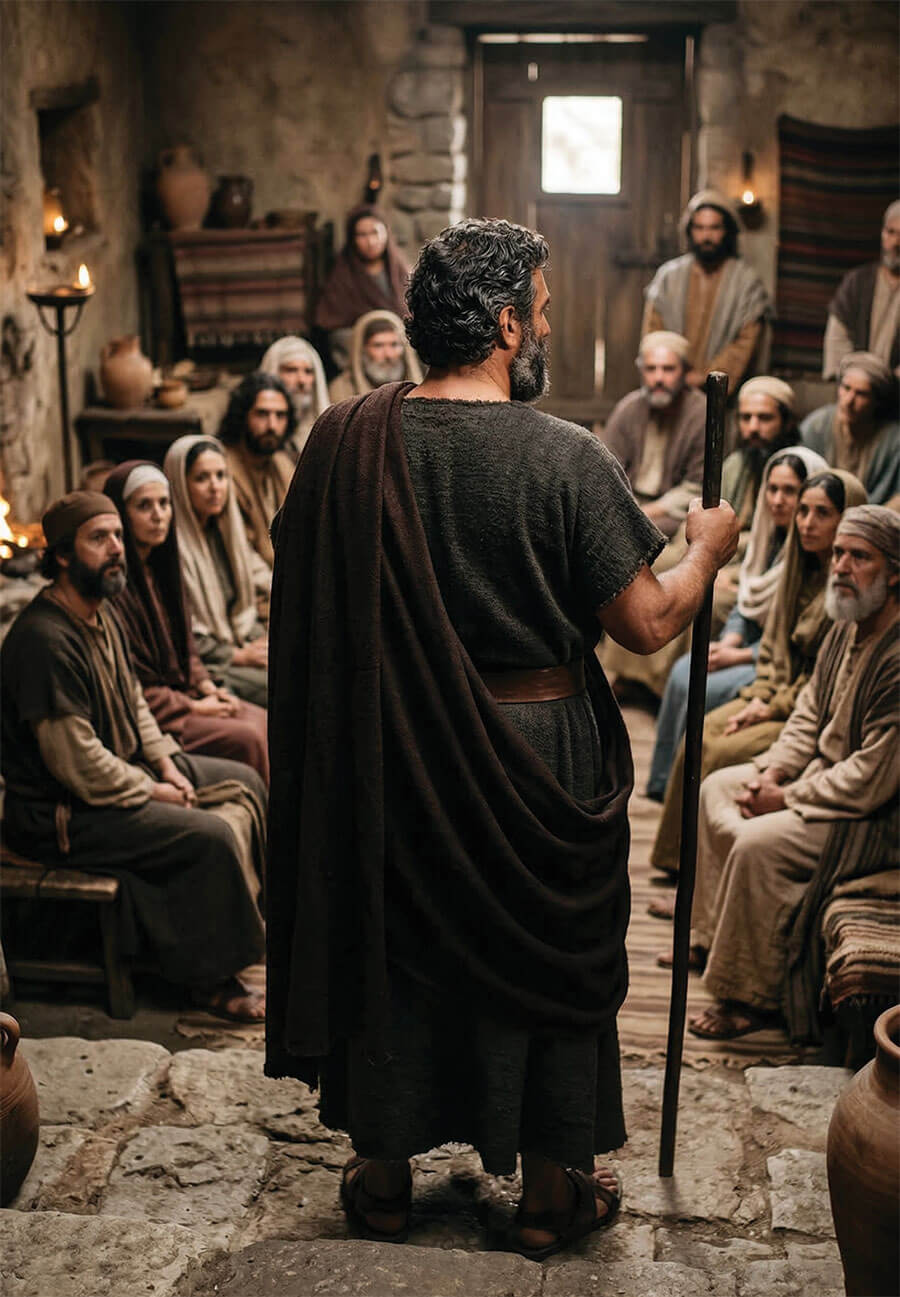
There are many many pernicious influences on the Household of Faith. The most recognizable threats come from outside our community. Secular humanism, in all its malignant manifestations, usually appears as a blatant rejection of all that pertains to the God of the Bible. When those outside try to base everything—knowledge, morality, agency—in human beings rather than God, they raise red flags. Although never easy to conquer (because they speak so compellingly to our flesh), these red flags are simple to detect and straightforward to address.
But not all threats come from outside the household. One especially destructive internal threat is posed by those typified by Diotrephes, an elder “who loves to have the preeminence.” (3 John 9 NKJV). The household doesn’t always recognize those controlling leaders who are wreaking havoc. In the Old Testament, God had to show the people, through His prophets, that the leaders cared only for themselves: “Thus says the Lord God to the shepherds: ‘Woe to the shepherds of Israel who feed themselves! Should not the shepherds feed the flocks?’” (Ezekiel 34:2 NKJV). In Jesus’ day, the people didn’t see the religious rulers as men who valued their position more than anything else: “If we let Him alone like this, everyone will believe in Him, and the Romans will come and take away both our place and nation.” (John 11:48 NKJV).
As a community, we courageously confront the dangers of secular humanism. How can we guard against the more subtle internal threat exemplified by Diotrephes?
The Preeminence
John describes Diotrophes as one who “loves to have the preeminence.” (3 John 9 NKJV). The Greek word philoprōteuōn is a compound term that reveals much about Diotrephes’s character. The word is formed by joining two Greek roots:
Philo: To love, or to have a strong affinity for.
Prōteuō: To be first, to hold the first place, or to be chief.
Literally translated, it means “loving to be first.” It’s a word rich in denotation and connotation, which is why it’s translated in a variety of ways:
- “I wrote to the church. But Diotrephes likes to be the number-one leader, and he won’t pay any attention to us.” (CEV).
- “I sent a letter to the church, but Diotrephes, who likes to be in charge, does not acknowledge our authority.” (Mounce).
- “I wrote something to the church, but Diotrephes, the one loving-to-be-first among them, is not accepting us.” (DLNT).
The overall sense is that Diotrephes’s mission was to control his ecclesia. The DLNT captures the verb tense, which implies a habitual action. The need to control his ecclesia was Diotrephes’s constant, defining characteristic.
How Diotrephes Controlled His Ecclesia
Diotrephes used a variety of methods to control his ecclesia. First, he treated controlling his ecclesia as his full-time job. Through tautology, John emphasizes Diotrephes’s work ethic: “his deeds [ergon] which he does.” Thayer notes that the primary meaning of ergon is “business, employment, that with which anyone is occupied.” Most members in the ecclesia would not have had the time to make ecclesial matters a full-time job. Consequently, they would have gladly let Diotrephes handle the organizing and communication of ecclesial matters. We can imagine the meetings (both individual and collective) that Diotrephes organized and conducted to advance his agenda of control. The result? Diotrephes could then make his agenda the ecclesia’s agenda.
Ceding the ecclesia’s organizational work to Diotrephes’s control enabled him to wield another powerful tool. Diotrephes controlled the flow of information into the ecclesia. Diotrephes suppressed the letter that John wrote to the ecclesia: “I wrote to the church, but Diotrephes, who loves to have the preeminence among them, does not receive us.” (3 John 9). Brother John Hellawell comments on Diotrephes: “It may be that Diotrephes was the ‘recording brother’ and chose neither to respond to John nor reveal the receipt of the letter.”1 By carefully curating the ecclesia’s flow of information, through exclusion and inclusion, Diotrephes was able to shape the members’ perspective.
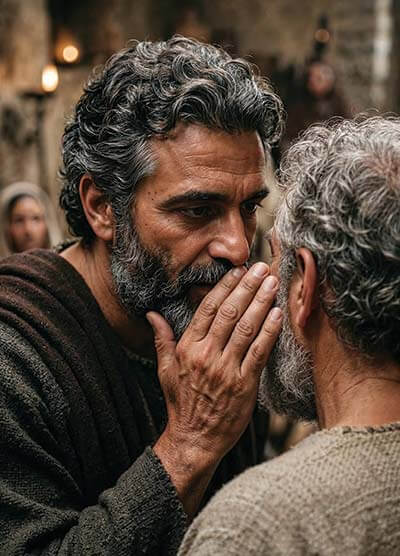
Diotrephes’s next vehicle for control was his strategic use of slander and gossip to undermine others. John calls out Diotrephes’s method of operation: “disparaging us with malicious talk.” (3 John 10 Mounce). How could Diotrephes have successfully waged a smear campaign against John? We can infer that—because John’s spiritual credentials were so impeccable—Diotrephes’s smear campaign must have been subtle. So how would Diotrephes have attacked John?
There is no Scriptural evidence that John and Diotrephes disagreed about doctrine.2 In fact, Brother Tim Young asserts that there is a progression in John’s epistles, moving from dealing with incorrect doctrine in the first two letters to addressing incorrect fellowship practice in the third.3 Brother Young’s conclusion is a stark warning: “It is just as wrong to deny fellowship to those who are true brethren” as it is to accept false doctrine.
Diotrephes’s and John’s fundamental disagreement was about fellowship practice. Diotrephes simply felt that John’s fellowship standards weren’t high enough: “Diotrephes…does not receive [epidechomai] us… And not content with that, he himself does not receive the brethren [epidechomai]” (3 John 9-10 NKJV). Epidechomai, occurring only here, literally means “to accept into the house.” The contemporary Christadelphian equivalent would be for the ecclesial secretary/recorder to direct the ecclesial doorkeeper to ensure that John (and brethren associated with John) would not be welcomed to the ecclesia.
John wrote extensively about fellowship in both his Gospel (John 15-17) and in his letters (e.g., 1 John 1:3-7). John knew Jesus’s approach to fellowship from first-hand experience. Yet Diotrephes does not defer to John’s approach as the Biblical standard on fellowship. Rather, Diotrephes demonstrates his misunderstanding of fellowship by engaging in “block disfellowship,” defined by Brother Alfred Nicholls in this way:
It has happened more than once that a group of brethren or ecclesias has withdrawn from another ecclesia over what is in their opinion some error of doctrine or more usually of practice and then withdrawn from all other ecclesias who do not support that judgement, on the ground that the latter are involved in the sin of the first ecclesia. This is sometimes known as “block disfellowship” and clearly has no sanction in Scripture.4
This practice is exactly what Diotrephes was doing: “He refuses to welcome the brothers. He even prevents those who would like to and puts them out of the church.” (3 John 10 Mounce). Diotrephes was wielding fellowship like a weapon in his ecclesia.
 Diotrephes’s Motivation
It is easy to view Diotrephes as a caricature, a control freak who only wants to serve his own ego. My reading of Diotrephes is more sympathetic. Although we know from John’s description that Diotrephes loved to be in control, there is more to his behavior than that. Unlike the bad shepherds that had so plagued natural Israel, there is no indication that he received any personal benefit from his approach. There is no evidence that he was a shepherd who fed only himself.
My reading of 3 John is that Diotrephes was sincere in his belief that John had gone off-track in his approach to fellowship. Most scholars agree that 3 John was written in AD 85-90, a critical time for the ecclesia. The generation of eyewitnesses to Jesus was dying off. The wolves of which Paul warned were roaming about: “After my departure savage wolves will come in among you, not sparing the flock. Also from among yourselves men will rise up, speaking perverse things, to draw away the disciples after themselves.” (Acts 20:29-30 NKJV). Therefore, I can see that Diotrephes’s approach, especially regarding fellowship, would make sense if he were sincerely trying to “strengthen the things that remain.”
Sincerity is an explanation; it is not an excuse. Diotrephes engaged in means he knew were wrong (i.e., slanderous gossip and block disfellowship) to achieve his ends. However sincere his motivations, Diotrephes’s actions should have told him that he was on the wrong path.
Lessons for Ecclesial Leaders
Diotrephes is a cautionary tale for all of us who have leadership positions in the body of Christ. He was clearly capable, and I have argued that his motivation was a sincere concern for his ecclesia. However, he was incredibly destructive in his own ecclesia and throughout the body. As leaders, we can avoid the “Diotrephes Trap” if we honestly ask ourselves some questions:
- Do I seek consensus?
- Do I have to control things?
- What do I do when others disagree with me?
- Do I look down on the standards of the ecclesias around me?
John himself provides the most important piece of advice for ecclesial leaders. His deliberate choice of the rare NT word philoprōteuōn is an essential clue. The verb form of that word occurs here: “And He is the head of the body, the church, who is the beginning, the firstborn from the dead, that in all things He may have the preeminence.” (Colossians 1:18 NKJV). The opposite of Diotrephes’s approach is to give everything to the only one who deserves preeminence—Jesus Christ. Our most important act as leaders is to serve Jesus, instead of our egos or our need for control.
As Brother Roberts wisely stated:
How can we guard against the more subtle internal threat exemplified by Diotrephes? Most importantly, we must identify the characteristic in ourselves and extinguish it through an “only service” approach. The next step is more challenging; like John, ecclesial leaders must confront those leaders who demonstrate a Diotrephes spirit, fully recognizing that any opponent of the Diotrephes spirit will be the target of malicious gossip and the threat of disfellowship (just as John was). Fundamentally, everyone in the household must see a Diotrephes figure for what he is—a present danger to the ecclesia. Brother H.P. Mansfield wrote:
Brother Mansfield’s wise words exhort us to action. When the Diotrephes spirit manifests itself through malicious gossip, bullying, and threats of disfellowship, then it must be “vigorously challenged and effectively silenced.”
Shawn Moynihan,
Cambridge Ecclesia, ON
- John Hellawell, “Not with Paper, Pen and Ink…,” The Christadelphian, July 2003, 258.
- Although in Eureka, volume 1, Brother Thomas suggests that Diotrephes was teaching false doctrine, there is no Biblical evidence to support this suggestion.
- Tim Young, “Fellowship in the Epistles of John,” ccbible.com/fellowship_epistles_of_john
- Alfred Nicholls, “The First Century ‘Grape Vine,’” The Christadelphian, September 1982, 344.
- Robert Roberts, The Ecclesial Guide.
- H. P. Mansfield, The Christadelphian Expositor: From James to Jude (Findon, SA: Logos Publications), 307-308.
This was an intriguing article. One point I would like to raise concerns the treatment of “block disfellowship.” Diotrephes may indeed have improperly applied such a practice within fellowship, as suggested by the quotation from Bro. Nicholls. However, the difficulty lies in our reliance on a term that is not used in Scripture.
If one refers to Bro. Nicholls’ complete statement, his very next sentence begins with “However…”. He then goes on to outline other cases of what he considers acceptable “block disfellowship”, cases that many Christadelphians today would quickly condemn as being Diotrephes‑like.
Hi Bro. Tim! Thanks for your comment. For those who would be interested in reading the whole reference by Bro. Nicholls, The Christadelphian has generously made the original article, and Bro. Nicholls’s response, freely available here: https://thechristadelphian.com/blog/the-christadelphian/the-first-century-grape-vine/