Building Relationships God’s Way: Part 4
Family is the first setting where faith, character, authority, and love are learned, making parents stewards of a sacred inheritance passed from one generation to the next.
 Read Time: 11 minutes
Before there was an ecclesia, there was a family. Before there was a nation of Israel, there were the households of Abraham, Isaac, and Jacob. The family is God’s first and most fundamental human institution—the setting where we first learn about relationships, authority, love, and Him.
Across this series, we have traced the golden threads of divine relationship principles: our relationship with God, the foundation of all else; the ecclesial brotherhood, the spiritual family baptism brings us into; and the male-female relationship, the covenant of marriage that reflects Christ and the ecclesia. Now we turn to the family itself, where these principles find their most daily, practical use.
The family is uniquely placed to shape character. Here, children first meet authority, learn respect and obedience, and develop the relational skills life will demand. Here too, more than anywhere, faith passes from one generation to the next. Little wonder Scripture gives such attention to family relationships.
The True Inheritance: More Than Material Wealth
In the ancient world, inheritance meant far more than the transfer of property. When a father handed down his inheritance, he transmitted the family name, reputation, trade, connections, and above all, the family faith. An inheritance was a legacy: everything gathered across generations that would shape the identity and future of those who followed.
Scripture carries this fuller sense when it declares, “Behold, children are a heritage from the LORD, the fruit of the womb is a reward.” (Psalm 127:3). The Hebrew for “heritage” is nachalah—the word used for Israel’s inheritance of the Promised Land. Children are more than a biological blessing; they are a sacred trust, an inheritance from God to be stewarded and handed on.
This truth transforms how we see our roles. Parents are stewards entrusted with a divine inheritance that reaches back through the ages and forward to generations yet unborn. Children are heirs being prepared to guard and hand down this sacred legacy of faith.
Consider the chain of transmission in 2 Timothy 1:5: “When I call to remembrance the genuine faith that is in you, which dwelt first in your grandmother Lois and your mother Eunice, and I am persuaded is in you also.” From Lois to Eunice to Timothy—three generations linked by a shared faith. This is God’s design for the family.
The Threefold Cord in Family Life
The threefold cord that strengthens every relationship applies with full force to family life. Between husband and wife, parent and child, brother and sister, God’s presence, as the third strand, provides the stability that holds a family together through its stresses.
Without God at the center, family relationships slide into competing self-interest—parents pursuing their ambitions, children their desires, siblings their own advantage. The household becomes a collection of individuals sharing space rather than a family sharing life. Like a two-strand rope, such a family unravels under pressure, each member turning about their own axis until the bonds give way.
But when God is woven in as the essential third strand, everything changes. Shared submission to His authority creates common ground between generations whose views naturally differ. His Word settles disputes over values and priorities; His love models the self-sacrifice that lets family members put others first.
The result is the binding stability we have traced throughout this series: the resistance to unraveling provided by the third strand. Reinforced by the divine presence, family bonds hold even when individual members fail. The triangle of God, parent, and child forms a self-reinforcing structure that grows stronger under pressure, not weaker.
The Divine Pattern in Family Relationships
The pattern of mental, moral, and physical development that has guided our study applies just as powerfully here. Each member of the family has a part to play, and each part follows this progression.
Parents begin with mental instruction—teaching children God’s ways and the principles of righteous living—which ripens into moral conviction in the heart—a settled, inward commitment to what is right even when mom and dad are not watching. Finally, the physical expression appears in character and conduct that reflect godly teaching. The fruit is the next generation of believers, raised to love the Lord and walk in His ways.
This is exactly what God commanded Israel: “You shall teach them diligently to your children.” (Deuteronomy 6:7). The Hebrew for “teach diligently” (shanan) means to sharpen or whet, like honing a blade. Parents must work carefully and persistently at instruction, shaping their children’s minds with divine truth until it cuts through to the heart.
Mental → Moral → Physical → Fruit
This is God’s pattern for raising children who love the Lord.
Husbands and Wives: The Foundation of the Home
In any home, the marriage relationship is the bedrock on which the other family relationships are built. When husband and wife are united in purpose and rightly ordered in their roles, the whole household benefits; when that foundation is weak, everything built on it suffers. Our third article explored these roles in depth; here we simply recall them.
The Husband’s Calling
Scripture gives the husband a leadership role—a place of responsibility, not privilege, defined by the charge to love his wife “as Christ loved the church and gave Himself for her.” (Ephesians 5:25). This is self-sacrificing love that puts her needs above his comfort, seeks her growth in God, and makes a home where she can flourish. A husband who loves like this makes his leadership a joy to follow because it so plainly serves for the good of his wife.
The Wife’s Calling
The wife is called to be “a helper comparable to him” (Genesis 2:18): a complement and a partner, his equal in worth. The Hebrew word ezer, “helper”, is used of God Himself: “The God of my father was my help.” (Exodus 18:4)—a word fit for the Almighty cannot mean an inferior. And kenegdo, “comparable to him,” occurs only twice in all of Scripture, here and three verses later, where Adam names the animals and finds no counterpart among them (Genesis 2:18, 20). It describes one who stands opposite and corresponds, a matching counterpart. Her submission “as to the Lord” (Ephesians 5:22) is a willing respect honoring both his role and the God who established it. Proverbs 31 paints her portrait: industrious, wise, compassionate, and faithful, building her home so that “the heart of her husband safely trusts her.” (Proverbs 31:11). This is a woman who flourishes in her role. When both fulfill their callings, the children see daily what a godly relationship looks like.
Heirs Together
Peter adds a word that protects the whole arrangement. Husbands are to dwell with their wives “with understanding, giving honor to the wife… and as being heirs together of the grace of life, that your prayers may not be hindered.” (1 Peter 3:7). “Heirs together:” the Greek synkleronomoi sets husband and wife side by side in a shared inheritance. Whatever their roles in the home, they are equals before the throne.
Parents and Children: The Sacred Trust
Children, we have seen, are a heritage from the LORD (Psalm 127:3). They are gifts entrusted to parents by God Himself, and with the gift comes a weighty responsibility: to raise these precious lives in the nurture and admonition of the Lord.
The Parents’ Responsibility
Scripture sets out the parents’ sacred duties with clarity:
To love them. Titus 2:4 instructs older women to “admonish the young women to love their husbands, to love their children.” This is more than affection; it is committed care that perseveres through difficulty and delights in the child’s flourishing.
To instruct them in God’s Word. “You shall teach them diligently to your children.” (Deuteronomy 6:7); “The father shall make known Your truth to the children.” (Isaiah 38:19). This is not handed off to the ecclesia or the Sunday School; it is the primary work of parents in the daily rhythms of home.
To train them for godly living. “Train up a child in the way he should go, and when he is old he will not depart from it.” (Proverbs 22:6). Training is instruction and practice together—not words only, but consistent example.
To correct them when needed. “He who spares his rod hates his son, but he who loves him disciplines him promptly.” (Proverbs 13:24). Discipline in love, never anger; measured, never excessive—an expression of care: “For whom the LORD loves He chastens.” (Hebrews 12:6). Parents who never correct their children fail them grievously.
To avoid provoking them to wrath. “And you, fathers, do not provoke your children to wrath, but bring them up in the training and admonition of the Lord.” (Ephesians 6:4). Harsh, unreasonable, or inconsistent parenting breeds resentment; godly parenting joins firmness with tenderness and an authority a child can approach.
To provide for them. “But if anyone does not provide for his own, and especially for those of his household, he has denied the faith and is worse than an unbeliever.” (1 Timothy 5:8). Provision is more than material; it includes emotional support, time, attention, and presence.
The Children’s Responsibility
Children, too, carry responsibilities within the family:
To honor their parents. “Honor your father and your mother, that your days may be long upon the land.” (Exodus 20:12). This is the fifth commandment, and “the first commandment with promise” (Ephesians 6:2). The Hebrew for “honor” (kabad) carries the sense of weight—treating parents as significant, worthy of respect.
To obey their parents. “Children, obey your parents in the Lord, for this is right.” (Ephesians 6:1). In childhood and youth, obedience is the chief expression of honor, bounded “in the Lord”: should parents command something plainly contrary to God’s Word, they forfeit the claim to obedience in that matter alone—a rare exception, not a convenient loophole.
To attend to parental teaching. “My son, hear the instruction of your father, and do not forsake the law of your mother; for they will be a graceful ornament on your head, and chains about your neck.” (Proverbs 1:8-9). Children who receive their parents’ instruction with humility gain wisdom that adorns their whole lives.
To care for aging parents. “But if any widow has children or grandchildren, let them first learn to show piety at home and to repay their parents; for this is good and acceptable before God.” (1 Timothy 5:4). The child once nurtured in infancy has a duty to nurture in return when parents grow old: a cycle of care completed, the sacred duty of godly children.

The Blessing of Generations
Scripture prizes the multi-generational family: “Children’s children are the crown of old men, and the glory of children is their father.” (Proverbs 17:6). Grandparents hold a special place in God’s design: repositories of wisdom, living links to the past, witnesses to God’s faithfulness across the decades. Their experience is priceless.
The elderly deserve particular honor: “You shall rise before the gray headed and honor the presence of an old man, and fear your God.” (Leviticus 19:32). This reverence for age has all but vanished from modern culture, yet remains God’s requirement. Wisdom gathered over years of walking with God cannot be replaced by youthful energy, though the two are richly complementary.
When the generations connect—grandparents sharing faith with grandchildren, the middle-aged honoring aging parents while guiding growing children—something beautiful appears. The faith that sustained one generation passes to the next, growing richer with each handing-on: “One generation shall praise Your works to another, and shall declare Your mighty acts.” (Psalm 145:4).
Family: A School for Understanding God
Family relationships serve a great purpose beyond their immediate benefits: they teach us about God. The vocabulary of family—Father, children, brothers and sisters, inheritance—runs all through Scripture’s description of our relationship with the divine.
When we feel a father’s loving discipline, we grasp why God chastens His children: “For whom the LORD loves He chastens, and scourges every son whom He receives.” (Hebrews 12:6). When we rest in a mother’s comfort, we see how God consoles us: “As one whom his mother comforts, so I will comfort you.” (Isaiah 66:13). And watching parents sacrifice for their children, we glimpse the Father’s gift of His Son.
This is why healthy family relationships matter so much. They shape our capacity to know and relate to God. A child who experiences consistent, loving authority learns to trust divine authority; a child who knows a parent’s forgiveness more readily grasps God’s. The family becomes a school of faith, preparing hearts for the gospel’s greater truths.
Building Strong Families
How, in practice, do we build the kind of family Scripture envisions? A few disciplines prove essential:
Establish daily Bible reading. Nothing shapes a family’s spiritual culture more than consistent time together in Scripture. Around the breakfast table or before bed, make God’s Word a daily presence in your home. Aim for quality over quantity—a few verses truly understood beat three chapters rushed through to “do the readings.”
Pray together regularly. Families that pray together own their shared dependence on God and welcome His presence into their days. Children who hear their parents pray learn to pray themselves; they watch mom and dad bow to the greater authority of God.
Prioritize ecclesial involvement. Attend meetings faithfully as a family. Let children see that gathering with God’s people takes priority over competing activities in an age that fills Sundays with everything else. Habits formed in childhood often become norms they later hold dear.
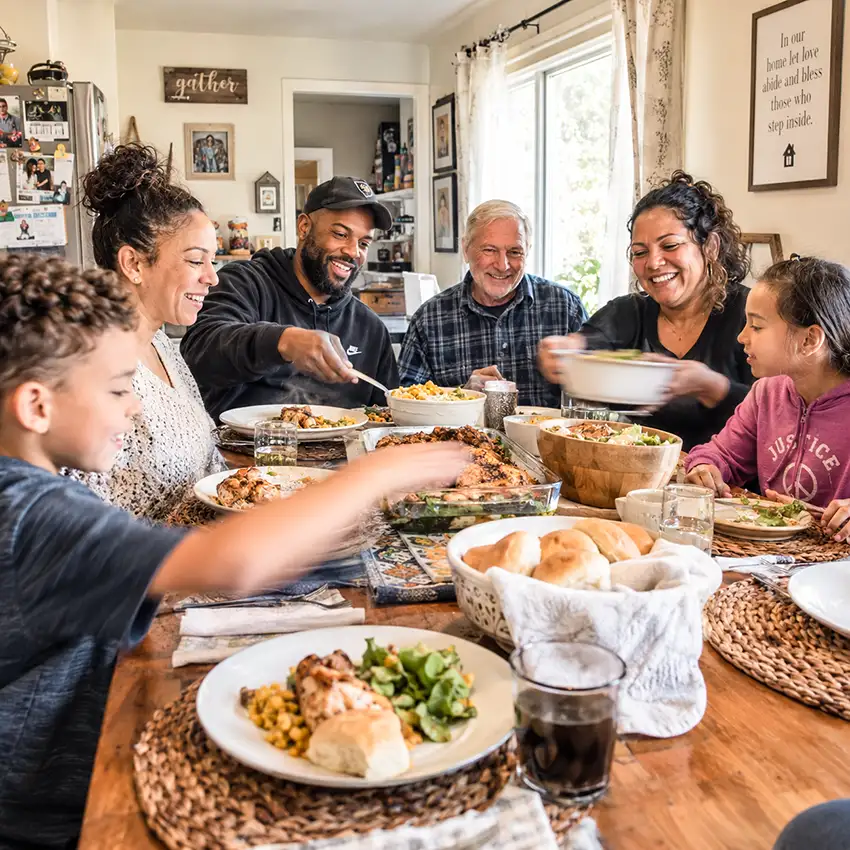
Create space for conversation. Turn off the screens. Eat meals together. Talk about faith naturally, as Deuteronomy 6 envisions—when you sit, when you walk, when you lie down, when you rise up. Let spiritual conversation be woven into the fabric of ordinary life.
Model what you teach. Children learn more from watching than from being told. Let them see you reading Scripture, praying, serving others, handling conflict graciously, repenting when you fail. Your example speaks louder than your words—they will become what you are.
Maintain the threefold cord. Keep God at the center of your family. When He is the common reference point, disagreements find resolution; when His authority is honored, submission becomes worship rather than a burden; and in a home filled with His love, human love flourishes.
The Family’s Eternal Significance
We close this series where we began—with God. Every relationship we have examined finds its source and model in Him. The divine relationship establishes our identity as His children. The ecclesial brotherhood extends that family across time and space. The male-female relationship pictures Christ and his bride. And the human family is the setting in which all these truths are first learned and daily practiced.
We have set out high, lofty ideals we may never fully reach. But, like Paul, God’s love compels us past our failings toward higher, nobler things—without God’s high standards we risk having none at all:
But I press on, that I may lay hold of that for which Christ Jesus has also laid hold of me… forgetting those things which are behind and reaching forward to those things which are ahead, I press toward the goal for the prize of the upward call of God in Christ Jesus. (Philippians 3:12-14).
The family that keeps God at its center, follows His pattern of mental, moral, and physical development, and acknowledges His authority as the ground on which unity is built will bear fruit that lasts. Not perfect, but growing, pressing on together toward the day when the family of God is complete, gathered around His throne, every relationship perfected in His presence.
Until that day, may we build all our relationships walking together in agreement, united by submission to His authority. Let us follow the pattern He has set: mental understanding deepening into moral commitment, expressed in physical action, bearing fruit to His glory.
And may the threefold cord—ourselves, our loved ones, and our God—never be broken.
Now to Him who is able to keep you from stumbling, and to present you faultless before the presence of His glory with exceeding joy, to God our Savior, who alone is wise, be glory and majesty, dominion and power, both now and forever. Amen. (Jude 24-25).
David Fraser,
Pinetown Ecclesia, South Africa
-
All Bible references are from the NKJV unless otherwise stated.