See the Salvation
The details surrounding Christ’s mock coronation point beyond the cruelty of the cross to God’s repeated work of bringing salvation to His people.
 Read Time: 5 minutes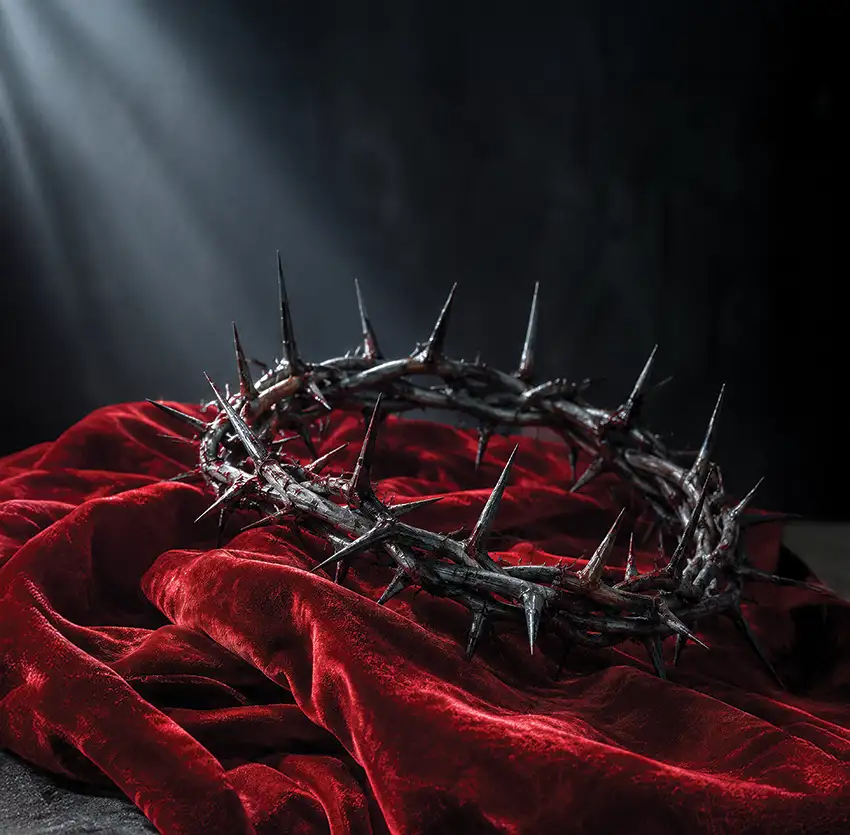
One could argue that Matthew 27 is one of the saddest parts of the Bible. So much happens in that chapter that, on its own, would be very sad. In this chapter, it just keeps coming, and most of it happens to Jesus, a man whom we love.
The Jewish rulers are planning to put Jesus to death. Judas is overcome by his decision to betray Jesus. Pilate is manipulated and backed into a corner to allow Jesus to be killed. Jesus is beaten and scourged. He is mocked, abused, and killed, witnessed by people, many of whom were women, who loved him.
And to add insult to all that injury, he is mocked by being dressed up like a pretend king. In John 19, we see Jesus fully dressed in his crown and robe, and we know from Matthew that he was also given a reed as a staff. “Jesus then came out, wearing the crown of thorns and the purple robe.” And then the record says, “Behold, the Man!” (John 19:5). We’re literally told to look at Jesus.
All of that is true and happened, but is that what God wants us to see? Does God want us to see the sadness, the pain, and the humility by having Jesus mocked with his crown, his robe, and his reed? Maybe. Or was God showing us something else? Something that He was accomplishing at this time; something He has been doing all along?
If we consider the items given to Jesus and how they were used in the Old Testament, we can see they share a common theme—one that mirrors exactly what God did when His Son died on the cross. God brought salvation. He did that in the days of old, He did that in the day Christ died, and He will do it again. In fact, many are destined to obtain salvation.
But since we are of the day, let us be sober, having put on the breastplate of faith and love, and as a helmet, the hope of salvation. For God has not destined us for wrath, but for obtaining salvation through our Lord Jesus Christ, who died for us, so that whether we are awake or asleep, we will live together with Him. (1 Thessalonians 5:8-10).1
So what were these items? In Matthew 27:27-29, we can see them all.
Then the soldiers of the governor took Jesus into the Praetorium and gathered the whole Roman cohort around Him. They stripped Him and put a scarlet robe on Him. And after twisting together a crown of thorns, they put it on His head, and a reed in His right hand; and they knelt down before Him and mocked Him, saying, “Hail, King of the Jews!”
First, the robe. A colorful robe. What does that remind you of? In Genesis 37, we read of a man who was given a colorful robe. Joseph’s father gave him this robe because he loved his son. His brothers did not love him. He was sold for money by his own brothers. What did God accomplish through all this, though?
Now do not be grieved or angry with yourselves, because you sold me here, for God sent me before you to preserve life. For the famine has been in the land these two years, and there are still five years in which there will be neither plowing nor harvesting. God sent me before you to preserve for you a remnant in the earth, and to keep you alive by a great deliverance. (Genesis 45:5-7).
And again, “As for you, you meant evil against me, [but] God meant it for good in order to bring about this present result, to preserve many people alive.” (Genesis 50:20). God brought salvation to many people through this event.
The next item they gave to Jesus was a crown. But it was a crown of thorny branches, twisted and woven together to form a tight circle. On that very same mountain, another father took his son and was willing to slay him. Abraham was asked to go up the mountain and kill the promised son, who carried the wood on his back as he was led to the place where he was to be killed.
Isaac was not to be sacrificed, of course. But an animal, provided by God, was offered up so that the son might live. This animal, a ram, was caught in the thicket (Genesis 22:13). The root word for thicket means to entwine, fold together, or wrap.
In so many ways, this points forward to what our Father did through His Son. And the crown of thorns, twisted together, that was placed on Jesus’s head reminds us not only that Isaac’s life was saved, but that many, many more were saved by God through the sacrifice of the Lord Jesus.
And finally, the reed given to Jesus. Who is the man who comes to mind when we think of reeds? Moses’s life almost starts among the reeds. After hiding her son for three months, Jochebed places the baby boy in a basket, covers it with tar and pitch, and sets it among the reeds (Exodus 2:2-3). The life of this baby boy, Moses, changes dramatically from this point and continues to change as he grows older. Eventually, he was the one to lead the children of Israel out of slavery in Egypt and toward the promised land. But they didn’t head straight for the land of Canaan, the land God had promised. God led them by the way of the wilderness to the Red Sea (Exodus 13:18). The interesting thing about the word “Red” is that it is the exact word used for reeds in Exodus 2:3, 5, where Moses was placed and found among the reeds. It is only translated “red” when it is in combination with the word “sea.” So, really, instead of the Red Sea, it should be called the Sea of Reeds.
Life isn’t easy. Life is very hard at times. And sometimes we cry out to God and say, Why? Why God, why? Why this pain? Why this heartache? Why this suffering? God isn’t adding insult to injury in our lives; He is actively working to bring salvation.
Whatever this body of water should be called, when standing at the banks of this sea, the Israelites were terrified. They were stuck between the water and a fast-approaching Egyptian army. They cried out to God, and they turned on Moses, asking him why he brought them out here in the wilderness to die. At least they were alive in Egypt. Moses’s response shows us exactly what God accomplished through this man, taken from the reeds, standing by the Sea of Reeds. “But Moses said to the people, ‘Do not fear! Stand by and see the salvation of the LORD which He will accomplish for you today; for the Egyptians whom you have seen today, you will never see them again forever.’” (Exodus 14:13).
God brought salvation. So was it an insult added to injury when Jesus was dressed up with these items, like a pretend king? Or was it God showing that, once again, He was doing what He intended from the very beginning? To bring salvation, so that many people might be saved.
What is our perspective? Life isn’t easy. Life is very hard at times. And sometimes we cry out to God and say, Why? Why God, why? Why this pain? Why this heartache? Why this suffering? And sometimes we can be consumed by it and fail to see that God is working in our lives to bring salvation to us and those around us through our trials. God isn’t adding insult to injury in our lives; He is actively working to bring salvation. “And we know that God causes all things to work together for good to those who love God, to those who are called according to His purpose.” (Romans 8:28).
Thanks be to God that we have time to stand still, to remember the sacrifice, to see the salvation. To eat bread, and drink wine, and know that in Christ a great many people are saved.
Jochem Hale,
Cambridge Ecclesia, ON
-
All quotations, unless otherwise noted, are from the New American Standard Bible 1995.