Are All Sins Created Equal?
Scripture treats all sin seriously, yet calls some sins greater. What changes when we consider the harm our choices do to others?
 Read Time: 7 minutes
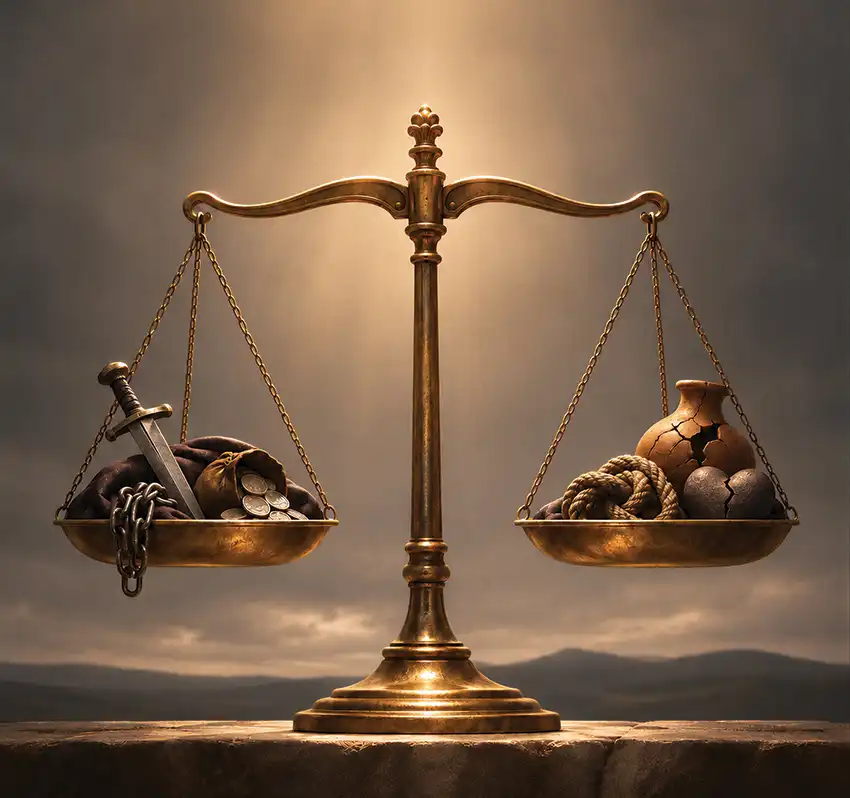
What if someone told you that all sins were the same? Would you readily agree? Or maybe you’d find yourself hesitating.
Maybe I should clarify: what if someone told you that all sins are equal?
The question isn’t just some made-up scenario. I’d guess that you’ve probably had this discussion before. Maybe you’ve been the one to tell others that all sins are equal. Perhaps you’ve been in a discussion with someone who can’t forgive themselves, and to comfort them, you offered the idea that “a sin is a sin.” Or maybe you’ve been someone who pushed back against the idea. Regardless, this equality of sin comes up frequently in spiritual discussions.
Biblically, as with so many topics, the answer is perhaps more complicated than we’d like. Distilling something as complex as sin into a “sin is sin” phrase inevitably misses the nuance Scripture teaches. Indeed, if God wanted things to be this simple, He wouldn’t have given us a book that’s over 1000 pages with examples, ideas, and stories for us to consider. He could have just given us a nice one-page document with phrases like “I love you,” “Sin is sin,” and “Be a good person.” But He didn’t do that. Because our God is a God whose glory is “to conceal things” (Proverbs 25:2)¹ and who has His son speak in parables so that hearers “will indeed hear but never understand.” (Matthew 13:14). God wants His people to think deeply
So what does that mean when it comes to sin?
Equality
The stickiest falsehoods aren’t entirely false. When we hear them, we think, “Yeah, I can see how that’s true.” So if I said to you that the sky is always blue in California, you might not think about the fact that this really isn’t actually true (and seeing that this really isn’t an important theological truth, it wouldn’t really matter if you thought about it deeply or not); yet, the sky isn’t always blue because it often turns red and purple at sunset, and then is completely black during the night. I recognize that I’m venturing into territory that isn’t my specialty; I’m not a physical scientist. But I think you can see what I’m saying.
One reason this “sin is sin” idea sticks so well in our minds isn’t just because it’s snappy. It’s because, in a way, it’s true. Consider what makes sin equal: “For there is no distinction: for all have sinned and fall short of the glory of God.” (Romans 3:22b-23). Here, the apostle specifically attempts to show that everyone finds themselves in the same situation, regardless of whether they’re a Jew or a Gentile. Everyone has sinned. We see equality in that no one can escape sin; it plagues all of us, and at some point we must acknowledge that it holds us captive.
Yet, Paul goes further. As we know, all sins carry the same theological wages, and all have the same solution: “For the wages of sin is death, but the free gift of God is eternal life in Christ Jesus our Lord.” (Romans 6:23).
We cannot mistake this point. A recognition of the fact that we all sin, all deserve death, and all need Christ is what compels us to transformation: “Forgiving one another, as God in Christ forgave you.” (Ephesians 4:32). When we recognize that we were “dead in the trespasses and sins in which [we] once walked,” (Ephesians 2:1-2), we learn to show humility, compassion, and mercy, because we remember where we came from.
Beyond sin’s universality, however, it also has another way it’s equal. James writes, “For whoever keeps the whole law but fails in one point has become guilty of all of it. For he who said, ‘Do not commit adultery,’ also said, ‘Do not murder.’ If you do not commit adultery but do murder, you have become a transgressor of the law.” (James 2:10-11). One sin, no matter what it is, breaks the perfection of the law. And, recognizing that “all have sinned,” we see that living by law is simply impossible for us humans. While this is similar to what we saw in Romans, it’s slightly different because it applies specifically to rules and legalism. By recognizing that we cannot live according to law—because one transgression breaks the whole law—we not only transform our character, as mentioned above, but also how we see the world.
Consider how Paul writes about love: “When I was a child, I spoke like a child, I thought like a child, I reasoned like a child. When I became a man, I gave up childish ways.” (1 Corinthians 13:11). In the beginning of life, we have certain structures that guide us and teach us. But as we grow, we no longer need them because we mature. Such is the law. When we understand who we are, what sin is, and who God is, we no longer follow rules and commandments. Instead, we live by principle. Once again, recognizing the equality of sin helps us to live more like Christ and to think according to God’s principles.
Unequal
Thus all sin is indeed sin. We all sin, we all deserve death, we all need Christ, and we can’t save ourselves through law. But that’s not the end of the story. Scripture’s pretty clear that all sin isn’t equal. Just look at the following verses:
- And Moses said to Aaron, “What did this people do to you that you have brought such a great sin upon them?” (Exodus 32:21).
- The next day Moses said to the people, “You have sinned a great sin. And now I will go up to the LORD; perhaps I can make atonement for your sin.” (Exodus 32:30).
- Jesus answered him, “You would have no authority over me at all unless it had been given you from above. Therefore he who delivered me over to you has the greater sin.” (John 19:11).
For all the ways in which sins are equal, they also aren’t. Scripture classifies some as “great.”
Nevertheless, recognizing this conclusion should lead us to ask a few more questions: Why does Scripture classify some sins as “great”? And why does that matter to us?
Unfortunately, human nature tends to take advantage of things like this. We look at Aaron’s sin of the golden calf and the Jewish rulers’ sin of turning Christ over to Pilate, and we say, “Well, those really are big things, and I’ve never sinned like that, so I guess I’ve never committed a ‘great’ sin.” We thus use this to build ourselves up and tear others down. We create a hierarchy of sin and make sure we come out looking good.
Yet I don’t think the point is to judge which sins are really bad and which are just sort of bad. We need to temper this with what we just saw: it is indeed equal. So how could sins also be different? It’s an enigma, a conundrum, an oxymoron.
The difference is perhaps in the impact. Aaron led a whole nation astray. The rulers caused a whole people to reject their king. In other words, God cares about people, and he cares about what happens to them. That’s the reason why we see “great” sins. These sins have an outsized influence on the lives of others.
So what does this all mean? Yes, it means that sin is sin. That should humble us. But it also means that sin affects people. All sin leads to death and is an affront to God, and therefore should be avoided—yet some sin touches the lives of generations and peoples. God cares about those people, and so should we.
This Issue
In this issue, we’re going to keep digging deeper. Dalton Henley opens our Life Application section by discussing materialism at the beginning of his series, Faith and Finances. Deb Flint tells the harrowing story of Adili Mbuto and his family.
For our Exhortation and Consolation section, we’re publishing an exhortation by Cliff Terrell on gratitude. Mike Jenner writes for Back to the Original about how the Greek text can sometimes follow the Hebrew text, and how comparing the two word orders can yield exciting insights. For Stuff that Works, Dave Jennings describes a joint preaching campaign on the biblical teaching of Satan undertaken by many ecclesias in California. In a similar vein, James Bates writes for our First Principles section and discusses what it means that Jesus cast out demons.
In Bible Studies, we continue our two series. Ben Brinkerhoff considers the meaning of “spirit,” and Ben Kitchen the laws of inheritance and redemption. Jen Wallace writes for Mothers in Israel about raising neurodivergent children. Finally, we wrap up the magazine with chapter four of Held in His Hands (the last chapter we’ll be sharing), reports from Uruguay and Paraguay and El Salvador, and the second installment of Peter’s story by George Booker.
Altogether, we aim to ask questions and dig deeper, remembering that while it is “the glory of God to conceal things,” it is “the glory of kings… to search things out.” (Proverbs 25:2).
Jason Hensley
- All quotations, unless otherwise noted, are from the English Standard Version.