I am John The Baptist: Part 2
John the Baptist leaves the security of the priesthood for the wilderness, carrying a message of repentance and preparing people for the coming Christ.
 Read Time: 7 minutes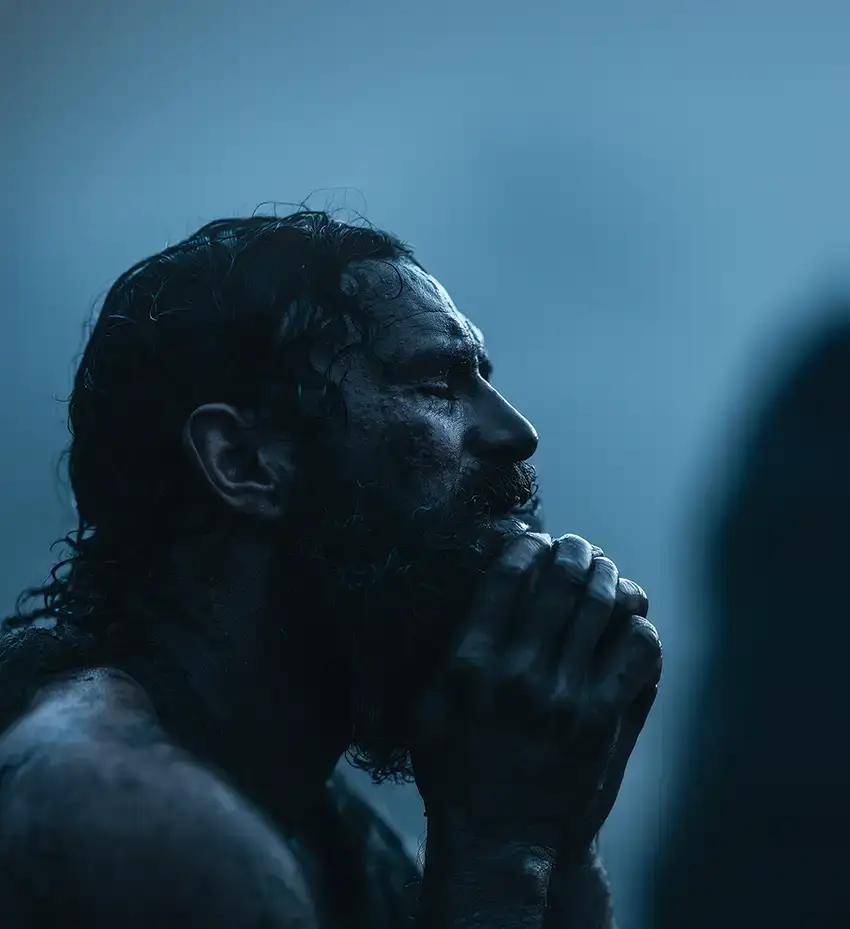
Finally, my parents both died, one departing soon after the other, as often happens with older couples. They had lived together and prayed together for many, many years. At times, they had wondered if the Divine One heard them. Which of us doesn’t have such thoughts, at least once in a while? But then their persistence in faith and prayer was rewarded in a special way, and I was the result. I was their legacy to the world, and I could not let them down, any more than I could turn my back, so to speak, on the words of the great angel Gabriel. Now I knew what my life’s work would be, whether long or short.
I would forsake Herod’s temple, the place where my father had served as priest with great distinction. I would turn my back on the splendor of one of the world’s great buildings. Its beauty was no more than a façade hiding, from some eyes, the greed and graft and lust of men who knew not the Lord of heaven and earth.
With one last look and, I must admit, one final thought of regret for the comfort and security I would be leaving behind, I turned away and set my course out to the wilds of Judea, to a place called Bethabara, just beyond the Jordan River. I left behind the beautiful garments fashioned by my loving mother; they would not serve me well in the desert. I would eat what I could find; I would wear what I could put together for myself. I would impress no one by my fine appearance, but I hoped to touch the hearts of any listeners with a simple message: “Repent. Turn your life around. Be baptized—washed—for the forgiveness of your sins, and be ready for the One who shall come!”
I was determined to give up all the pretense in the regulated, regimented life of that great institution, the priesthood of Aaron. Once it had been useful, but by now it had outlived its purpose. It was decaying from the inside out, and soon everyone would see its rottenness. Even if I had little to eat and little to wear, I would have little to leave behind when my time comes—as it comes for us all—to depart this life. I would do so gladly, knowing that the one thing I would carry with me was the hope of a better life to come. I did not know how long or how short my sojourn would be in the vastness of the wilderness, but I hoped that it would not last long. And indeed, I believe now that it will be a very short time.
When I preached, I preached with the fierce urgency of one who sees an imminent danger, but at the same time, of one who sees a great blessing as well! God be praised, many came out to listen, repent, and be baptized. They came from Jerusalem and all of Judea, from Jericho, and even from Galilee. Rich people came; I told them to share what they had with the poor. Tax collectors came; I told them, “Be fair and honest in your dealings.” Roman soldiers also: “Don’t take bribes, and be content with your wages.” And to all, I gave the same simple message: “Repent. Be ready. The Messiah is coming!”
In my preaching, I did not hold back anything, but declared what I saw and what I knew to be true. I singled out Herod Antipas, tetrarch of Galilee and Perea, for his adultery, knowing I was making myself a target for rich and powerful enemies. The Jewish leaders, priests, Levites, and Pharisees came out to hear me. I expected them. They came in groups, like wolves or wild dogs, to hunt me, but first they interrogated me. I knew my mission now, and I remained firm in my resolve. Nothing they could offer me, and no threat they could make to intimidate me—neither had any effect on me. No, I told them, I am not Elijah. Nor am I the great Prophet, or the Messiah. I am the voice of one man crying out in the desert: “Make straight the way for the Lord to come to Israel!”
And I continued to cry out, so loud at times that the sound of my voice echoed from the distant hills and sounded in our ears again: “Repent, and be baptized. The Holy One is coming from God!” I knew such a ministry was very dangerous; I could see my enemies at times, gathered on the outskirts of the crowds, salivating at the prospect of tearing me limb from limb. But I knew I was safe for the time being, because an angel from heaven had given me the message: “You will see the coming of the Messiah.” So I preached and waited, and waited and preached.
My Reward
It had only been a few months, not even a year, when my waiting would be rewarded. But when the Coming One arrived, I did not recognize the man who would be my blessing and my reward, at least not at the beginning.
First, a message came to me. I can’t say who delivered it, for it truly felt like a dream. I realize that when a person thinks seriously and long enough about something, he may dream about that very subject without any divine intervention. But this message was so powerful and so memorable that, unlike some dreams, it didn’t leave me. Weeks later, I still held the words in my heart, and wondered from time to time if it represented my wishful thinking, or a true revelation from on high:
When you see divine power descending from heaven, and resting upon one man, then you will know that you are seeing the only true Son of the Almighty. He will come with such power that you cannot imagine.
Finally, one afternoon, I learned the answer to my question: What I thought was a dream was indeed a message from Heaven. A young man came to the river. He was a very ordinary man; nothing in his appearance set him apart from anyone else. But as he came closer to me, I felt there was something very special about him. It was, and still is, difficult to explain. He seemed to project kindness and love that touched everyone near him, as though his very presence were speaking to others: “I love you, and I care about you.” Now the other folks, who had been instinctively drawn to him also, moved aside just enough for him to pass through them and approach me. It was like the Jordan River parting when the ark of the covenant entered its waters.
There was also a great calm about him, which he wore like a garment. I sensed that he could stand in front of a raging storm or a charging army and not flinch. It felt as though nothing could frighten or intimidate him. Wherever he went, he was in charge. And I found it practically impossible to take my eyes off him.
I asked him his name, and he replied: “Yehshua, from Nazareth in Galilee.” It was a Hebrew name of great meaning, dating back to the days of Moses and his close confidant and successor, Yehshua, or Joshua, who led the people of Israel into the Land of Promise. The name means “One who saves.” The mention of Nazareth brought back old memories of my parents telling me about a young woman, one of my mother’s distant relatives. She came from Nazareth in the north to visit them in Judea and revealed to them that, independent of my parents, she had also been visited by the angel Gabriel. She explained that, although betrothed to a young man in Nazareth, she was miraculously with child, conceived by the power of the Holy Spirit. Could this Yehshua, this Jesus, be her son? Could he be the child of the Almighty?
Jesus now asked me to baptize him. I felt so unworthy—it’s hard to say why—and I spoke up: “But it is you who should be baptizing me.” “No,” he contradicted me, but with real gentleness, “It is my Father’s will, and it must be this way, for now.” And I consented.
When I baptized him, then there appeared something very much like a dove, which slowly descended from the clouds until it settled down upon his head, as gently as though it were another dream. And then there was a voice, much louder than the others I had heard earlier: “This is my beloved Son. I am well-pleased with him.” I do not know how much others heard, but I heard those words distinctly. It was my dream, now come to life before me, and I praised the Lord.
There came to me one more message, and I know this one was from the heavenly Father. It was the same voice, but I heard it even more plainly, and it was directed toward me alone. The message itself settled down on me like another dove from heaven, enveloping me in a warm embrace of love. I knew then that nothing could ever separate me from that love: “My dear child John, you have served me well; you have been my new ‘Elijah,’ and you have prepared the way for my Son. Now, my friend, you may begin to lay down your burdens and take your rest. You may tell your disciples to follow him and do as he directs them. In the proclaiming of the good news, you will decrease while he increases. Your labor is nearly over, while his work is just beginning. He is the bridegroom come to claim his bride, but you are the great friend of the bridegroom, and when he rejoices, you will rejoice with him.”
My Blessing
I, John the Baptizer, tell you, my friend: I am fully prepared to die, whether it be soon or much later, it matters not. I will not fear what any man can do to me, for my eyes have seen the greatest Glory, greater than that which resides in Herod’s temple. I have seen the Lamb of God coming out of the desert, the true Lamb who will take away the sins of the world.
I have heard rumors that Pilate’s soldiers or Herod’s minions will be coming to arrest me, either for being a general troublemaker or for calling attention to the sinfulness of Herod’s lifestyle—or for both. But I am not at all troubled, nor should you be troubled. I know that I have a Redeemer and a Savior, and at this very moment, he is walking about among men. I know that I have completed the task the Almighty has given me. I have prepared the way for the King of the Jews to begin the great task of declaring his Kingdom and taking his throne.
I tell you, my new friend: I do not expect to live long, but I have no regrets. Don’t mourn for me when I am gone, for you and I will meet again. Follow your new Master, the Lord Jesus Christ. I have baptized you with water, but he will baptize you with the Holy Spirit and show you the way into the presence of his Father. Follow Jesus, and even the gates of death and the grave will hold no fear for you, because your heavenly Father will be pleased to give you all things, including a glorious eternal Kingdom. I bestow upon you the great priestly blessing, which I learned from my own father:
May the Lord bless you and keep you; may the Lord make his face shine upon you and be gracious to you; may the Lord turn his face toward you and give you peace.
Amen.
George Booker,
Austin Leander Ecclesia, TX
References:
- A place called Bethabara: The KJV uses “Bethabara”, while most modern authorities and translations use “Bethany.” It is quite possible that John the Baptist moved from place to place to reach more listeners with his preaching. “Bethabara” signifies “the house of passing away, or crossing over.” This suggests the passing away of the Law of Moses, facilitated by the efforts of John the Baptist and then by Jesus.
- My reward: Matthew 3:13-17; Mark 1:9-11; Luke 3:21-23; Luke 1:26-56; John 3:26-30.
- My blessing: John 1:29; Matthew 3:11; Numbers 6:24-26.